
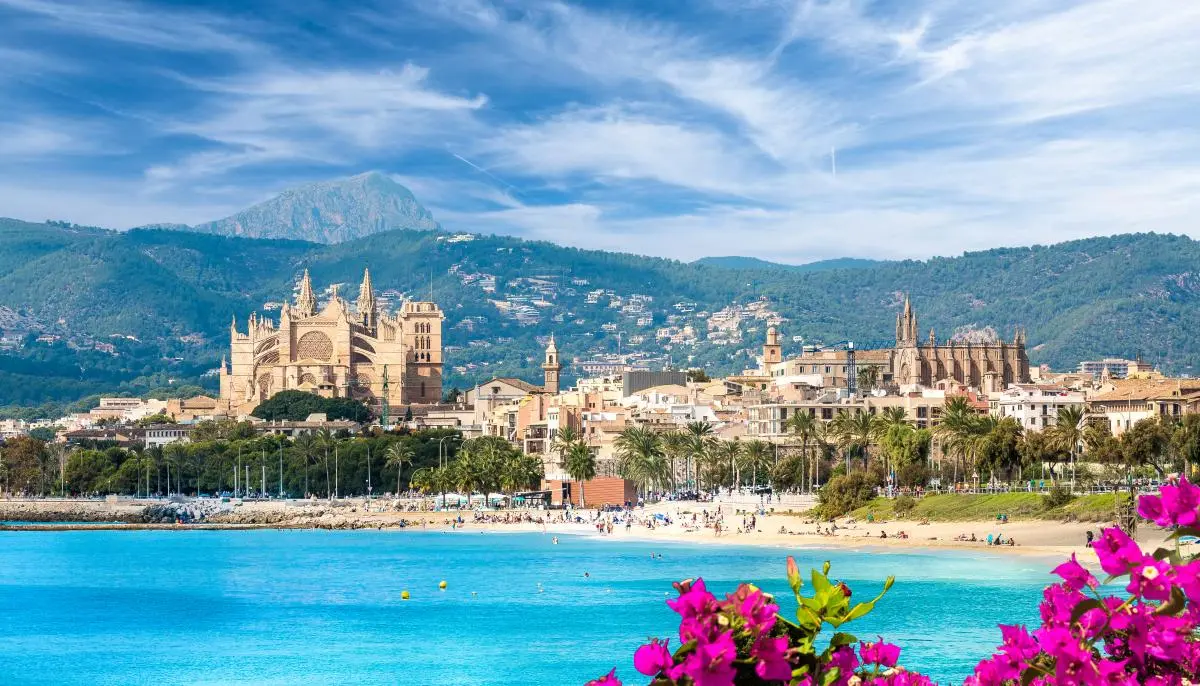
Majorca, the largest of the Balearic Islands, is becoming an increasingly popular destination for fall travel thanks to its mild climate. The island welcomes over 13 million tourists each year and enjoys more than 300 sunny days annually. The average temperature in September hovers around 27 °C, while in November it reaches about 18 °C, according to The Independent.
Climate data for the island is maintained by the Spanish State Meteorological Agency (AEMET). The reference data from the weather station at Palma Airport, located at an elevation of 5 meters, are based on the period from 1981 to 2010. They cover average temperatures, precipitation, humidity, sunshine duration, and the number of cloudless days, according to AEMET data.
The island is home to about one million people, nearly half of whom live in the capital, Palma. In addition to the beaches, tourists are drawn to the old town with its Roman, Gothic, and Baroque architecture, as well as the Cathedral of Santa María, known as La Seu. Its construction spanned 372 years, beginning in the 13th century, on the site of a former mosque.
This fall, Palma hosted the 30th edition of the Nit de l’Art arts festival: galleries opened their doors to visitors, and exhibitions and performances spilled out onto the streets. Local tour guide Lorena Torres sees this as an opportunity for visitors to experience life the way locals do.
“It’s a day to enjoy the Spanish way of life,” says Torres.
Other popular destinations include the Caves of Drach near Porto Cristo, home to the underground Lake Martel, where classical music concerts are held, as well as the fishing town of Portocolom in the southeastern part of the island. A week at the local Wyndham Portocolom resort, renovated in April 2026, starts at 720 euros for a group of up to six people.
Off-season without the crowds
Photographer Cecilia Renard, a native of Menorca, has been living in Mallorca for the past five years. She advises against planning a trip for June through September, when tourist traffic is at its peak. According to Condé Nast Traveler, she herself has left the island during this time for the past five years.
Renard believes that the fall months reveal a different side of the island than the usual beach vacation.
“From October through December, Mallorca offers a more peaceful atmosphere; the sea remains warm, and many establishments stay open. There are plenty of activities beyond the typical ‘sun and beach’ tourism: visiting local markets, hiking in the Serra de Tramuntana, exploring charming villages, or discovering the island’s cultural and culinary offerings,” Renard advises.
Winter in Mallorca, according to the photographer’s observations, is mild. However, due to the humidity, the cold feels more intense, especially since many older homes are poorly insulated. In January and February, the flow of tourists drops noticeably, and the island is predominantly populated by locals and second-home owners.
The Price of Mass Tourism
The island’s popularity has a downside. As recently as 2019, Mallorca welcomed 11.8 million tourists, while the local population did not exceed one million. The cost of living has risen sharply, in part due to the conversion of family homes into vacation rentals. Tourism has also depleted water resources, and development has encroached on vulnerable slopes. To describe the uncontrolled development of resorts, where short-term profit takes precedence over sustainability, researchers have even coined the term “Balearization,” according to National Geographic.
Despite this, the archipelago is deeply dependent on visitors. Rosana Morillo, Director General of Tourism for the Balearic Islands, estimates the industry’s direct contribution to the region’s economy at approximately 25 percent, and about 35 percent when indirect effects are taken into account.
“We have about 200,000 jobs that depend on tourism,” Morillo emphasizes.
About 500 cruise ships call at Palma each year, bringing 2 million passengers. In 2016, the authorities introduced a tourist tax to fund environmental restoration. Resort towns also began cracking down on violations of the rules of conduct, hoping to replace partygoers with families interested in local culture.
Julio Batle, a sustainable tourism researcher at the University of the Balearic Islands, sees the root of the problem in scale. Few of the locals he speaks with have had genuine personal interactions with visitors to the island. The scientist is convinced that the pandemic-induced hiatus provided an opportunity to rethink this model.
“The window for change is open,” Batle says.
Cecilia Renard urges visitors to support local projects, protect nature, and remember that the island is not just a resort but also a home for many people.
“The island is a paradise, but it’s up to all of us to make sure it stays that way. You’re welcome here—but treat it as if it were your home,” Renard emphasizes.