
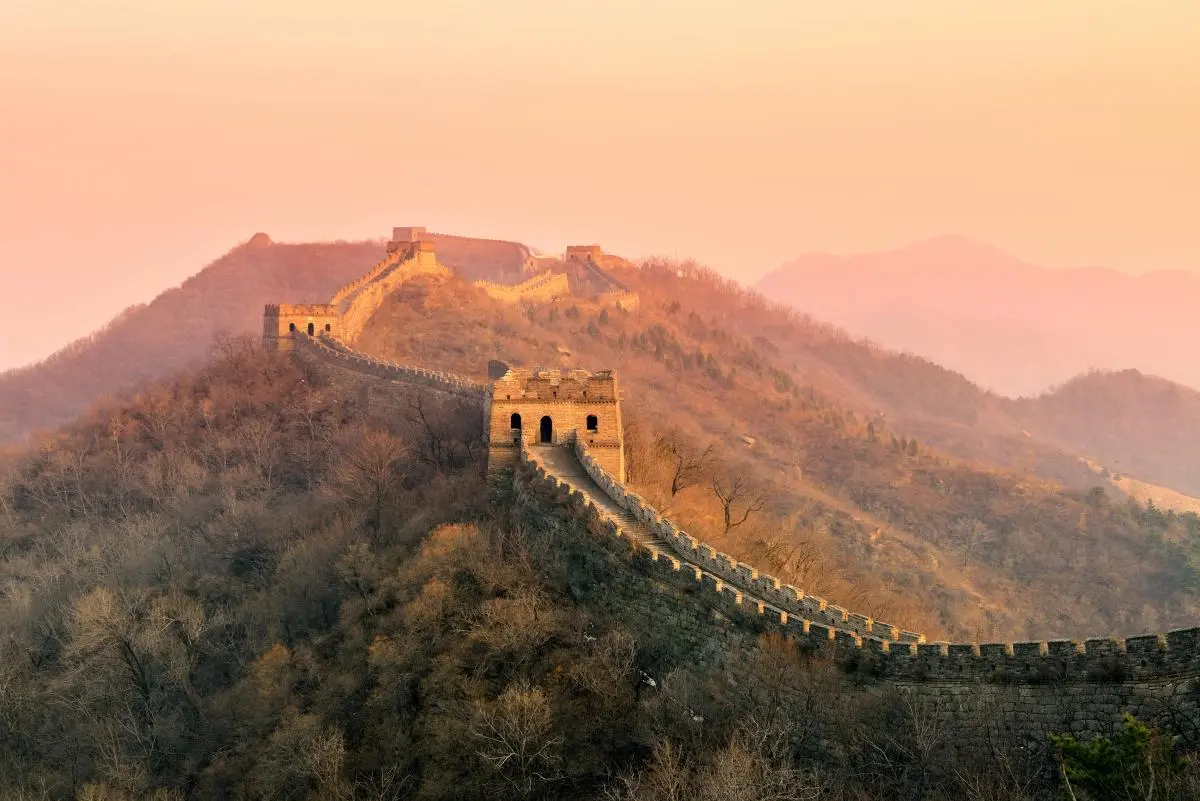
The Great Wall of China, a UNESCO World Heritage Site, is in a picturesque yet precarious state of disrepair. Only a tiny fraction of its total length has been restored and opened to visitors, according to Lonely Planet.
It is not a single structure, but a system of defensive fortifications built over the course of centuries. The oldest sections date back nearly 2,000 years, to the reign of Qin Shi Huangdi, the first emperor of a unified China. However, most of what can be seen today was built during the Ming Dynasty (1368–1644). The length of the Ming Wall, including all its branches, is 8,850 km. A 2012 government survey estimated the total length of all sections that have ever existed at 21,196 km.
The State Administration of Cultural Heritage of China is responsible for the preservation and restoration of the monument. The agency is restoring crumbling sections and old watchtowers using traditional materials. It also enlists experts and local heritage advocates to counteract erosion caused by inclement weather and the influx of tourists. The condition of the structure is monitored, in particular, through remote sensing.
The Badaling and Mutianyu sections near Beijing remain the most accessible and best-preserved. It was in Badaling in the mid-1950s that the first large-scale restoration since the Ming Dynasty began. At that time, as well as in 1987, more than 8 km of the wall and over 20 watchtowers were restored there. Remote sections, such as Simatai or Jiankou, are difficult to access and dangerously unstable, so it is recommended to visit them with organized groups.
Guards from border villages
About one-third of the Wall lies in ruins, and saving the rest is considered perhaps the world’s greatest cultural heritage preservation challenge. Near the eastern end of the structure, where it meets the sea, local resident Qiao Guohua patrols a section about 8 km long. Local authorities provide him with a uniform and pay him about $150 a year. He reports on the risk of collapses and makes sure tourists don’t take pieces of the wall as souvenirs, NPR reports.
Qiao is convinced that respect for the monument comes when people learn the price at which it was built.
“Every section of this wall was built with the blood and sweat of the working people. When I tell people how many died during its construction, they learn to protect the wall,” notes Qiao Guohua.
According to him, when he was a child, the towers and battlements were still in excellent condition. However, in the 1970s, during the Cultural Revolution, officials encouraged people to dismantle the fortifications for materials to build their own homes.
Dong Yaohui, vice chair of the China Great Wall Society, believes the government cannot handle such a massive undertaking on its own. He proposes that businesses and concerned citizens take individual sections under their care, with the funds raised going to local communities and authorities for patrols and repairs. Pilot programs are already in place, and he is pushing for their implementation nationwide.
“Do you see these bricks in the wall? Each one is quite ordinary. But together, in large numbers, they form a majestic wall. The same idea applies to protecting the wall. Every person or company we bring on board is like a brick,” emphasizes Dong Yaohui.