
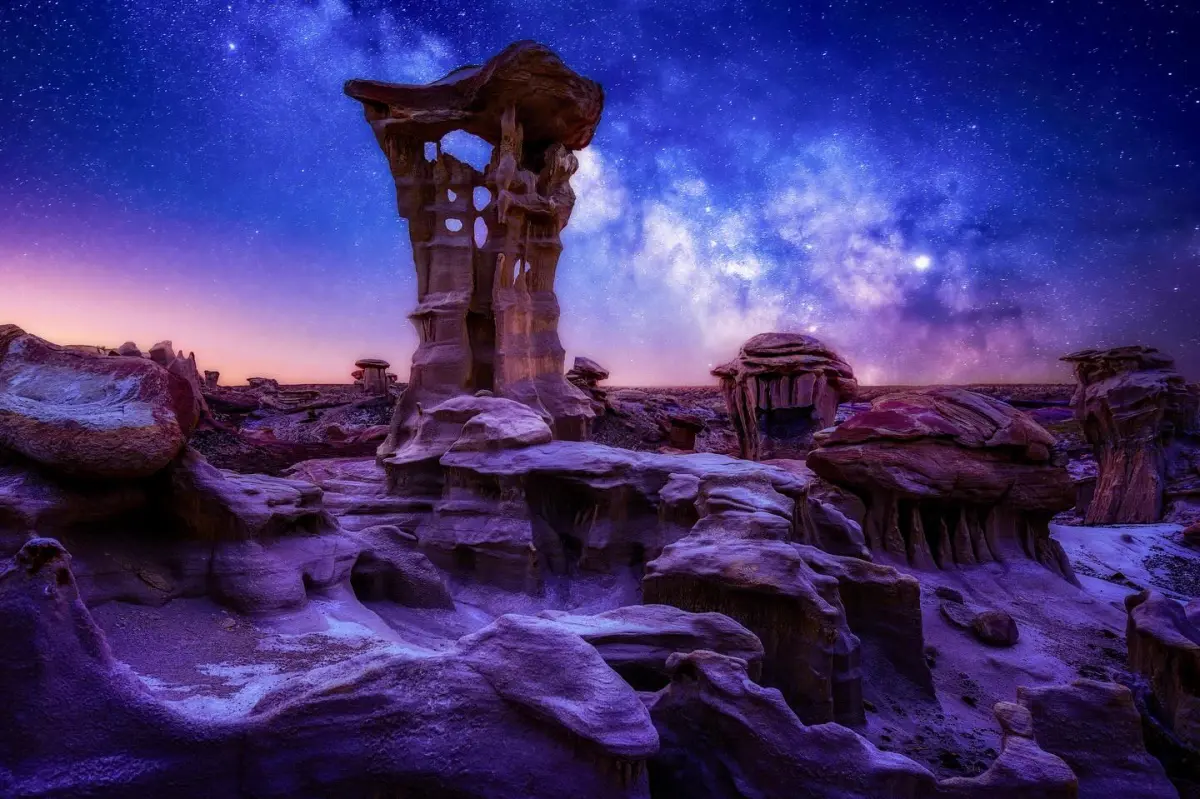
In the desert of northwestern New Mexico, two famous rock formations—the “Alien Throne” and the “King of Wings”—collapsed. Both landmarks collapsed within a few weeks of each other, as the southwestern United States was hit by a series of downpours and floods. They were destroyed by the very same forces of nature that once created them, according to The Independent.
The collapsed “Throne,” known in the Navajo language as Tsé Bináká Níyol, was discovered on October 30 by guide Kialo Winters, founder of Navajo Tours USA. Due to washed-out roads, he was unable to reach the area on the edge of the Ah-Shi-Sle-Pa desert for several weeks, so the exact date of the collapse is unknown.
“It was surreal. I just had to stop. A lot of thoughts went through my head,” Winters told the AP.
News of the “King of Wings” falling first emerged in early October. At that time, visitors posted photos on social media of a massive stone slab lying on the ground near the clay hill where it had previously been perched.
Winters is of Dine’ and Zia descent. He grew up in the area and, as a guide and educator, specializes in the geological and cultural heritage of the Bisti Desert and neighboring territories, according to New Mexico True.
Trillions of Gallons of Water
In late October and early November, tropical moisture moved into the region. Experts estimate that more than 20 trillion gallons (75.7 trillion liters) of rain fell across the Four Corners states and Nevada. In New Mexico, Colorado, Utah, and Arizona, rivers burst their banks, and torrents of water raced through normally dry riverbeds, destroying homes and eroding the soil. The water is already receding, but preliminary estimates suggest the damage could reach hundreds of millions of dollars. On the Navajo Nation, many dirt roads have become impassable or have been completely washed away.
The Ah-Shi-Sle-Pa desert area is known for its badlands, colorful hoodoos made of argillite and sandstone, petrified wood, and Late Cretaceous fossils. Route NM-57, which leads to the area, can become impassable after rain or snow. Climbing on the hoodoos and damaging the fragile geological formations there is prohibited, the U.S. Bureau of Land Management emphasizes.
More Than Just Rocks
For the region’s Indigenous peoples, these rocks have served for millennia as landmarks along their ancestors’ trade routes and have been passed down from generation to generation through oral traditions.
“They hold cultural significance for our identity and our stories,” Winters emphasizes. In his view, photographs, illustrations, and the stories of people who have visited these sites will preserve the memory of these formations.
The guide urges visitors to let these sites “rest”: do not climb on the remains and do not take fragments home.
Tourist Alan Studt from Ohio visited here in 2019 and last April. Looking through his photos, he noticed that the rocks were eroding: new holes were appearing in the “Throne,” and cracks were forming at the base of the “Wing.” So their destruction came as no surprise to him.