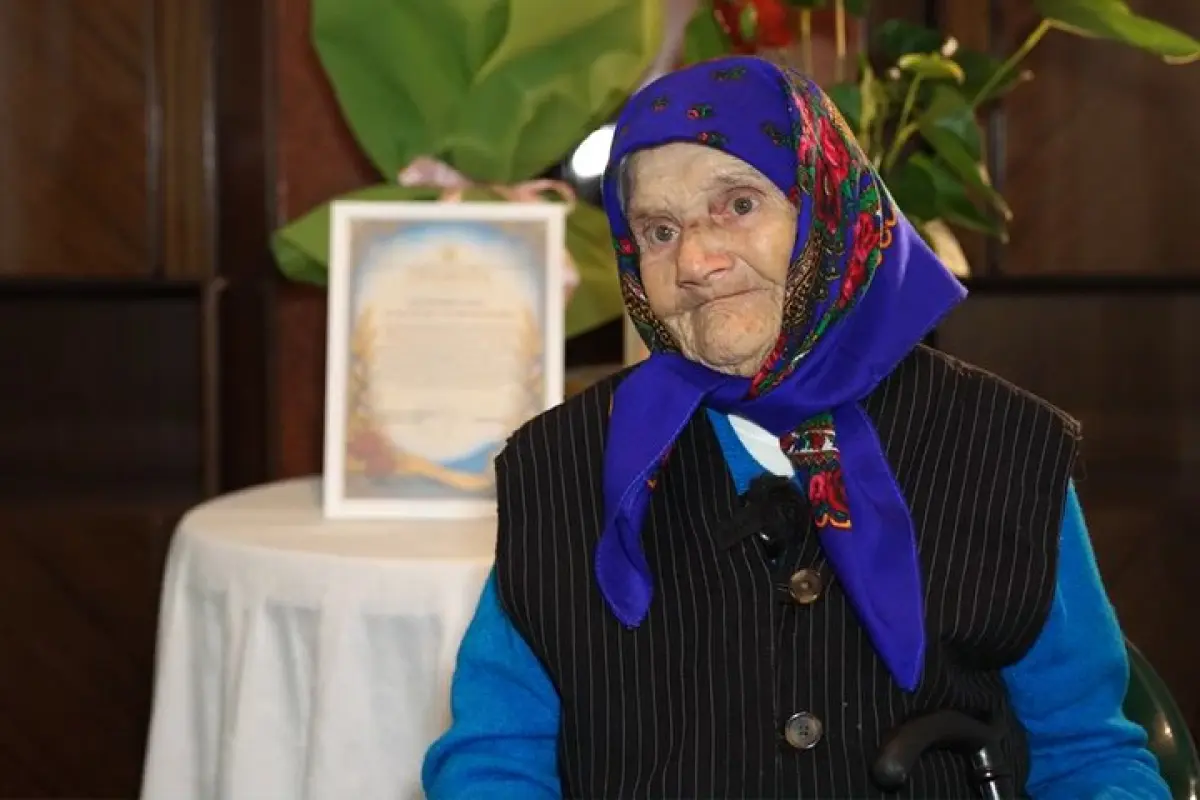
Maria Burkovska from the village of Dolinyany in Bukovina celebrated her 100th birthday. She never started a family of her own because, after her parents died, she raised her younger brothers and sisters. She survived a famine, worked on a farm for 30 years, and this year lost her home in a fire. Now, her relatives are taking care of the centenarian, according to “Suspilne Chernivtsi.”
Maria’s father died during World War II and is buried in a mass grave in Poland. The very next day, her older brother went missing. Her mother was ill, so the responsibility for running the household and supporting the family fell on Maria, who was born in 1926 and was the oldest of the children.
In the postwar years of 1946–1947, she lost her mother. Five younger brothers and sisters were left in Maria’s care.
“My mother died in my arms during the famine. There was a famine—we grazed on grass because there was nothing to eat. We went to the sugar factory, gathered up the pulp that had fallen, and shoveled it aside. We’d fall down and get stuck in it there. I took the place of both my dad and my mom because I was the oldest—I loved them and cherished them,” says the centenarian.
For Bukovina, the famine of 1946–1947 was the first tragedy of such magnitude. It was caused by Stalin’s grain requisition policies and a crop failure due to drought. The flat, agricultural regions of the oblast were hit hardest, particularly the Khotyn, Kelmentsi, and Sokyryany districts, and local authorities, despite the threat, did not reduce grain delivery quotas, according to an article by historian Anna Skoreiko in the academic journal of Chernivtsi National University.
“She Fed Orphans, Not Men”
For years, Maria devoted all her energy and earnings to her younger siblings, which is why she never married. Her younger sister Lyuba was hired to work at a factory, and later Maria helped arrange marriages for both her and her sister Vera.
“I didn’t take anyone in—I fed orphans, not men. Lyuba, my youngest sister, was hired at the factory by a woman, and I organized her wedding. Then I married off Vera, and I organized her wedding, too. But I had nothing for myself, because there was nothing left to give,” the woman recalls.
After her mother’s death, Maria found work on a farm, where she worked for 30 years. She helped build a house for her brother and sister, and only then did she build a house for herself. While the house was being built, she slept in a chest and in a windowless room during the winter. Because of hypothermia, she now has problems with her legs and her left arm.
In January of this year, shortly after her brother’s death, the woman was left homeless.
“I was sitting alone in the house, my blood pressure spiked, I got cold, so I went to light a fire, but it fell over—and the house burned down. Kind people took me in; they didn’t forget about me, and I’ll pray to God for them,” says Maria Burkovska.
Now, of all her brothers and sisters, she has only one sister left. Despite her age, the long-lived woman still helps her relatives with the farmwork: she peels onions, sorts beans, and pulls weeds for the chickens.
“I can’t do it anymore; I don’t have the strength, but I want to keep working,” the woman admits.