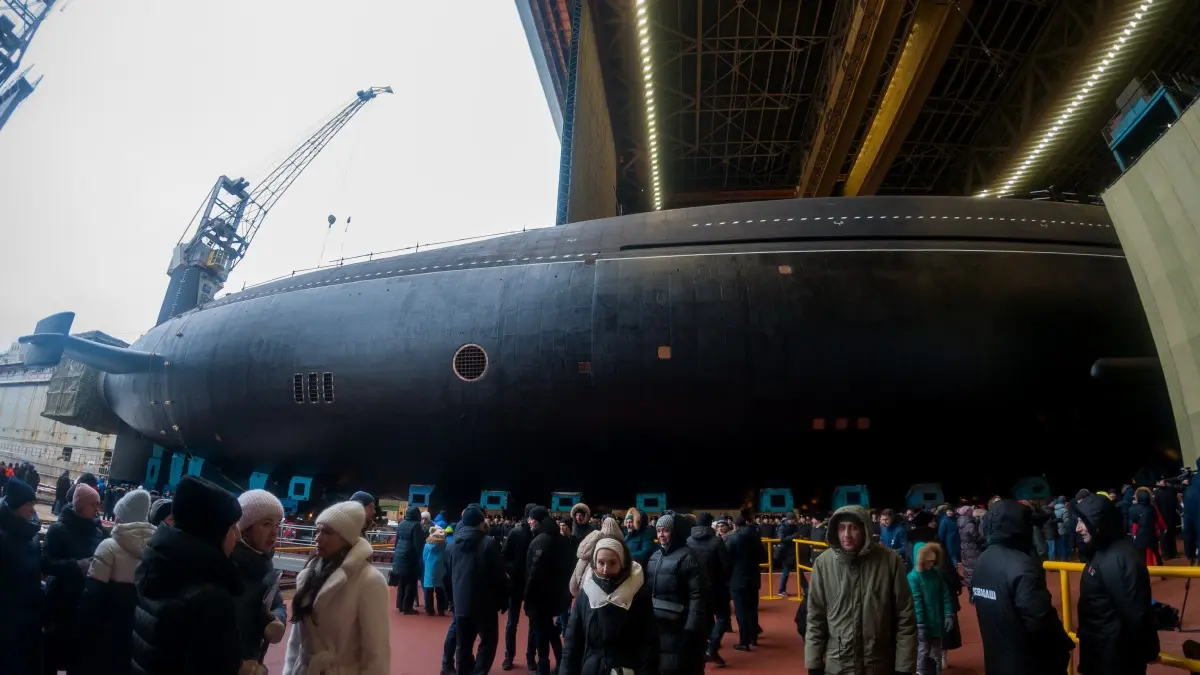
On Wednesday, October 28, a Russian nuclear submarine of the Pacific Fleet launched a "Bulava" intercontinental ballistic missile from a submerged position in the Sea of Okhotsk. The missile hit its target at a test range in the Arkhangelsk region, in the Arctic, thousands of kilometers from the launch site. The test site is located just over 600 kilometers from Russia’s border with Norway and Finland, according to Digi24.
The Russian Ministry of Defense posted a video of the exercises on Telegram and stated that the launch was carried out by the strategic submarine “Generalissimus Suvorov” of Project 955A “Borei-A.”
“In accordance with the combat training plan, the crew of the strategic nuclear submarine Generalissimus Suvorov of the Pacific Fleet launched an intercontinental ballistic missile ‘Bulava’ toward the Chizha test range in the Arkhangelsk region,” the ministry said in a statement. The statement also asserts that “the missile’s warheads successfully reached the test range at the scheduled time.”
On the eve of the launch, Norwegian Prime Minister Jonas Gahr Støre and Finnish President Alexander Stubb held a telephone conversation with Vladimir Putin regarding the war in Ukraine. The Kremlin leader told them that a just and lasting peace is possible “only if the legitimate interests of the Russian Federation are fully and unconditionally taken into account.”
According to the Center for Strategic and International Studies (CSIS), the “Bulava” has a range of about 8,300 kilometers and can carry up to 10 individually guided warheads. Each Borei-class submarine is capable of carrying 16 such missiles.
Launch Amid U.S. Nuclear Exercises
The Russian Ministry of Defense’s statement regarding the successful test has not yet been independently confirmed. The launch took place during the annual U.S. nuclear forces command and control exercise, Global Thunder. The day before, as part of these exercises, a U.S. Air Force B-52 strategic bomber flew to Northern Europe, escorted by British and Norwegian fighter jets, according to The Barents Observer.
A Show of Force Ahead of Talks
Analysts are noting the timing of the launch announcement: less than 24 hours after the leaders of the Nordic countries met with Putin. According to observers, the message is directed not only at NATO but also at the U.S., South Korea, and Japan.
“The test may be routine, but it sends a signal to the West. It can be interpreted as saber-rattling… a demonstration of the ability to intimidate and deter,” noted defense analyst Malcolm Davis in a comment to inews.
Erwan Alna du Fretey, an analyst with the Belgian Army Recognition Group, believes that for Moscow, such launches hold particular political significance in light of the war in Ukraine. “Since the start of the conflict, Moscow has repeatedly mentioned its nuclear arsenal in strategic communications, in particular to deter direct military intervention by the West and influence decisions regarding aid to Kyiv,” he emphasized.
Raji Rajagopalan, a senior research fellow at the Australian Strategic Policy Institute, is convinced that the westward launch is a message to Europe. “Russia would likely want to be in a position of strength if trilateral talks involving the U.S. and China take place in Asia next month. It is unclear whether NATO will respond immediately, but this clearly increases the likelihood of misunderstandings, misreading signals, and ultimately, an unintended conflict,” the expert warns.