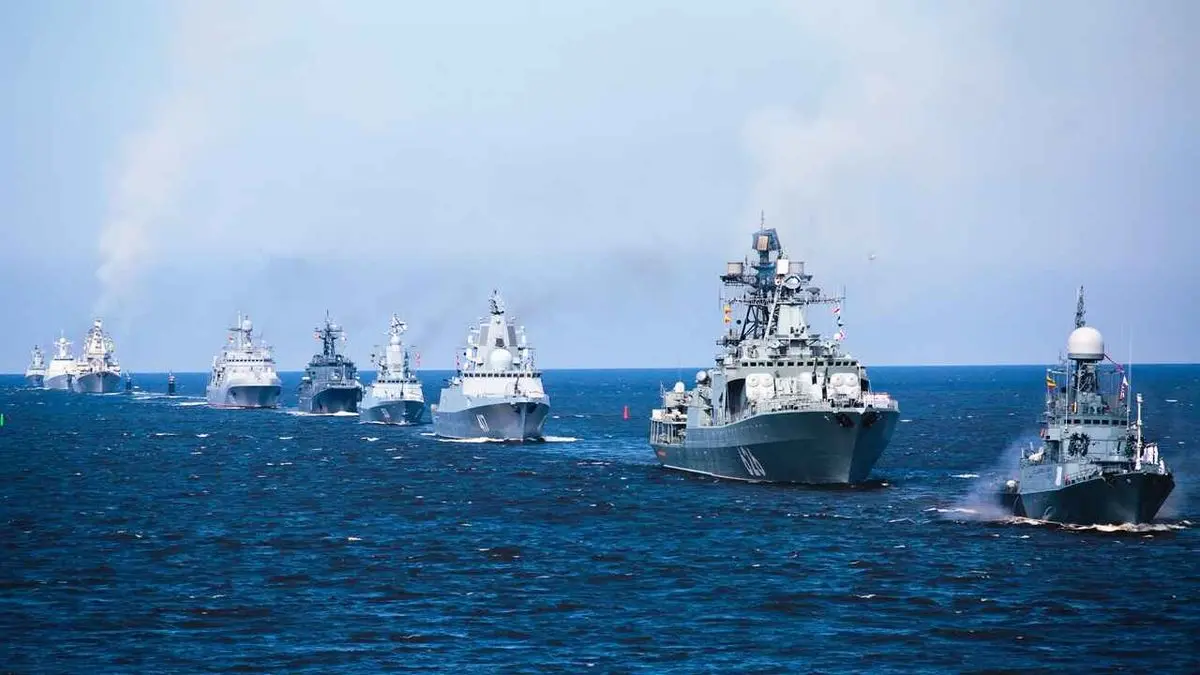
For the first time since 2016, the Russian Navy has disappeared from the Mediterranean Sea for nearly two months. As of early September, there were no Russian warships in the region. NATO attributes this to logistical challenges, the situation in Syria, and additional escort missions, according to WP Tech, citing an anonymous NATO official who spoke with Breaking Defense.
The OSINT project Russian Forces Spotter assesses the situation even more severely: according to its data, this gap in Russian presence in the Mediterranean is the first not since 2016, but since 2013. An analyst for the project cites two key reasons. First: Since the start of the full-scale war against Ukraine, Turkey has closed the straits to military ships, preventing the Black Sea Fleet from rotating its forces freely. Second: Tartus, Syria, is gradually turning into a limited logistics hub rather than a base for a permanent force, writes The Insider.
The question remains whether this is a temporary setback or a shift in Moscow’s entire naval strategy in the region.
“Russian deployments are increasingly appearing to be sporadic rather than continuous. The continuity has been broken. The question now is whether it can be restored, or whether this marks a lasting shift in Russia’s naval posture in the Mediterranean,” notes an analyst at Russian Forces Spotter.
A Long Route, Escorts, and Strikes on Bases
Mark Douglas, an analyst at Starboard Maritime Intelligence, points out the geography: ships heading to the Mediterranean are now forced to depart from Northern Europe and return by the same route. According to him, Russia also has to negotiate with various countries to secure supplies for its ships, and this is unlikely to win it any friends in Europe.
Naval resources are also being diverted to other tasks, including the security of the Kremlin itself and a presence off the British coast.
“Russian warships were attacked in St. Petersburg, which also led to the need to escort Putin’s yacht further north, while others are busy escorting ships in British waters and occasionally firing warning shots at yachts,” Douglas emphasizes.
Despite this, the expert does not consider the Russians’ absence from the region to be permanent.
“Russian ships will likely return [to the Mediterranean]. The question is when, not if,” Douglas is convinced.
Moscow’s position began to weaken after the fall of Bashar al-Assad’s regime in December 2024. In late 2024 and early 2025, a significant amount of weapons and equipment was shipped out by sea from the Tartus base. On the night of December 24, the cargo ship URSA MAJOR, owned by the company “Oboronlogistika,” sank between Spain and Algeria. The owner reported a “terrorist attack” and three explosions on the starboard side, after which military ships began escorting vessels from Syria. Subsequently, a fire broke out on the roll-on/roll-off ship Sparta, which was en route from Tartus.
In January, Reuters reported that Russia had begun withdrawing troops from the Kamishli airbase in northeastern Syria: some were redeployed to Hmeimim, while the rest returned home. At the same time, Moscow is attempting to reorient Tartus toward commercial use. The Syrian company Rus Line is setting up a logistics hub there for the transshipment of Russian grain, coal, timber, and steel. One berth will handle civilian cargo, while the other will retain its military purpose.
Algeria, Sudan, or Libya: The Search for a Replacement for Tartus
For the small Russian squadron, Tartus is extremely important primarily as a repair base, not just as a refueling and resupply point. It is precisely thanks to Tartus that ships of the “Admiral Grigorovich” class have been able to remain in the region for extended periods without returning to their home ports. In recent years, the squadron has typically consisted of no more than 11 vessels, including 3–5 support ships, and has served to demonstrate force, conduct reconnaissance, and support allies—in particular, to launch “Kalibr” strikes in the interests of the Assad regime, according to RUSI analysts.
Without the Syrian base, a fleet built around ships with limited range will be more dependent on the small number of Project 160 tankers. In addition, maintaining a permanent presence would require deploying more ships, leaving other areas unprotected. Among the possible alternatives, experts cite Algeria, which receives about 85% of its weapons from Russia and has the infrastructure to service Kilo-class submarines. However, disputes over Moscow’s actions in Mali make it an unreliable host, and access would likely have to be negotiated on a case-by-case basis.
Port Sudan on the Red Sea can accommodate only four ships, and negotiations regarding a base there have been dragging on for several years. Passing through the Suez Canal complicates urgent repairs and exposes the movement of ships to adversaries. The most realistic option appears to be eastern Libya under the control of General Khalifa Haftar, where there are about 2,000 Russian mercenaries and the Al-Qadim airbase is operational.
“If the Russian navy loses access to Tartus, it will not cease to be a regional player, but its presence will be much more scattered,” warn RUSI analysts.
Tobruk has well-established supply lines, but it lacks a dry dock, has insufficient large berths, and has limited capacity for expansion. Benghazi is more spacious and has better repair facilities, although much of its infrastructure remains unusable due to war damage.