
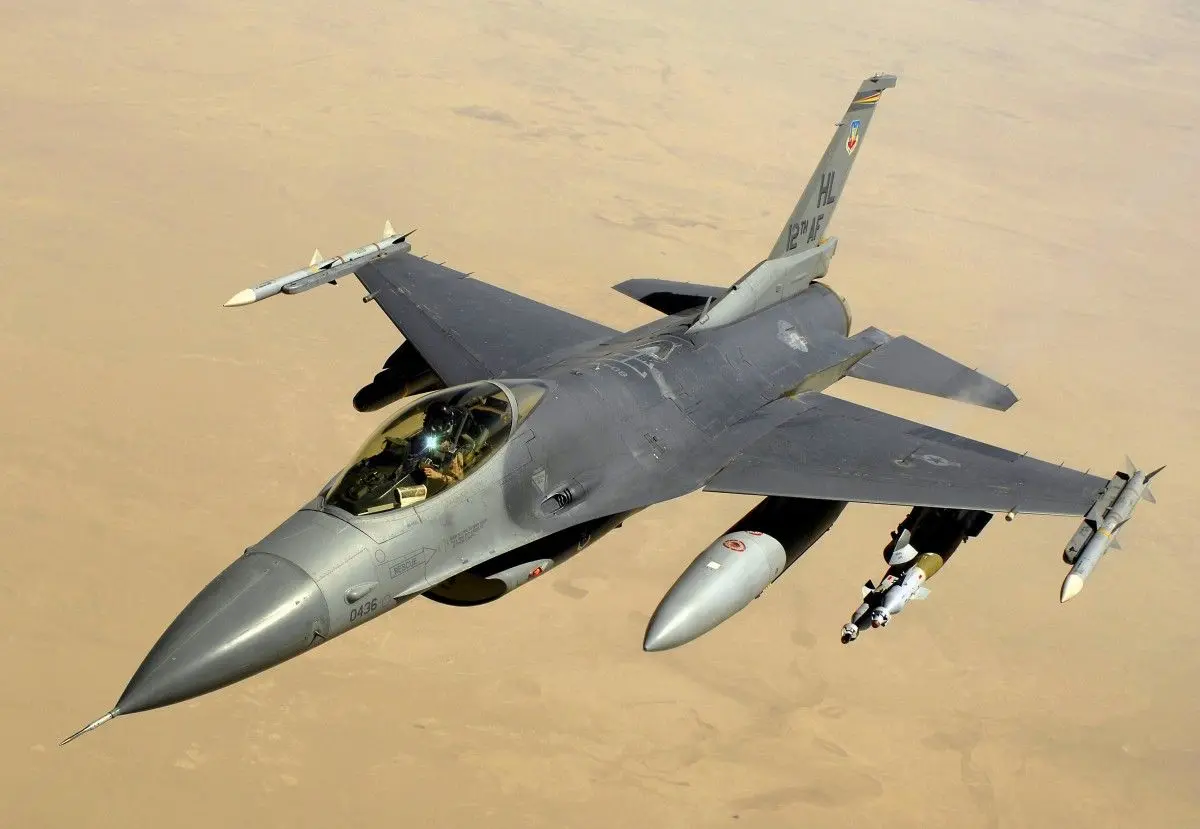
The American F-16C Block 30 fighter jet, nicknamed “Big Mouth,” is among the world’s best aircraft for close-range air combat. Its most serious rival is not the F-35, but the F-22 Raptor. This assessment comes from U.S. Air Force Lieutenant Colonel Philip “Rico” Malebranch, who has flown many variants of the F-16, according to 19FortyFive.
This version is equipped with a General Electric F110 engine and an enlarged air intake, which is what gave it its nickname. The wider “mouth” allows more air into the engine and provides greater thrust.
Malebranche also served in the U.S. Navy through an exchange program and flew the F/A-18C Hornet. He attributes the Block 30’s advantage to its design: “It’s the best for BFM Viper… because it didn’t have all the avionics, so its nose is lighter, and I can easily fly it along the horizon,” the pilot told the Aviation Geek Club.
“How long can you hold out?”
The most noticeable difference, according to the pilot, is in thrust-to-weight ratio compared to Navy carrier-based fighters. “The F/A-18E/F Super Hornet doesn’t come close to having the same thrust-to-weight ratio as the Viper. We can climb 3,000 feet higher than the Hornet and then go into a dive to lock it onto the HUD [for a cannon shot],” notes Malebranch.
The French Mirage 2000 with its delta wing, in his assessment, is capable of executing a single successful turn, after which it quickly loses energy. The F-15 Eagle is powerful and performs well at high altitudes, but at close range against the F-16, its size and weight become a disadvantage.
The situation is entirely different with a fifth-generation fighter. “Our toughest close-range dogfight is against the Raptor. When we’re fighting the F-22, it’s not about shooting it down, but about how long you can hold out!” the pilot emphasizes.
Experts cite the F-22’s two high-thrust engines and thrust-vectoring nozzles as its decisive advantages in training dogfights.
The F-35 Is a Different Story
As for the F-35 Lightning II, pilots’ opinions differ: not everyone believes that it is on par with the F-16 in a dogfight. At the same time, its stealth capabilities, advanced radar, and distributed sensors allow it to detect and attack targets before it is spotted, so the outcome of a hypothetical confrontation would depend on the specific circumstances.
Colonel Sonny “Blink” Blinkinsop is convinced that the “Viper” still sets the standard. “I think the F-16 can beat almost any fighter in the world today. Of course, I’m happy to say that the F-22 and F-35 are on our side!” he added.
However, the F-16 is not invincible: former Navy pilot Dan Green claims that his unit won at least half of its training dogfights against these aircraft. Meanwhile, the U.S. Air Force is gradually transitioning from the F-16 to the F-35, and at Luke Air Force Base, many “Viper” pilots are already being retrained on the new aircraft.