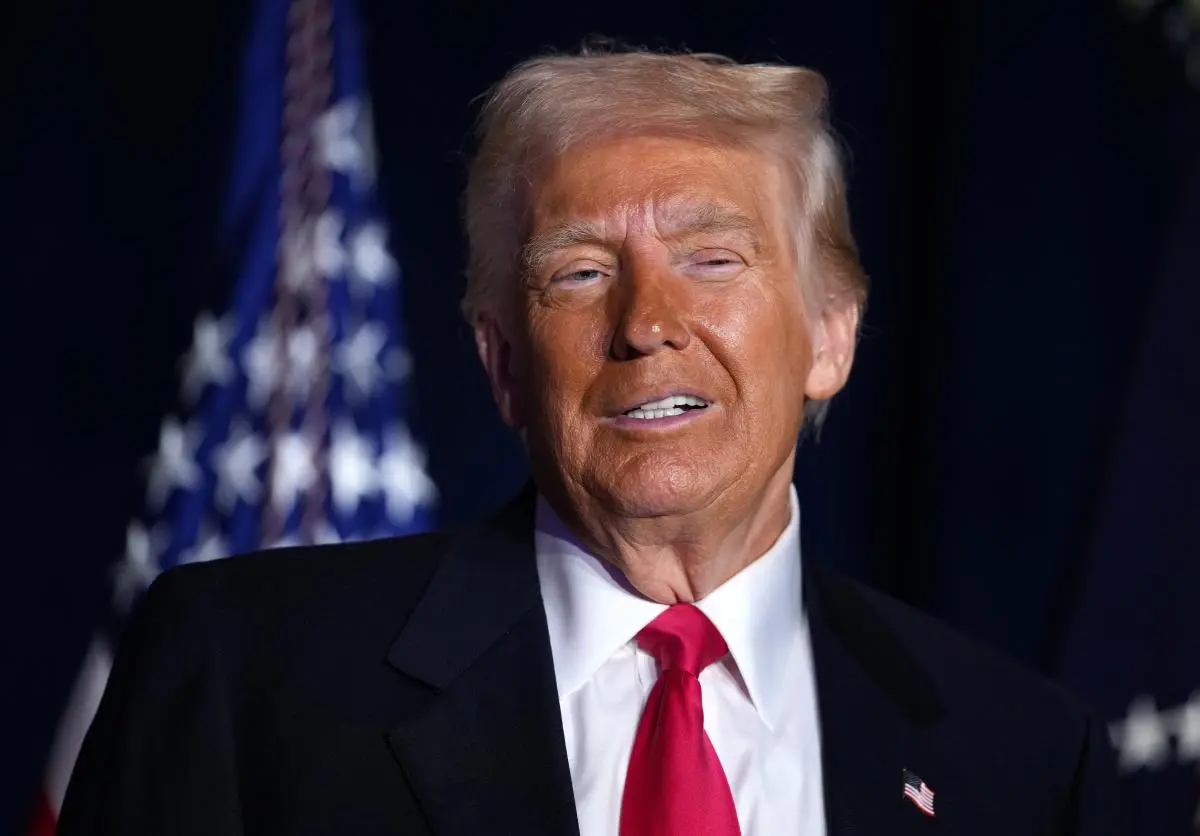
Clenched fists, motionless legs, and a tense grimace: U.S. President Donald Trump’s signature dance to the Village People’s song “YMCA” is interpreted by body language experts not as entertainment, but as a display of dominance and a tool for controlling the audience. The bent arms, which the politician rhythmically moves back and forth, have been a staple of his rallies and public appearances for many years, according to HuffPost.
Petty Wood, an expert in nonverbal communication and author of the book *Snap: Making the Most of First Impressions, Body Language, and Charisma*, attributes the recognizability of this routine to its predictability and the politician’s consistent on-stage image.
“It’s usually the same song and the same set of movements, and he usually does it while wearing a blue suit, a white shirt, and a red tie, so it’s part of his brand. One of the reasons it’s so interesting to watch is that we know exactly what he’s going to do, and yet we still watch every time [and try] to figure it out,” Wood notes.
Clinical psychologist Denise Dudley sees Trump’s gestures as a reflection of his rhetorical style.
“If you think about it a certain way, he dances the way he speaks. It’s extremely repetitive, very simple. I mean, it’s not complicated at all,” Dudley emphasizes.
Experts point to his fists as a key detail. According to Wood, a clenched fist creates tension in the observer’s central nervous system, since our instincts perceive it as a weapon, causing people to “remain somewhat on guard.” Metaphorically, this gesture signifies a fight, a struggle, or “alpha” status.
According to Dudley, this directly contradicts what people typically expect from someone on the dance floor: joy, spontaneity, and a sense of freedom.
“You want your arms to be open, so they look welcoming and relaxed, and so you can be emotionally expressive… so even in his ‘dance,’ he’s still conveying strength, control, and power. Clenched fists are simply a display of strength; it’s more of a victory gesture than a social dance,” Dudley believes.
The psychologist also views these movements as a way to lead the audience. People tend to mirror the gestures, intonations, postures, and rhythms of others, as happens in stadiums when fans stand up together or start a “wave.” A simple set of movements is easy for anyone in the room to repeat.
“All of his MAGA supporters, his voters—they can all do the same thing. I really see this as yet another way he’s signaling to the crowd: ‘Do as I do,’” says Dudley.
Still legs and a tense expression
Experts also consider his footwork to be atypical for a stage performance. Wood calls the feet “the most honest part of the body,” the part that gives the most away. When dancing, people usually step forward and backward or from side to side, and performers move around the stage to exchange energy with different parts of the audience.
“He may lean to the left or right, but he doesn’t lift his feet, doesn’t move through the space, doesn’t step to the edge of the stage, and doesn’t move sideways,” Wood notes.
Instead of the smile that comes naturally when dancing at a wedding or a party, Trump’s face often takes on a grim expression with tightly pursed lips.
“He often grimaces, as if he’s making a huge effort just to do so, as if he knows he has to,” Wood warns.
Sometimes the politician gives a faint smile, which, according to Wood, may be an attempt to look “cool” or to pretend he doesn’t enjoy it. However, his lowered eyebrows and narrowed eyes give the impression that he isn’t enjoying the process. Dudley adds that such a squint can be a gesture of victory or a dominant facial expression.
To understand Trump’s inner state, Wood advises recreating this dance yourself: instead of the freedom typically associated with dancing, you’ll feel negativity, discomfort, and tension. A single dance doesn’t reveal the full picture of the president’s psyche, but repeating the same movements over and over to the same song allows for a deeper insight.
“Our body language reflects our emotional state, but the opposite is also true,” Wood emphasizes.
“Unpresidential”: Melania and the Science of Charisma
First Lady Melania Trump also disapproves of her husband’s dance routines, which she considers “unpresidential.” During the 2024 election campaign, this dance became one of the pillars of Trump’s public image, alongside his improvisations and viral catchphrases, according to UNILAD.
“My wife hates it when I do that. She’s a very refined person, isn’t she? She said, ‘That’s so unpresidential,’ and I said, ‘But I became president,’” Trump said at one of his rallies.
According to Trump, Melania asked if one could imagine Franklin Roosevelt dancing. He replied that the story goes back further than she might realize, since Roosevelt was elegant, “even as a Democrat.”
Scientific research on charisma partly explains why such gestures work for politicians. The authors of a study published in PubMed Central concluded that charismatic leaders nonverbally convey two types of status signals: approachability (warmth and attractiveness) and dominance (competence and power). According to EEG data, such speeches simultaneously activate both approach and avoidance motivations in the audience, while perceptions of trust and authenticity are much less strongly linked to charisma, according to the study in PubMed Central.
Scientists also note that different nonverbal signals can serve the same function: clenched fists and furrowed brows both indicate aggression. According to their observations, successful leaders strike a balance between psychological closeness to their supporters and a sense of distance that underscores their special status.