
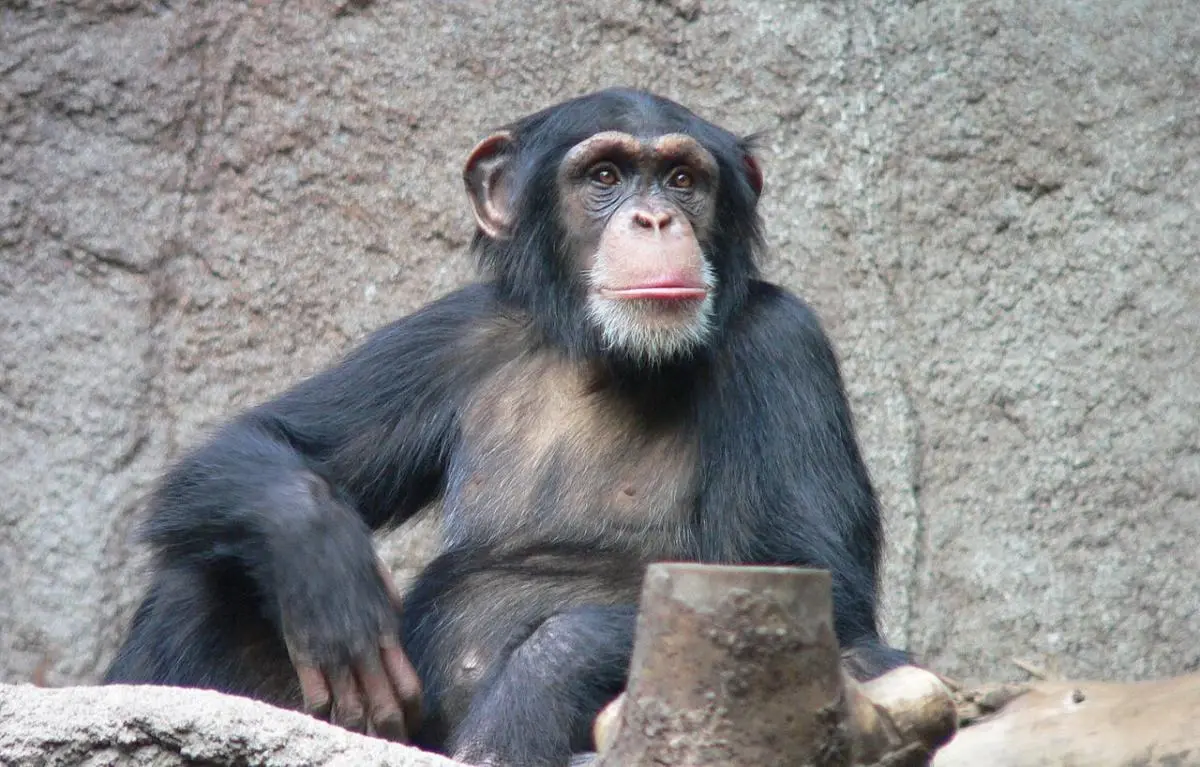
Chimpanzees at the Chimfunshi Nature Reserve in Zambia have begun inserting blades of grass into their ears and letting them dangle from the back of their heads, even though this behavior serves no practical purpose. Researchers from the Universities of Utrecht and Durham found that the chimpanzees picked up the habit from one another. Interestingly, this group had never come into contact with another group of chimpanzees at the same reserve, where a similar “trend” emerged more than ten years ago, according to Futura.
The results of the observations were published in the scientific journal *Behavior*. Of the eight chimpanzees in the new group, five wore grass in their ears, and six attached it to their hindquarters. Scientists believe a male named Juma was likely the initiator of the second habit. The researchers found no practical explanation for the behavior, such as an attempt to relieve itching.
A female named Julie was the first to start inserting a blade of grass into her ear in the 2010s. Other members of the group adopted her habit, and it persisted even after Julie’s death. Scientists interpreted this as an example of a socially transmitted tradition—that is, behavior that becomes established within a group through individuals learning from one another.
A Human Influence
During the study, it was discovered that both groups were cared for by the same reserve staff members. It was they who may have inadvertently set an example for the chimpanzees.
“Both groups, where the chimpanzees inserted blades of grass into their ears, had the same caretakers. These caretakers reported that they sometimes insert a blade of grass or a match into their own ears to clean them. The caretakers in the other groups said they don’t do that,” said Edwin van Leuven, a researcher at Utrecht University, as quoted by IFLScience.
The scientists were unable to conclusively prove that the animals copied humans. At the same time, the observations more convincingly suggest something else: within the groups, the behavior spread through social learning.
A Fad with No Practical Use
Chimpanzees usually learn useful skills from one another: how to forage for food, select tools, or treat wounds with plants. Some scientists have long believed that only humans are capable of imitating behaviors that seem pointless at first glance. A new study calls this assumption into question.
“This shows that, like humans, other animals also copy seemingly meaningless behaviors from one another. And this, in turn, may shed light on the evolutionary roots of human culture,” van Leuven emphasizes.
According to the researcher, this habit may have social significance. “By copying someone’s behavior, you show that you notice that individual and perhaps even sympathize with them. So this can strengthen social bonds and create a sense of belonging to a group, just as it does in humans,” the scientist notes.
Scientists suggest that such habits are easier to observe in captivity. Chimpanzees in a nature reserve have more free time, whereas wild animals expend a great deal of energy searching for food and defending themselves against predators.