
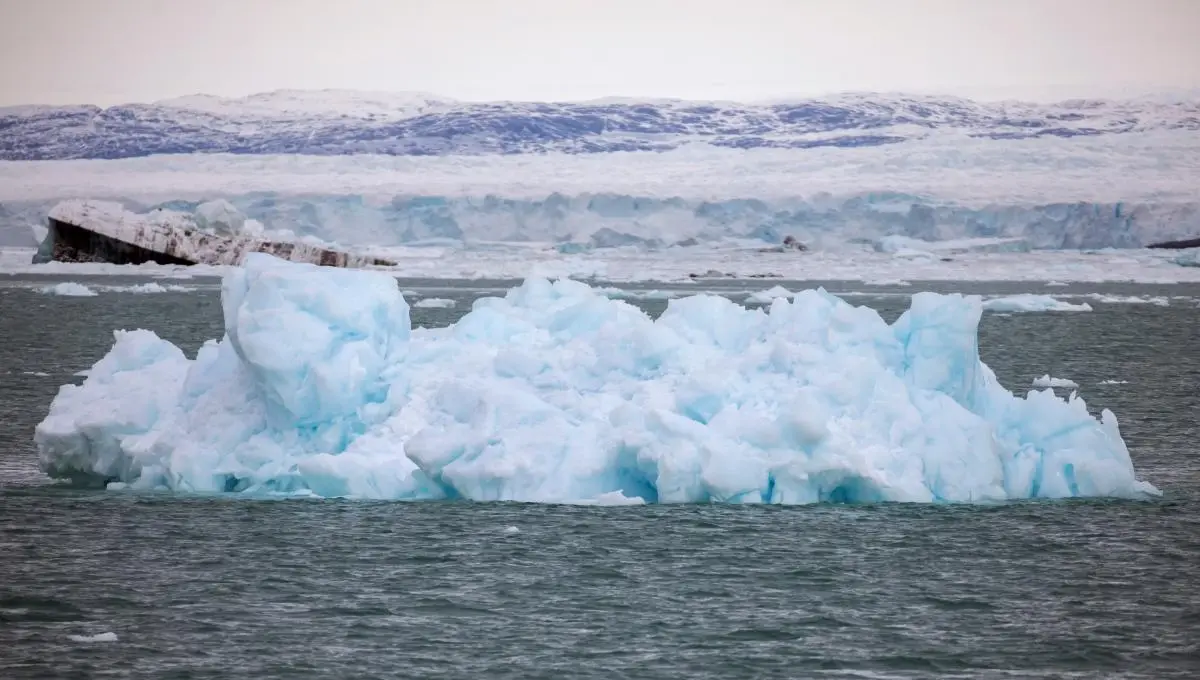
In October 1977, Saudi Prince Mohammed al-Faisal brought a chunk of glacier ice from Alaska to Iowa State University, located thousands of kilometers from the ocean. In doing so, he was demonstrating a project to tow icebergs from Antarctica to the Arabian Peninsula in order to supply arid regions with drinking water, according to Antena 3 CNN.
The initiator of the project, Khalid, the nephew of the King of Saudi Arabia, headed the company Iceberg Transport International, which he founded together with French engineer Georges Moizan. A block weighing about 1,133 kg from Portage Lake in Alaska was transported to the city of Ames by helicopter, plane, and truck. To prevent the ice from melting, it was wrapped in insulating materials and dry ice. Divers from the U.S. Navy’s Arctic Research Laboratory participated in the transport.
The demonstration was timed to coincide with an international conference held October 2–6, 1977, which brought together about 200 glaciologists, marine biologists, and engineers from 18 countries. The U.S. National Science Foundation allocated $25,000 for the project; the remaining costs, estimated at approximately $50,000, were covered by the prince, according to the student newspaper Iowa State Daily.
100 million metric tons of ice halfway around the world
The actual plan was much more ambitious. The company proposed towing an iceberg weighing about 100 million metric tons a distance of approximately 11,500 km, estimating the cost of the operation at $100 million. The calculations were based on one key condition: the iceberg was not to lose more than 20% of its mass along the way.
Conference materials are still preserved in the university library’s special collections. Among them are more than fifty reports on towing, thermal insulation, and the legal aspects of using Antarctic icebergs, as well as al-Faisal’s own paper on the possibility of moving ice blocks using paddle wheels, according to the Iowa State University archives.
Why the iceberg never reached the desert
The plan was never carried out. Obstacles included ocean currents, the rate of ice melt, and the cost of building sufficiently powerful tugboats. A similar plan announced in 2017 by National Advisor Bureau Limited of the UAE was also never implemented: the company wanted to transport icebergs from the vicinity of Antarctica to the coast of the emirate of Fujairah.
Peter Wadgems, former director of the Scott Institute of Polar Research in Cambridge, who later worked on similar projects himself, believes that the Saudi idea had a fundamental physical flaw from the start, according to the BBC.
“Prince Faisal then latched onto this idea and asked, ‘Can we tow icebergs to Saudi Arabia?’” Of course, the obvious answer is ‘no,’ because they would have to be hauled across the equator and would melt, but no one told him that because he had a lot of money to invest and funded quite a bit of research,” Wadgems notes.
According to the scientist, towing is only possible in fairly narrow latitudes and relatively cold waters, and the Saudi route did not meet either of these conditions. The project was scrapped in the early 1980s.