
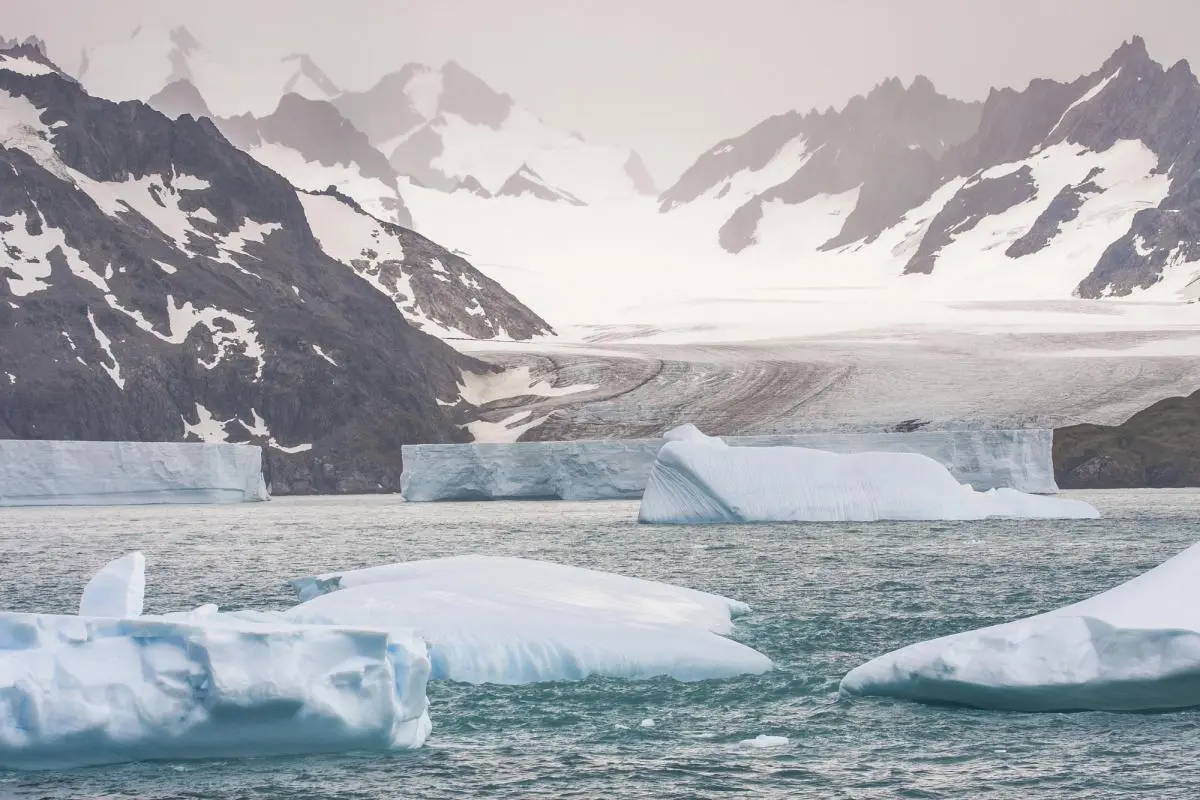
The potential melting of a significant portion of Antarctica’s ice sheet could cause global sea levels to rise by 50–60 meters, which would radically alter the planet’s geography and force millions of people to leave coastal areas, according to Ecologia Verde.
Mechanisms of Glacier Breakup
The Antarctic system is extremely vulnerable to global warming because a significant portion of the ice sheet rests on a bedrock surface located well below sea level. Unlike Greenland, where the edges of the ice sheet rest on land, in Antarctica they come into direct contact with the ocean, creating a risk of “marine instability of the ice sheet,” notes glaciologist Rob DeConto, according to The Bulletin.
“We are observing that the floating parts of the ice sheet are thinning and melting, while the grounding line is retreating inland, where the bedrock has a reverse slope. This triggers a positive feedback loop, with more and more ice flowing into the ocean, which could potentially lead to the collapse of the West Antarctic Ice Sheet,” DeConto explains.
In addition, the stability of glaciers is influenced not only by water temperature but also by atmospheric factors. When summer air temperatures rise above freezing, meltwater forms on the surface of ice shelves; this water seeps into cracks and, under pressure, destroys the ice’s structure, depriving the main body of the ice shelf of the necessary support.
Historical Context and Future Risks
New geological studies indicate that the East and West Antarctic ice sheets formed during different time periods and respond differently to climate change. An analysis of sediment cores from the Amundsen Sea revealed that West Antarctica remained ice-free for millions of years after the continent’s first glaciation began, according to the British Antarctic Survey.
“Even slight warming is enough to cause the ice in West Antarctica to melt again—and that is exactly what we are facing now,” notes geologist Johann Klages.
Scientists emphasize that although the complete disappearance of Antarctic ice is a process that could take centuries or millennia, even a partial loss of glacial mass will have irreversible consequences for the global climate. A reduction in ice cover decreases the albedo effect, causing the dark ocean surface to absorb more solar heat, which further accelerates global warming.