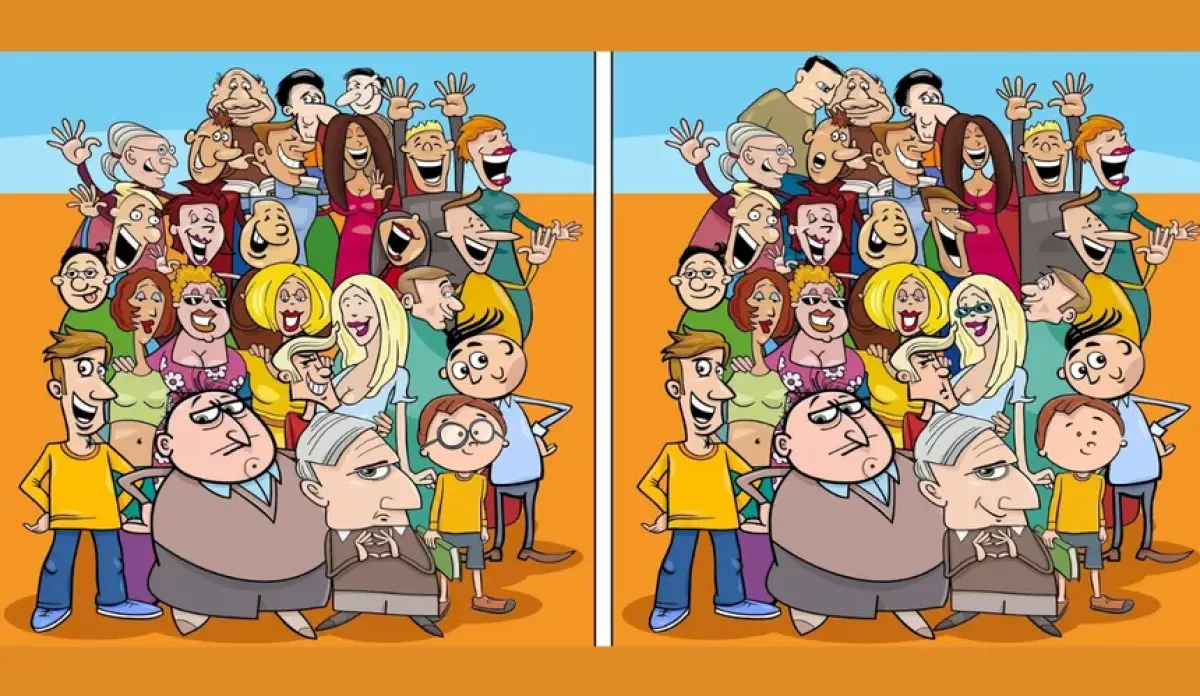
The Polish publication ChilliZET has challenged its readers with a new visual puzzle: find 12 differences between two nearly identical illustrations depicting a crowd of people. For those who want to make the challenge harder, ChilliZET recommends completing it in 30 seconds.
The illustrations were created by Polish illustrator Igor Żakowski. Both images feature a crowd of colorful characters of various ages, appearances, and facial expressions. Before you begin, the editors recommend turning on a stopwatch and seeing if you can stay calm as the time runs out unexpectedly quickly.
These kinds of challenges have simple rules and take very little time, so social media and app users eagerly take them on to test their observation skills and ability to think under pressure. The publication also attributes the popularity of these puzzles to nostalgia: spotting differences in pictures is something many people are familiar with from childhood.
Where Are the Differences?
Some of the changes involve the composition of the crowd. In one of the illustrations, a man is missing from the upper left corner and another from the upper right corner. In the third row from the top, a smiling woman and a smiling man have disappeared.
Other differences are harder to spot because they involve facial expressions and gestures. The man next to the gray-haired woman in glasses has a different facial expression, and the blonde woman below her is waving her hand. The man in the green sweater on the left is sticking out his tongue, and the man next to the blonde woman in the blue sweater is turned in the opposite direction.
Glasses have appeared on the nose of the blonde woman in blue herself and on the boy in the front row. Two more differences are the smiles: on the blonde man with the distinctive bangs in the second row from the bottom and on the gray-haired man standing in front of him.
For those who didn’t spot all the differences, the editors advise not to be discouraged: this skill develops with practice, and you can find other puzzles in the “Psychology” section on the publication’s website.