
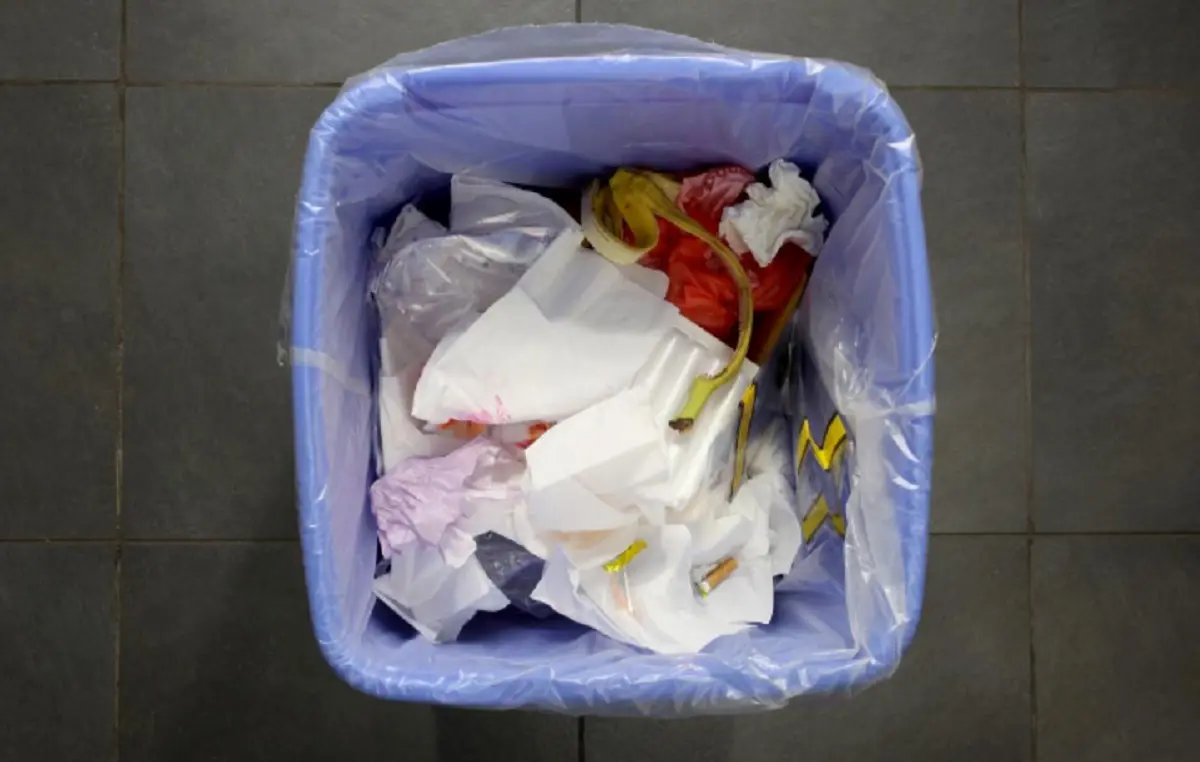
Professional kitchen designers are increasingly moving away from the classic trash can under the sink and are instead offering a closed food waste compartment built into a drawer. It holds a roll of biodegradable film that works like paper towels: you pull it out, form a bag, fill it with food scraps or coffee grounds, then seal it, tear it off, and dispose of the entire bag in a compost bin or general waste container. This was reported by the Hungarian publication Kertészkedj.hu, citing the interior design section of the Greek publication Bovary.
The space under the sink is considered the worst place for organic waste due to the heat and humidity near the siphon and drain. Moreover, a bucket hides leaks at the joints, which can go unnoticed for weeks. The odor from a poorly sealed container lingers in the cabinet, which is rarely ventilated.
The second problem is a lack of space. Separate collection requires separate bins for plastic and metal, paper, mixed waste, and food scraps. A maximum of two of them can be placed next to the pipes, while the rest end up in a corner, on the balcony, or in the storage room.
Pull-out sorting systems are now available in Hungary as well. The simplest 2×15-liter model with a soft-close mechanism costs approximately 30,000 forints. Premium sets for a 60-centimeter cabinet with multiple sections and a separate organizer drawer cost between 117,000 and 200,000 forints. When designing a kitchen, it’s recommended to place this section next to the sink and the organic waste compartment at the front, since it’s opened most often.
Plastic wrap doesn’t solve all problems
The authors of the Hungarian article consider the claim that the bag can be sent entirely to the compost pile to be an oversimplification. The European standard EN 13432 certifies materials for industrial composting, where the temperature inside the pile ranges from 50 to 70 °C, and humidity and aeration are controlled. Under such conditions, certified plastic film decomposes in 6–12 weeks. In a cool garden compost pile, it can remain undecomposed for months, so home composters are advised to empty the contents of the bag or use paper bags instead.
In Hungary, separate collection of kitchen biowaste began to be gradually introduced starting in January 2024. The deadline for EU countries, in accordance with the Waste Framework Directive, was December 31, 2023. In the first phase, the system was tested in 14 cities: households received a 5-liter odor-proof container for the kitchen and a 120-liter brown bin. The head of the concession company responsible for waste collection stated in 2024 that biogas plants are unable to process even biodegradable bags, so no packaging of any kind should be placed in the brown bin. According to local estimates, kitchen waste accounts for about 30% of household waste, and during the pilot project, approximately 300 grams per person were collected each week.
American experts interviewed by Wirecutter see no need at all for a liner in a kitchen waste bin. They recommend choosing a bin with a capacity of about 3.8 liters, a 15-centimeter opening, smooth sides, and a fully removable lid so it’s easy to clean. This bin should be emptied daily or once a week. If emptying it more often isn’t possible or if the kitchen gets hot, a charcoal filter can help, and leftovers can be stored in the refrigerator or freezer until they’re taken to a collection point.
New York City’s experience shows why operators are skeptical of bags. As Belinda Maher, director of digital media and communications for the Department of Sanitation (DSNY), explained, most of the collected organic waste is clean, but plastic bags remain the main contaminant. As a result, the city had to install mechanical lines to remove and sort them, according to Waste Today.
Why Cities Are Tackling Organic Waste
According to the United Nations Environment Programme (UNEP), households, food service establishments, and the retail sector discard 19% of food annually. Food loss and waste account for 8–10% of global greenhouse gas emissions and cost the global economy more than $1 trillion annually. Methane produced during food decomposition has a greenhouse effect 80 times stronger than carbon dioxide during its first two decades in the atmosphere. Sustainable Development Goal 12.3 calls for halving food waste by 2030, and the UN identifies composting as one of the key tools for achieving this goal.
New York launched a pilot project in 2013 in the Westerly neighborhood of Staten Island, where families received a kitchen bin and a large street-side container. Subsequently, the voluntary program expanded to cover 3.3 million residents and about 40% of public schools. Sorting organic waste became mandatory for large stadiums, hotels, and food producers. City officials at the Department of Sanitation and Waste Management (DSNY) explain their motivation as follows.
“Organic material that ends up in landfills harms the environment. In addition, when food scraps are left on the side of the road in plastic bags awaiting pickup, they attract animals such as raccoons and rats,” Maher emphasizes.
Some residents were initially concerned about a backlash. Therefore, the organic waste bins were made sturdy and equipped with locks on the lids.
“We’re already seeing how the brown bins help keep neighborhoods clean. The New York City Department of Health and Mental Hygiene supports the program as a way to reduce rodent and pest activity,” notes Maher.
The main challenges for the city’s sanitation department are not related to technology, but to people’s habits and work scheduling.
“The transition to any new collection system takes time and affects everything—from human behavior to route planning and the vehicle fleet,” warns Maher.