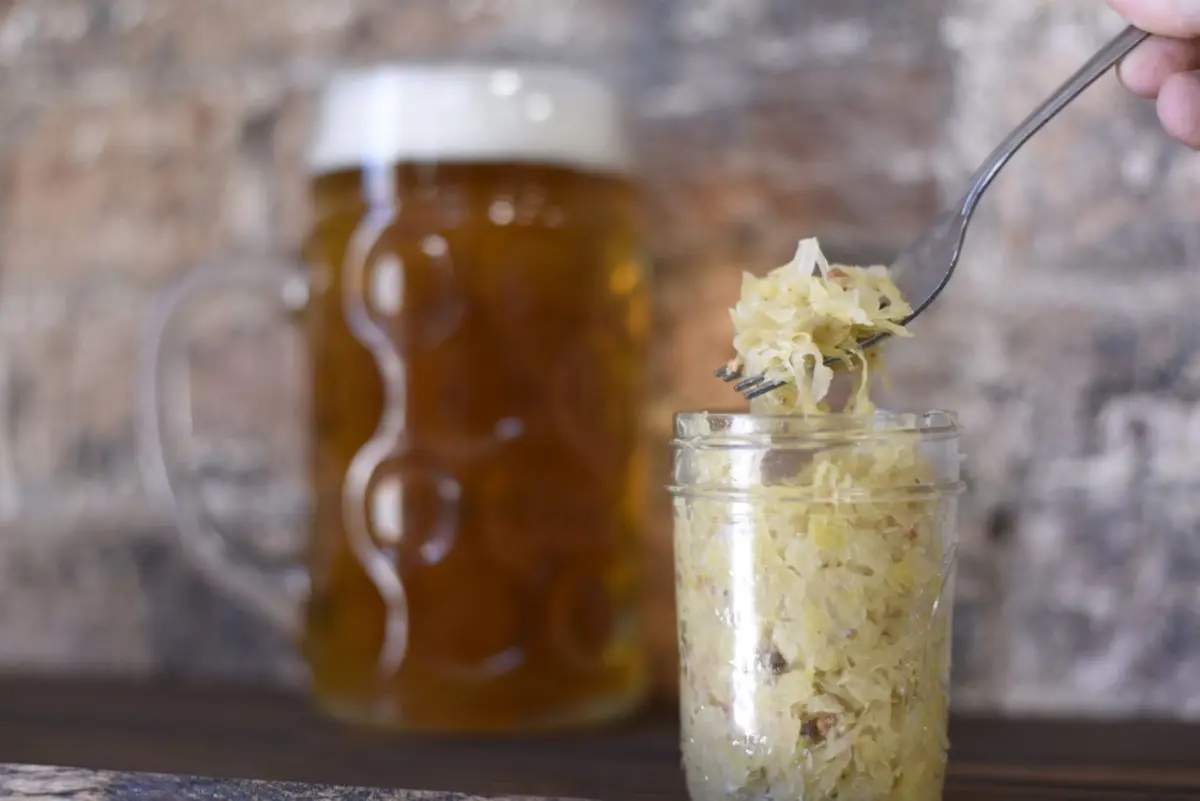
To pickle cabbage in a jar, one level spoonful of non-iodized rock salt—that is, 10 g—is sufficient for every kilogram of cabbage. This ratio ensures proper fermentation, prevents the cabbage from becoming too salty, and keeps it from spoiling during storage, according to the Polish publication Dziennik.pl.
For a three-liter jar, you’ll need 2 kg of white cabbage, two carrots, and about 20 g of salt. This method is suitable for those who live in apartment buildings without a cellar and don’t have room for large barrels.
Cut the cabbage into thin strips, grate the carrots on a coarse grater, and mix both ingredients with salt. Then knead the mixture with your hands for a few minutes until the cabbage releases its juice. Layer it in sterilized jars and pack it down thoroughly with a wooden spatula to remove any air bubbles. The juice should cover the top.
Keep the sealed jar at room temperature for 5–7 days, depending on the desired acidity. Check daily to make sure the juice covers the cabbage, and once every 1–2 days, pierce the mixture all the way to the bottom with a stick or a long knife. If gas remains trapped inside, it will cause bitterness, an unpleasant odor, and uneven fermentation. A light foam on the surface is a normal sign of fermentation.
Once the flavor is to your liking, transfer the jars to the refrigerator, a cellar, or a balcony to halt the process. The cabbage is ready in 2–3 weeks, and the longer it sits, the richer its flavor becomes.
What Happens Inside the Jar
From a biochemical perspective, fermentation is a metabolic process: microorganisms convert the sugars in the food into alcohols and acids. In the case of cabbage, lactic acid bacteria are involved. Liliana Fruk, a chemist at the University of Cambridge, broke down each step of the home recipe in a conversation with The Naked Scientists.
You should start with cleanliness. Microbes live on any surface, and some of them can derail the process. Therefore, all utensils must be washed thoroughly so that the fermentation is carried out primarily by the microorganisms found on the cabbage leaves, the researcher advises.
The most delicate issue concerns the amount of salt used. It determines whether the preparation will ferment properly or rot.
“So, a certain amount of salt will kill the harmful microorganisms you don’t want during fermentation, but the bacteria needed for cabbage fermentation will survive it. However, the balance is very delicate. The lactic acid bacteria needed for cabbage fermentation can tolerate up to 8% salt by weight, which is good. But if you add a little more, you’ll kill them too, so you won’t get anything,” warns Fruk.
The brine must completely cover the cabbage, as this prevents oxygen from entering the fermentation zone. At the same time, the container should not be completely sealed, the chemist notes. Carbon dioxide is released during the reactions. If it accumulates, it partially dissolves in the liquid, increases acidity, and can harm the microorganisms. This logic is the basis for the advice to pierce the cabbage regularly.
Separately, the researcher discusses signs that are visible through the glass. Cloudiness in the liquid is to be expected.
“If you see something black or brown, it’s probably time to take everything out and throw it away. But as long as you only see minor changes in the liquid’s color or, perhaps, changes in the texture of the leaves, that should still be normal,” Fruk emphasizes.
Not a German invention
Because of its German name, sauerkraut is usually considered an ancient German invention. In fact, it gradually evolved from early forms of pickled cabbage and took on its modern form only in the 17th century, according to Alan Davidson’s reference book *The Oxford Companion to Food*, published on the ckbk platform. Historian Joyce Tumr traces its origins to China in her 1992 work: in her view, the Tatars brought this dish to Russia and Eastern Europe.
The history of pickling in the West dates back to the 3rd century B.C., but all early preparations were “wet,” meaning they were made with brine or other liquids. Sauerkraut is distinguished by dry fermentation: all the liquid in the finished product is drawn out of the cabbage itself by salt, and it is preserved and develops its flavor through fermentation. The Romans were the first to introduce dry fermentation of vegetables when they began making silage for livestock, but this method fell out of use for many centuries afterward.