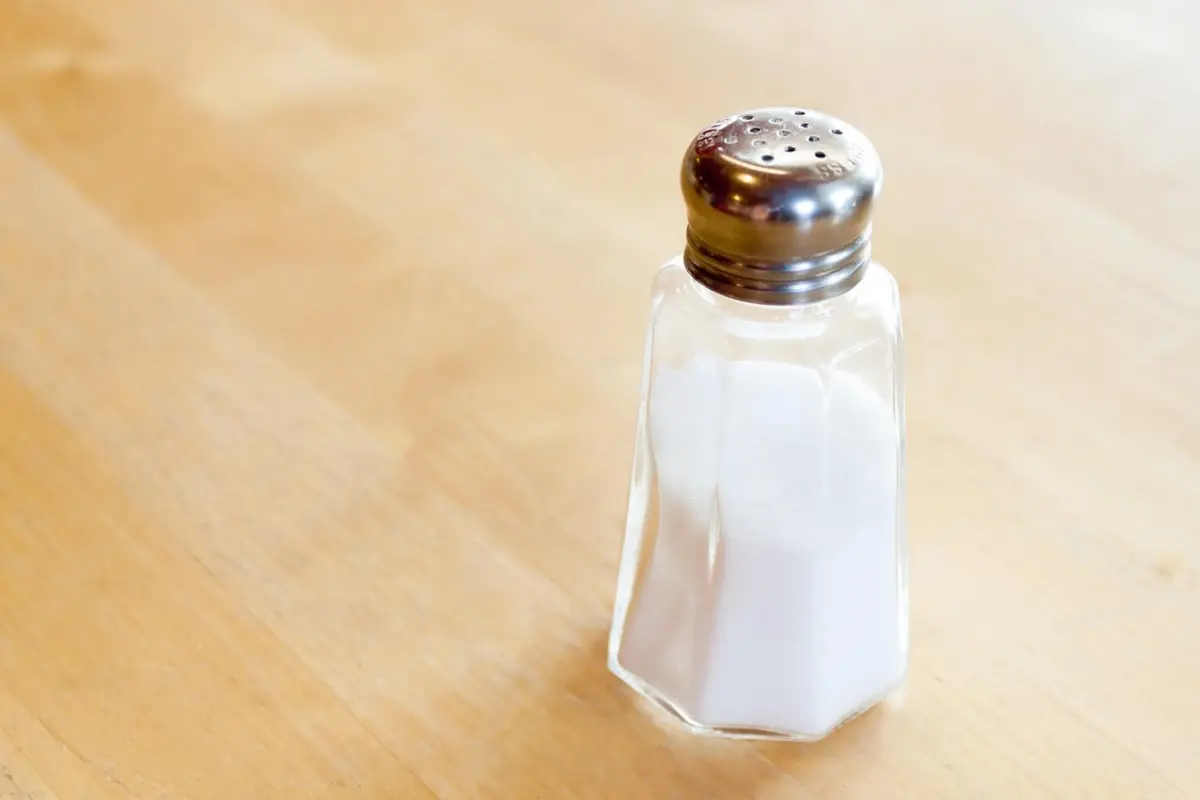
A handful of raw rice in a salt shaker does indeed prevent the salt from clumping, but not in the way people usually think: the grains absorb moisture slowly and in small amounts, and mechanical action plays an equally important role. When shaken, the hard rice grains break up the clumps that are beginning to form and prevent the salt shaker’s openings from getting clogged, according to Kertészkedj.hu.
Table salt is very sensitive to moisture. According to the materials science database of the Museum of Fine Arts in Boston, at a temperature of 20 degrees and a relative humidity of over 75.5%, salt crystals absorb so much water from the air that their surface dissolves. When the air dries out again, a thin layer of the solution crystallizes and binds the grains together. Near the stove or above a pot from which steam is rising, this threshold can be exceeded in just a few minutes.
Rice acts as a buffer in this cycle: during humid periods, it absorbs some of the moisture, and in dry air, it gradually releases it. However, its capacity is limited. A portion of about 5 grams can absorb only a few tenths of a gram of water, so it won’t save an open salt shaker standing in the path of steam.
The limitations of rice as a moisture absorber were confirmed by an experiment conducted by the University of Huddersfield in the UK in 2013. Student Claire Bowks tested which method dried a cell phone that had fallen into water the fastest. Even in small quantities, silica gel absorbed all the moisture, while the best variety of rice absorbed only 78% of the moisture in a day, and brown rice—44%.
Why grains don’t clump together with salt
Food technologist Brian Quoc Le, author of the book *150 Food Science Questions Answered*, explained the difference between how rice and salt behave in a salt shaker in a comment to Hunker. He recommends putting about half a teaspoon of uncooked rice in the salt shaker.
“Rice can absorb a certain amount of moisture, primarily in place of salt, so the moisture is retained inside the rice grains rather than in the salt crystals. Since rice consists mostly of starch, it doesn’t dissolve or stick to the salt,” Le notes.
The scientist considers food-grade packets of calcium chloride or silica gel to be a more effective alternative. However, silica gel packets from shoe or electronics boxes should not be placed directly in the salt, as they are not intended for contact with food. They can be taped to the inside of the lid of a large container.
How to Prevent Salt from Clumping
This depends mostly on where you store it. Move the salt shaker from near the stove or the shelf above the sink into a closed cabinet. When cooking, it’s better to pour the salt onto your palm first rather than sprinkling it directly over a pot from which steam is rising. It’s recommended to replace the rice in the salt shaker monthly and not to dip a wet spoon into it.
Salt that has been sitting for a while does not go bad. You can dry it on a clean, dry baking sheet in the oven at a low temperature, and then grind it in a mortar or roll it out with a rolling pin inside a bag.
Amanda McNulty, an extension educator at Clemson University, emphasizes that white rice is the best choice for a salt shaker. According to her, even health-conscious people should buy white rice for this purpose, as it works better than brown rice, reports SC Public Radio.