
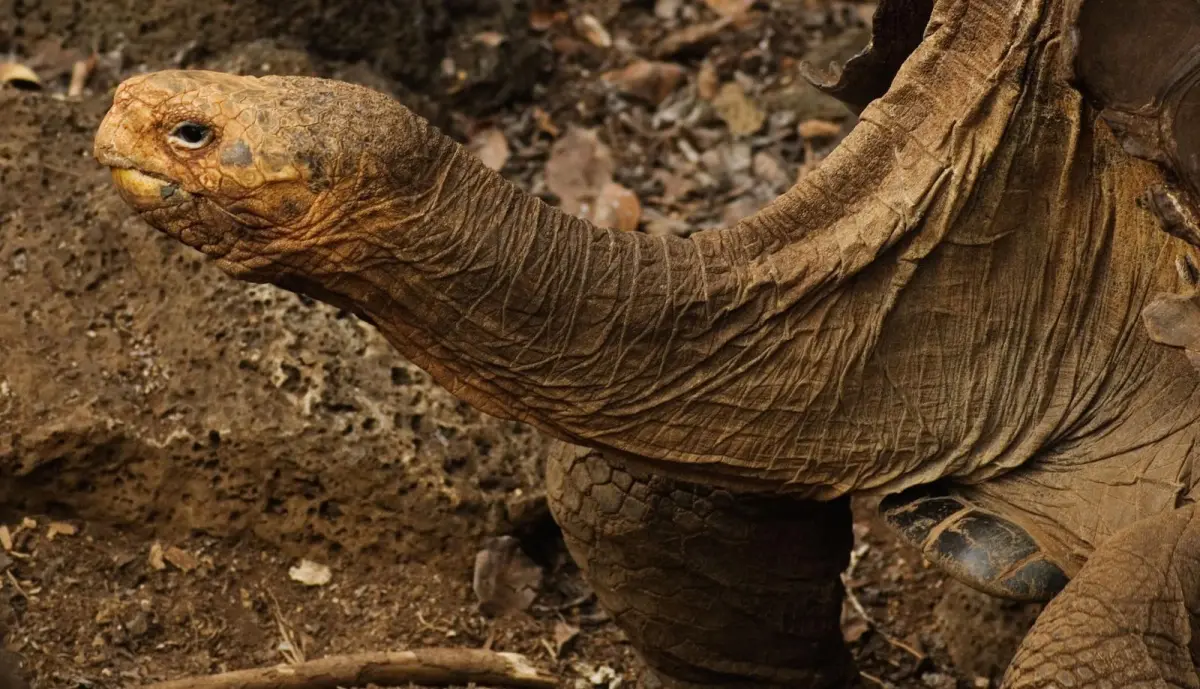
Diego, a male giant tortoise who was taken from Espanola Island in the early 1930s and kept at the San Diego Zoo for nearly four decades, became the father of about 800 tortoise hatchlings after returning to the Galápagos. According to estimates by the Galápagos Conservancy, he is responsible for approximately 40% of all captive-bred tortoises released on Española, reports Futura-Sciences.
Diego joined the breeding program on Santa Cruz Island in 1977 as the third male. Prior to that, rangers had gathered all 15 surviving individuals of the species Chelonoidis hoodensis there. Over the course of 55 years, the program has returned more than 2,000 tortoises to Española and reestablished a wild population capable of sustaining itself.
Despite his reputation as the “savior of the species,” genetic data indicate a collective contribution from all 15 founders. An analysis of 134 tortoises in 2004 showed that the male E5 sired nearly as many offspring as Diego, while a third male, E3, played a much more modest role. The effective population size—that is, the number of individuals who actually pass on their genes to subsequent generations—ranged from only 5.5 to 7.9 between 1994 and 2007.
Unequal Contributions and Lost Diversity
The authors of a 2004 study found that 12 females and three males produced more than 1,200 offspring, but the distribution of paternity turned out to be very uneven. According to the researchers, this led to a further loss of genetic diversity and threatens the long-term survival of the population. Changes to the breeding program could mitigate the problem, they noted in *Proceedings of the Royal Society B*.
The Return of the Founders
The breeding program was officially closed on June 15, 2020. Diego and 14 other founder tortoises underwent quarantine, were fitted with microchips and GPS transmitters, and were then released into the cactus-rich Las Tunas region. There, they joined more than 2,300 of their descendants. Natural reproduction on the island became possible after feral goats were completely eradicated there in 1978: by 2007, tortoises that had hatched on Espanola accounted for nearly 24% of the surveyed population.
Jorge Carrión, director of the Galápagos National Park, assessed the role of this male for the island on the eve of Diego’s return, while he was still in quarantine.
“He has made a significant contribution to the gene pool we are reintroducing to Espanola. It brings us great joy to have the opportunity to return this tortoise to its natural habitat,” Carrión told AFP, according to the BBC.
Diego’s descendants are already changing the island’s landscape: the population, which numbered about 3,000 tortoises in 2024, is restoring native grasses and cacti and clearing open areas needed by short-tailed albatrosses for takeoff. “When the tortoises were gone, the vegetation really closed in,” emphasizes Elizabeth Hunter, a conservation biologist with the U.S. Geological Survey, as reported by BBC Future.