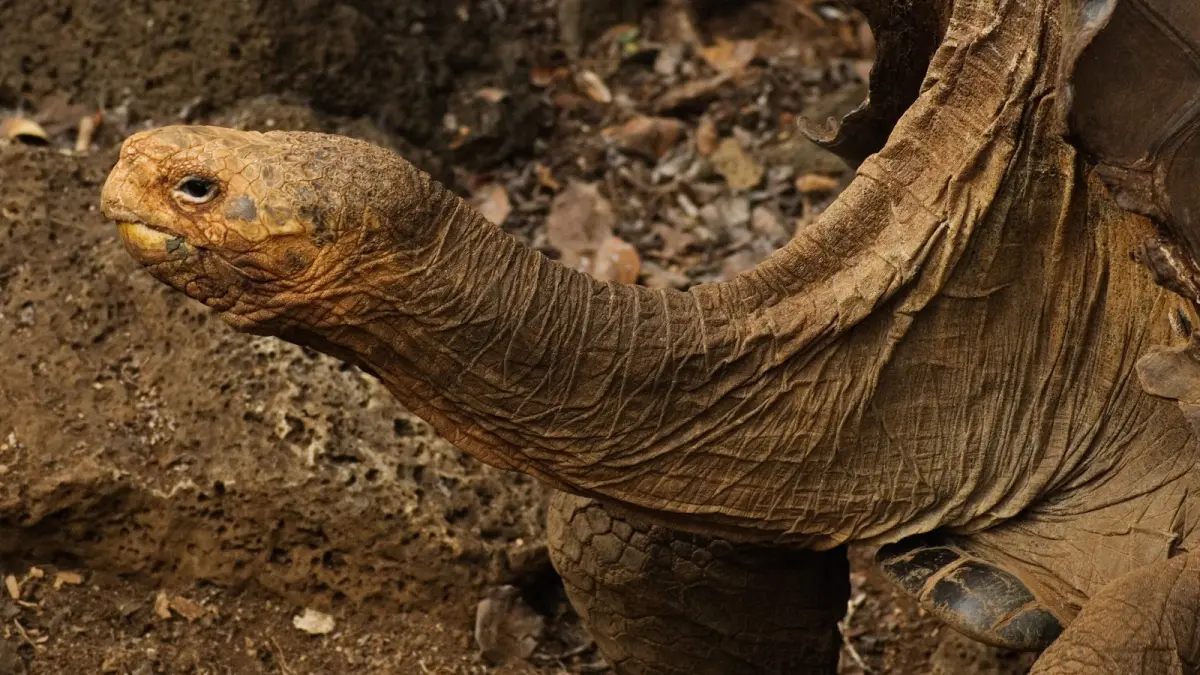
Diego, a giant tortoise who lived for nearly four decades at the San Diego Zoo, became the mother of about 800 tortoises after returning to the Galápagos. However, genetic studies show that the Chelonoidis hoodensis species was revived thanks to the contribution of all 15 founder individuals, not just a single male, according to Futura Sciences.
To prevent the species from going extinct, rangers transported all 15 surviving animals to a breeding facility on Santa Cruz Island. This marked the beginning of a 55-year restoration program, during which more than 2,000 tortoises were returned to Espanola Island, establishing a self-sustaining wild population.
Diego joined the program in 1977 as the third male. According to the San Diego Zoo Wildlife Alliance, he sired approximately 800 offspring at the breeding facility, and the Galápagos Conservancy estimates that he accounts for about 40% of all tortoises released on Española. The media often referred to him as the sole savior of the species, but conservation records point to a broader collective effort.
Genetics: Contributions Are Uneven, but Not Individual
In 2004, Michel Milinkovich and his colleagues published an analysis of the paternity of 134 tortoises studied on Espanola in 1994 in the journal Proceedings of the Royal Society B. They were able to establish paternity for all but two of the animals. Diego, cataloged as male E15, was indeed the father of a significant portion of the offspring, but male E5 sired a comparable proportion of the new generation. The contribution of the third male, E3, turned out to be significantly smaller.
Such estimates are interpreted in different ways. Henry Nicolls, an ambassador for the Galapagos Conservation Trust, writes that, according to the same 2004 study, Diego sired offspring with nine of the 12 females and was the father of nearly 60% of all tortoises born in captivity. Because of his active role in the breeding program, he was even nicknamed “Macho” for a time. Ecologist Linda Kayote called the project “one of the most successful captive breeding programs for the recovery of an endangered species anywhere in the world,” according to the Galapagos Conservation Trust.
A subsequent study, published in 2013 in the journal *Evolutionary Applications*, tracked the effective population size. It stood at 5.5 individuals in 1994, 7.6 in 2003, and 7.9 in 2007. Since the entire species descends from just 15 animals, genetic diversity remains a concern for biologists, even despite the increase in the total population size.
Return to Espanyol
Breeding in captivity made sense only if the natural habitat could be restored. In 1978, feral goats were completely eradicated from Española, allowing the local vegetation and Opuntia cactus thickets to recover. Among the 134 tortoises examined in 1994, not a single one had hatched on the island. In 2003, the proportion of locally hatched tortoises was 2.6 percent, and by 2007, it had risen to nearly 24 percent.
The discrepancy in the data regarding the number of founder individuals is explained by the history of Diego itself. In the early 1960s, staff at the Charles Darwin Station found 14 tortoises on Española: 12 females and two males. Diego, however, had been taken off the island by a scientific expedition as early as 1934 and was likely still young at the time. He returned to the Galápagos in 1977, after a 43-year absence, and spent another 43 years at the breeding center on Santa Cruz.
Between 1975 and 2012, 1,825 tortoises born in captivity were released on Espanola. Signs that the tortoises were successfully breeding in the wild began to appear in the 1990s, and the current population is estimated at over 2,000 individuals.
On June 15, 2020, the Galápagos National Park Directorate and the Galápagos Conservancy officially closed the program. Diego and 14 other founding tortoises underwent quarantine, treatment, and microchipping, after which they were transported deeper into Espanola, to the cactus-rich Las Tunas region. Now, the 15 tortoises equipped with GPS transmitters are monitored by camera traps, and more than 2,300 of their descendants live alongside them in the wild.
Washington Tapia has witnessed most of the archipelago’s conservation successes over the past 35 years. He admitted that he could barely hold back his tears when the founders were released onto the island.
“I considered each of them a conservation hero who saved their species. I believe these turtles knew they were home,” Tapia wrote.
According to Nichols, Diego managed to entertain and educate visitors at a North American zoo, work for over forty years to restore his species, and return to the wild on Española—all before his 100th birthday.