
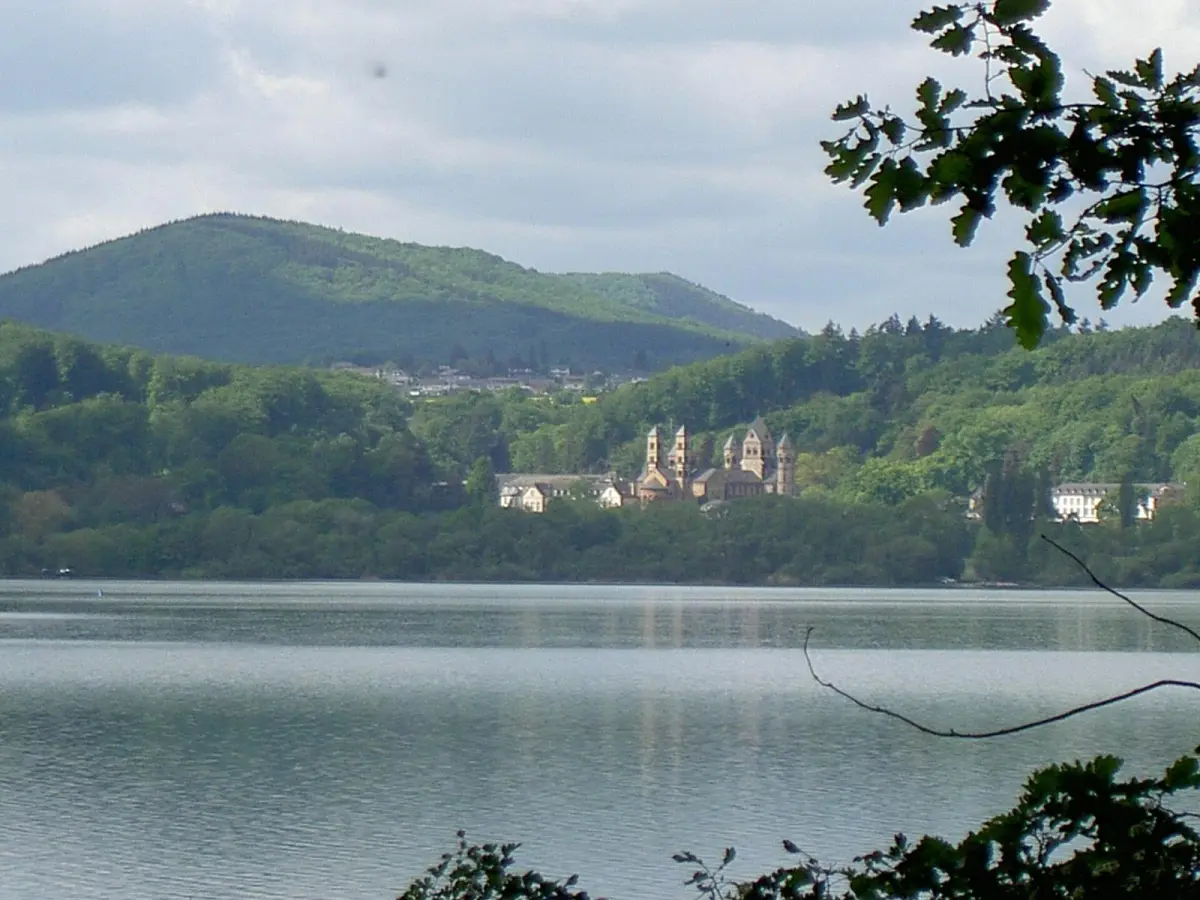
The dormant Laacher See volcano in western Germany may pose a greater threat to Poland than the supervolcanoes in Italy or the United States: in the event of a major eruption, the country would be hit by acid rain, a cold snap, and damage to agriculture, according to TwojaPogoda.pl.
The volcano is located 8 km from the town of Andernach in the state of Rhineland-Palatinate. It last erupted about 13,000 years ago with a Volcanic Explosivity Index (VEI) of 6. At that time, ash and pumice rose nearly 20 km into the air and spread across Europe from Scandinavia to Italy. In the Rhine Valley, the layer of volcanic rock reached 7 meters in thickness, blocking the river and causing massive flooding.
Where the caldera once stood, there is now a lake 2 km in diameter and up to 53 meters deep. Near its southeastern shore, carbon dioxide bubbles rise from the bottom. Every year, several dozen earthquakes are recorded in the region, the strongest of which had a magnitude of 4.0.
The magma chamber lies at a depth of 5–8 km and has a volume of nearly 7 cubic kilometers. According to the portal’s estimates, the densest ash fall would occur in Koblenz, 24 km from the volcano, and in Bonn, 37 km away. It is impossible to predict the exact date of a possible eruption.
Signals from the Depths
The Polish publication cites a study in the *Geophysical Journal International* as evidence of the volcano’s activity. Seismologists recorded eight series of deep, low-frequency microearthquakes in four clusters at a depth of 10–40 km beneath Laacher See. According to the authors, the stress field at these depths may contribute to the vertical movement of magma or magmatic fluids. Such tremors, along with constant gas emissions, indicate an active magmatic system, possibly linked to a melting zone in the upper mantle, as noted in the *Geophysical Journal International*.
“Not today, not tomorrow”
At the same time, some experts assess the threat more cautiously. Seismologist Adrien Ott, scientific director of the European Center for Geodynamics and Seismology in Luxembourg, is participating in the Laacher See research. In 2023, his team deployed about 500 seismic sensors in the region, according to the Luxembourg Times.
“Especially in recent years, it has become increasingly clear that this is an area showing signs of active volcanism. However, this does not mean that the Eifel will erupt as a supervolcano today or tomorrow, to put it bluntly,” Ot emphasizes.
According to him, if an eruption does occur, it will likely be smaller and localized, such as the formation of a new cinder cone or a maars.
“You always hear about these dire scenarios, but it’s quite unlikely that a major eruption will occur there in the next 1,000 years,” the seismologist is convinced.
According to GPS measurements from 2000 to 2019, the Eifel is rising by about 1 mm per year. This is the most noticeable ground uplift in Northwestern Europe. The author of that study, American professor Corne Kremer, also believes that this does not mean an eruption is inevitable.