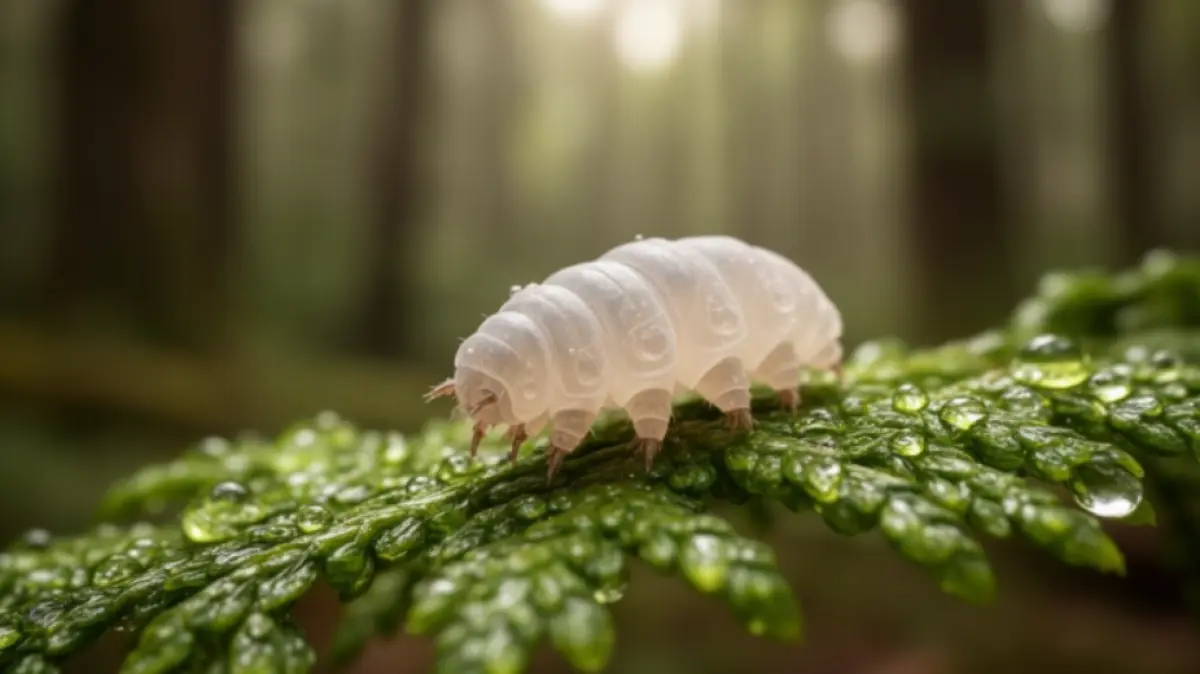
A new species of millipede, *Platicrista angustata*, capable of surviving in extreme conditions, has been discovered in the forests of Germany near the Polish border. The discovery, made by Polish researcher Piotr Gonserek in the Taunus Mountains, has been confirmed by DNA analysis and published in the journal *Evolutionary Systematics*, according to Zielona Interia.
The Phenomenon of Biological Resilience
These microscopic octopods are known for their ability to enter cryptobiosis—a state of “hidden life” during which their metabolism almost completely shuts down. Thanks to this mechanism, these organisms can withstand temperatures ranging from absolute zero to 150 degrees Celsius, as well as radiation, the vacuum of space, and extreme pressure.
Researchers note that tardigrades are capable of surviving even after passing through the digestive systems of other animals, such as snails. Their survival rate when colliding with obstacles at speeds exceeding 2,600 km/h reaches 100 percent, making them a subject of intense study for space programs.
Medical Applications of “Water Bears”
The unique survival mechanisms of tardigrades have become the basis for developing new technologies in modern medicine. Scientists have discovered that during dehydration, these creatures use a special sugar—trehalose—which replaces water and preserves the integrity of cell membranes, according to Science Friday.
“The world of modern medicine has borrowed an idea from the tardigrade handbook. Scientists have identified a number of practical applications for trehalose, including the preservation of vaccines and platelets, which can now be transported around the world and ‘revived’ with a single drop of water,” the researchers note.