
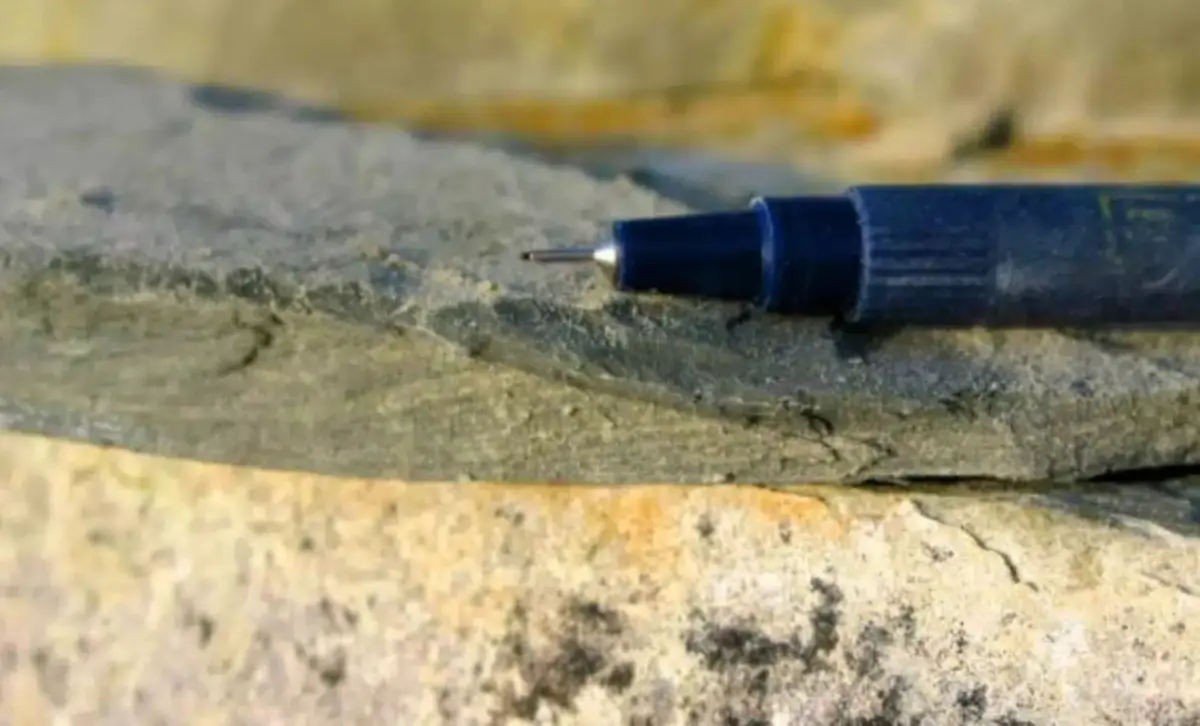
A microscopic fossil of the fungus Tortotubus protuberans, dating back 440 million years, continues to baffle scientists: it remains unclear what it fed on on land, where there were no trees, forests, or plant remains at the time. At the same time, its complex structure suggests that fungi were already helping to transform barren land into soil back then, according to the Daily Galaxy.
The fungus was identified by Martin Smith, a paleontologist at Durham University (United Kingdom). Some of the specimens were found in old quarries on the Swedish island of Gotland in the Baltic Sea. In 2016, the fossil was described as the oldest known fungus and, at the same time, the oldest terrestrial fossil organism known at that time.
Despite its modest appearance, the microscopic filaments of the fungus had a surprisingly orderly, cord-like structure. Smaller branches extended from the main filament, curving backward, attaching to it, and gradually wrapping around it. According to a study published in the *Botanical Journal of the Linnean Society*, this pattern resembles the structures of modern fungi, which transport nutrients within the colony and participate in the decomposition of organic matter.
Decay Without Forests
During the Silurian period, only simple, rootless moss- and lichen-like plants grew on land, so they had almost no effect on what lay beneath the surface. Fungi, on the other hand, spread their hyphae across the ground, decomposed organic matter, stabilized sediments, and promoted weathering, setting in motion processes that transformed loose material into soil.
“In this fossil, we see the complex ‘behavior’ of fungi in one of the earliest terrestrial ecosystems—it contributed to soil formation and initiated the process of decay on land,” Smith notes.
The question of what exactly Tortotubus decomposed remains open. Smith speculates that the source of organic matter could have been bacteria and algae, which were likely already living on land. However, such organisms rarely leave fossils, so it is difficult to determine exactly what existed alongside the fungus.
The Invisible Menu of Ancient Land
A similar mystery was previously investigated by Kevin Boyce, a paleobotanist at the University of Chicago, while studying Prototaxites—a six-meter-long organism that was once thought to be a giant fungus. An analysis of carbon isotopes showed that it likely fed not on vascular plants, but on algae from temporary shallow bodies of water. According to the scientist, the fossil record is dominated by vascular plants because only their cell walls are well-preserved.
“The fossil record of mosses and soil algae is virtually nonexistent. This doesn’t mean they weren’t there, and every paleobotanist understands this,” Boyce notes in an article in The University of Chicago Magazine.
However, the classification of Prototaxites itself as a fungus is currently in question. A study published in the journal *Science Advances* in January 2026 showed that its 407-million-year-old fossils are chemically distinct from fungi of that time and structurally unlike any known fungus. The authors believe that this organism belonged to a completely extinct lineage of eukaryotes, according to the University of Edinburgh.