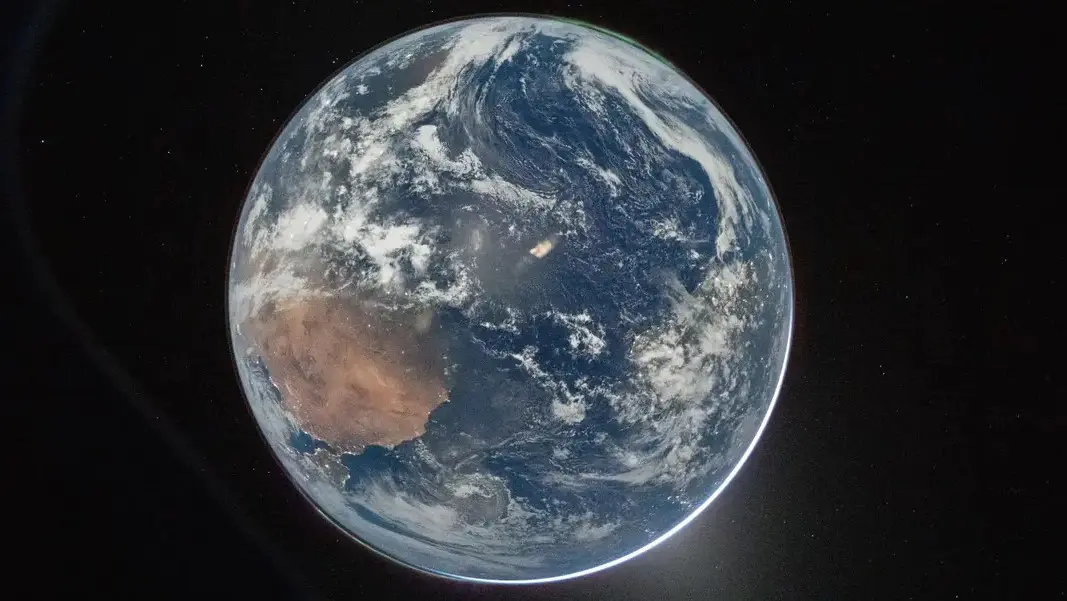
Conditions on Earth will become uninhabitable in about a billion years, specifically in the year 1,000,002,021. This date was determined by supercomputer simulations conducted by a team of scientists from NASA and Japan’s Toho University, according to WP Tech.
The study was conducted by Kazumi Ozaki of Toho University and Chris Reinhard of the Georgia Institute of Technology as part of a NASA project focused on the habitability of planets. They modeled the planet’s climatic, biological, and geological systems. According to their calculations, in the distant future, the composition of the atmosphere will resemble that of the period preceding the Great Oxygenation Event about 2.4 billion years ago, writes New Scientist.
“We found that Earth’s oxygen-rich atmosphere will not be a permanent feature,” Ozaki emphasizes.
The aging Sun will deprive the planet of oxygen
The main cause of these changes will be the Sun’s aging: the star will become hotter and emit more energy. As a result, carbon dioxide levels will drop so low that plants and other photosynthetic organisms will be unable to survive. Their mass extinction will cause a drastic change in the composition of the atmosphere.
“The drop in oxygen levels will be very, very extreme—we’re talking about roughly a million times less oxygen than today,” notes Reinhard.
At the same time, methane concentrations could increase 10,000-fold compared to current levels. Once the process begins, it will escalate rapidly: researchers estimate that the atmosphere could lose all its oxygen in as little as 10,000 years.
“The biosphere cannot adapt to such a dramatic shift in the environment,” warns Ozaki.
In the future, only microbial life will remain on Earth, specifically primitive anaerobic bacteria. Both terrestrial and aquatic organisms will disappear, and the destruction of the ozone layer will expose the planet’s surface and oceans to intense ultraviolet radiation.
A billion years or more
Estimates by other scientists vary. Early one-dimensional climate models predicted that an increase in solar radiation of just 6% would trigger an uncontrollable greenhouse effect and the evaporation of the oceans, and that Earth would become uninhabitable in as little as 650 million years. At the same time, three-dimensional modeling by Eric Wolf of the University of Colorado Boulder showed that liquid water on the planet’s surface could persist for at least another 1.5 billion years. Wolf himself clarifies that, in an astrobiological sense, a planet suitable for life will not necessarily remain suitable for humans, according to NASA Astrobiology.