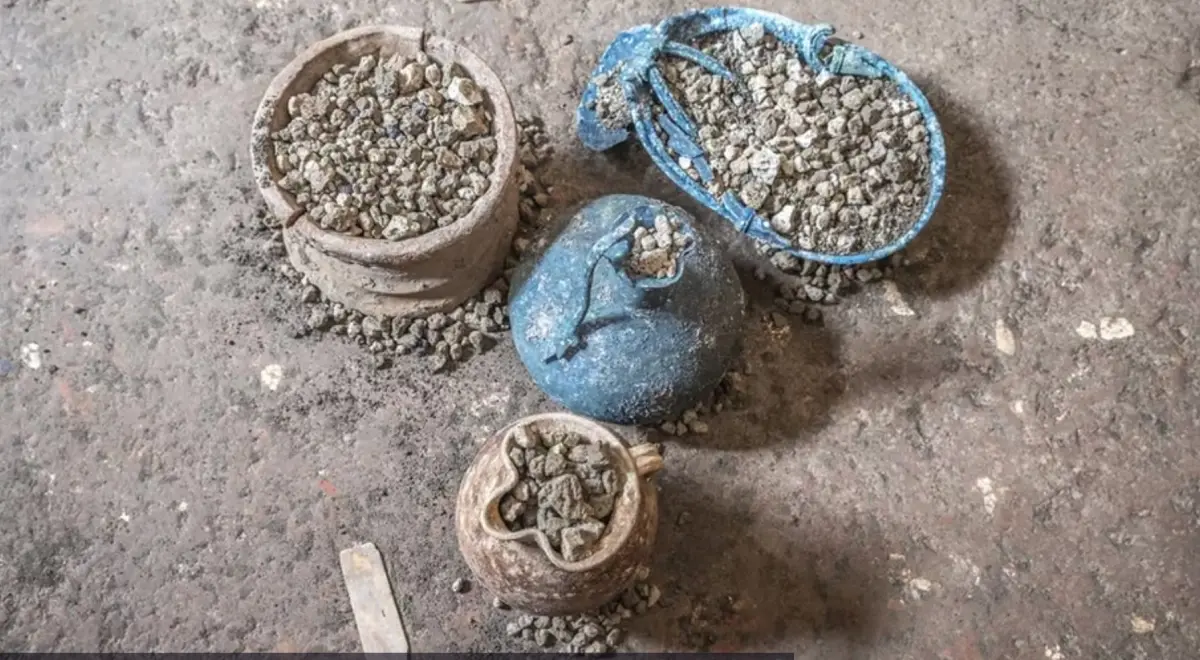
Archaeologists have discovered a cabinet in Pompeii that was buried during the eruption of Vesuvius in 79 CE. Inside were 24 children’s amulets, including some made of rock crystal, 38 coins from the time of Nero, and eight lead weights, according to WP Tech.
The discovery was made in Region IX, in a house on Via dell’Abbondanza known as the House of Cornelius Maximus. The wood itself did not survive, but imprints in the volcanic material made it possible to reconstruct the cabinet’s structure and the arrangement of its shelves. In addition to valuables, it contained tableware, cosmetic items, an oil lamp, and a perfume bottle.
The miniature amulets are made of faience, bone, glass paste, and rock crystal. They all have holes for hanging, so they likely formed a necklace. Among the figurines are depictions of the deities Bes and Mercury, as well as hands, a foot, pinecones, bunches of grapes, and a pendant in the shape of a winged sandal. Archaeologists have classified them as crepundia—that is, objects associated in the Roman world with childhood and the protection of children.
The amulets were found in a small cloth pouch. Scholars speculate that someone kept them as a memento of their childhood: other finds from Pompeii indicate that such items accompanied their owners into adulthood.
Pocket Money and a Merchant’s Cargo
Next to the amulets, 38 bronze coins were found in a basket made of plant fibers. All but the two oldest and most worn coins were minted during Nero’s reign, primarily between 64 and 67, and 21 of the coins date to 65. Researchers believe this was a small supply for daily expenses rather than savings.
In the same cupboard stood a wooden box containing eight lead weights, six of which had iron components. This may indicate that the house was used for trade or some other professional activity.
The Mystery of the Residents
The fate of the residents remains unknown. No one took either the coins or the amulets, so archaeologists speculate that the owners either fled with no chance of returning or perished in a disaster. Scientists are also unable to confirm that all the items belonged to a single person.
The name Cornelius Maximus is linked to the house as its probable owner based on inscriptions found inside. Additionally, according to researchers, the jingling of the protective necklace may have helped adults keep an eye on the child, reports Archaeology.
Gabriel Zuchtriegel, director of the Archaeological Park of Pompeii, acknowledges that it has not yet been possible to determine exactly who lived in the house. “We cannot definitively reconstruct the identity of the person who lived in the house, but these fragments bring us closer to their everyday life,” noted Zuchtriegel.
He also emphasizes the value of such humble finds. “Pompeii is not just a place of great works of art. It is also a place where the most ordinary objects give the past a human dimension,” the park director concluded.