
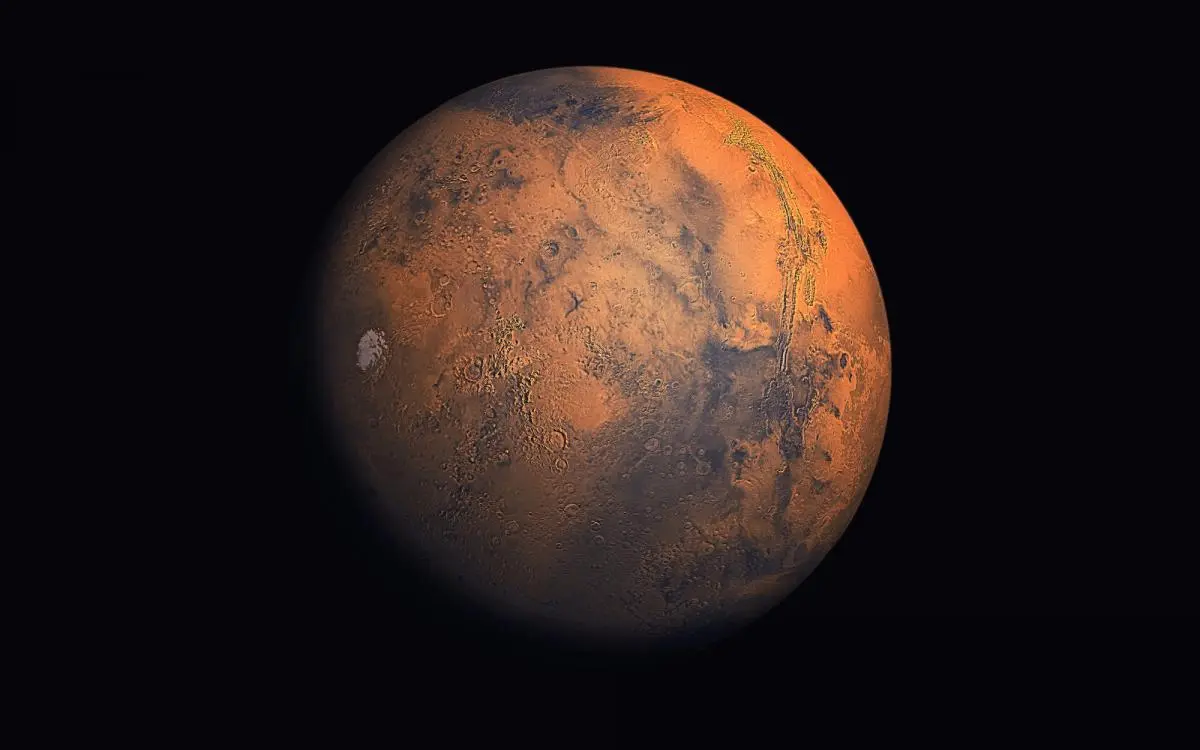
The ExoMars Trace Gas Orbiter (TGO) has detected hydrogen chloride above fissures in the Alba Mons region, the largest volcano on Mars by area. Scientists believe the most likely source of the gas is volcanic emissions from beneath the surface, suggesting that Martian volcanoes may not be extinct but rather dormant, according to RMF24.
The study was published in the journal *Science Advances* and is based on observations from a mission by the European Space Agency (ESA) and Roscosmos. On Earth, hydrogen chloride is a common component of volcanic gases, and its presence in the lower layers of Mars’ atmosphere may indicate the release of gases from magma beneath the surface.
Co-author of the study, Professor Daniel Meze of the Space Research Center of the Polish Academy of Sciences and the University of Bern, is convinced that atmospheric processes are unlikely to explain the finding. “We have determined that the most likely source of hydrogen chloride is volcanic emissions,” the scientist stated.
The gas seeps through cracks
Alba Mons is located in the northern hemisphere of Mars. It is a shield volcano, meaning a broad formation with gentle slopes. According to the researchers, the gas may be escaping through a network of cracks connected to an underground magma chamber: as the magma rises and the pressure drops, chlorine compounds turn into a gaseous state.
The concentration of hydrogen chloride increases every year in early summer on the volcano’s northern slopes. Scientists speculate that during other seasons, the cracks are blocked by ice, and warming allows the gases to escape into the atmosphere.
The amounts of gas involved are extremely small: about two HCl molecules per billion air molecules. Instruments from previous missions were not sensitive enough to detect them. The white spots in the CaSSIS camera images near the cracks may be deposits around the openings from which magmatic gases escape, Meze notes in the ESA blog.
The TGO first detected hydrogen chloride on Mars in 2021. At that time, its appearance was linked to dust storms and salt lifted from the surface, as the gas appeared simultaneously in distant locations and without other volcanic gases.
A Warm Interior and a Chance for Life
The new findings do not prove that the volcano is actively erupting, but they point to possible magmatic processes beneath the planet's surface. Previously, scientists had evidence of relatively recent volcanic activity dating back millions of years, while ongoing geological processes were also indicated by marsquakes recorded by NASA's InSight lander.
Mars could become the fourth rocky body in the Solar System—after Earth, Jupiter's moon Io, and Venus—with ongoing volcanic activity. Warm magma could heat subsurface water reservoirs, creating sheltered environments protected from the harsh surface conditions that would be favorable for microorganisms.
"An active magmatic system, the heat of liquid magma, and a certain amount of water in the crust create the conditions in which a hydrothermal system can emerge. And hydrothermal vents on the ocean floor are considered one of the most likely places where life originated on Earth. Perhaps the same could have happened on Mars," Mezhe emphasized.