
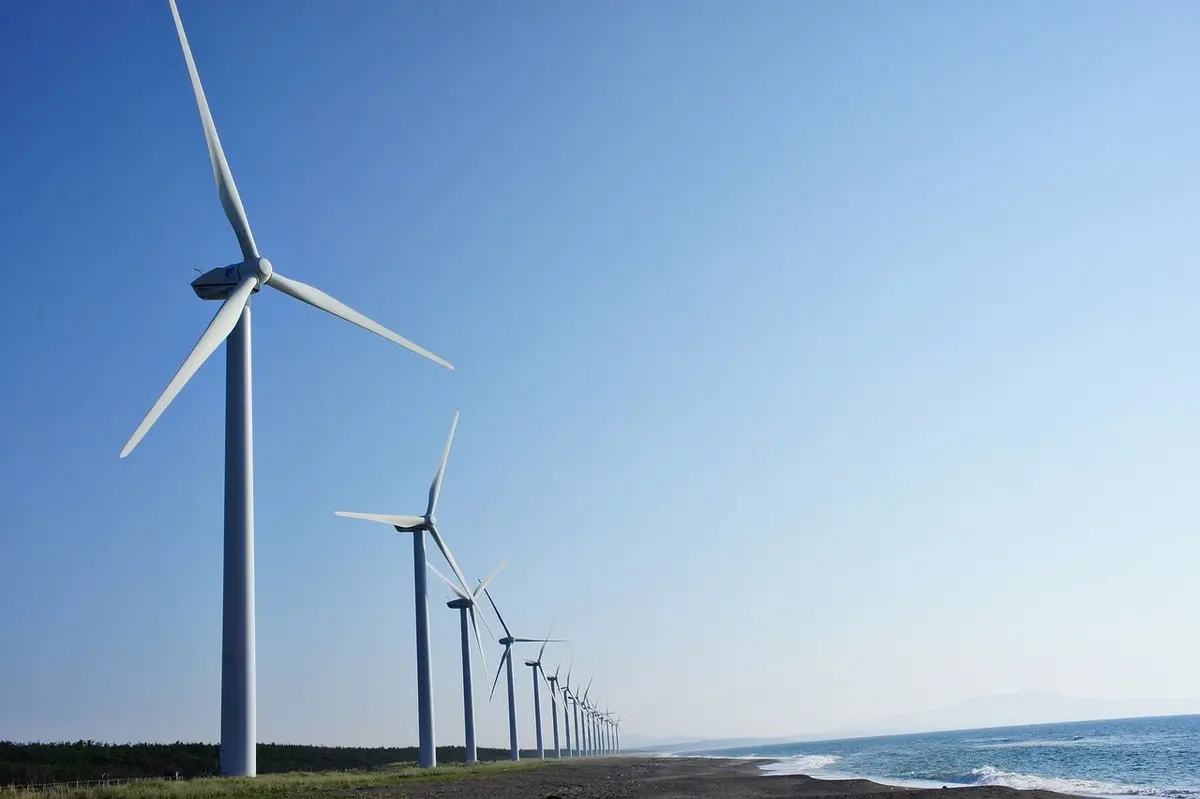
Researchers at Tsinghua University in Beijing have learned how to convert used wind turbine blades into graphene and silicon carbide. All it takes is a half-second electrical pulse, which heats the shredded material to approximately 2,000°C, according to Gry-Online.
The blades have a service life of about 20 years. They are made of fiberglass impregnated primarily with epoxy resin, which forms irreversible bonds with the fiberglass. Therefore, conventional recycling is not possible: dismantled blades are stored in landfills, ground into aggregate for asphalt or cement, or thermally treated, which is expensive.
Chinese scientists are proposing an alternative approach. The blades are ground into powder and mixed with carbon black so that the mixture conducts electricity. It is then placed between electrodes and heated using a pulse. The glass fibers form heat-resistant silicon carbide, while the carbon in the resin forms graphene.
The study was published in the journal Chem Circularity. The method, known as Joule flash heating, converted about 56% of the mixture into a composite consisting of 34% silicon carbide and 66% graphene in a typical experiment. Compared to chemical dissolution and thermal processing, greenhouse gas emissions are reduced by 92% and 83%, respectively, according to Gizmodo.
The resulting powder can be used to manufacture new blades. A 0.3% by-weight additive increases the resin’s resistance to deformation by 27% under tension and by 9% under bending. A 0.1% additive increases its thermal conductivity by 41%, which would make it easier to de-ice the blades in winter. The study’s lead author, environmental engineer Hao Bi, sees economic value in the technology.
“This can be used to transform low-value waste into high-value materials,” said Bi.
From Grams to Tons
According to the researchers’ estimates, on an industrial scale, the process would yield a profit of about $80 per metric ton. Currently, wind farm operators pay for disposal: pyrolysis costs about $460 per metric ton, and chemical dissolution costs about $1,800. However, this calculation takes into account only the process itself and energy costs. It does not include the dismantling, transportation, and cutting of the blades, nor the construction of the plant. The figure is based on market prices for graphene and silicon carbide.
So far, the technology has only been tested on samples weighing 0.3 grams; the largest batch weighed 10 grams. A single turbine produces tens of metric tons of waste, and it is difficult to heat such volumes uniformly to 2,000°C. The team has already built a 200-gram reactor, which still requires refinement, and plans to construct a facility with a capacity of 100 metric tons per year. Blades made from the new material also need to be tested under real-world conditions, ideally over their entire 20-year service life.
“I would describe this work as a promising proof of concept with initial scaling results, but it’s hard to predict when it will be ready for use in an actual wind farm,” Bi cautions.
The scale of the problem is significant: in the U.S. alone, about 8,000 turbines are decommissioned each year. Reusing the blades—for example, as frames for benches or bridges—accounts for only a fraction of this volume, notes Bloomberg.