
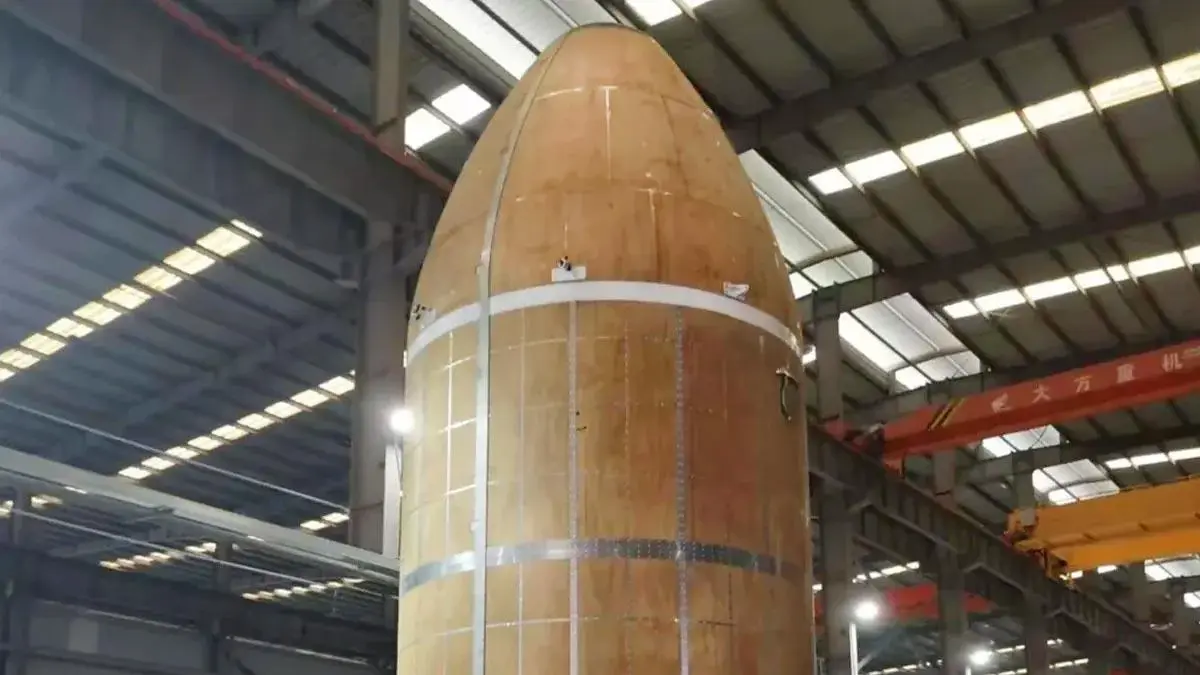
The Chinese startup Light Year Explorer has created a rocket nose cone with a wooden shell. According to the developers’ estimates, it will cost up to 10 times less than traditional designs made of special metal alloys. The company expects to significantly reduce production and launch costs and time, reports PiataAuto.md.
The fairing protects the payload at the top of the rocket. In space, it splits into two halves and releases the satellites, after which these parts usually remain in orbit as space debris. Due to increasingly frequent launches, the production of metal fairings has become a limiting factor in the number of launches. The reason lies not only in the cost but also in the complex technology involved in working with special alloys.
The new design is made of plywood with an adhesive composition and is reinforced on the inside by a thinner metal frame. The first prototypes have a diameter of 4.2 meters, which corresponds to standard Chinese rockets. The developers claim that wood provides comparable strength while also better transmitting radio waves, retaining heat, and dampening noise.
A Few Minutes to Prove Its Strength
The wooden structure must withstand the load, as the journey to orbit lasts only 3–4 minutes until the fairing separates. It is not designed to re-enter the atmosphere, where extreme temperatures would be encountered.
The company was founded in 2022, but it already has experience in developing lower-cost rocket components, including oxygen tanks for the Tianlong-3.
What Else the Wooden Fairing Must Prove
Light Year Explorer engineers emphasize that thorough testing is required before commercial launches. Not only must the wood be tested, but also the adhesive, as well as the wood-to-metal joints, which could be compromised due to differences in the thermal expansion of the materials. However, simulations and laboratory tests so far confirm the idea’s potential.
The company is based in Taicang, Jiangsu Province. The fairing’s outer skin is formed from low-density plywood in the shape of a von Kármán curve. According to the manufacturer, the product is on par with composite counterparts in terms of rigidity, radio transparency, noise absorption, and weight. It is suitable for group launches of multiple satellites and for large payloads. However, there has not yet been an independent verification of the claimed cost savings and performance characteristics; the date of the first launch has not been announced; and customers will receive the fairings only after additional testing, according to SatNet News.