
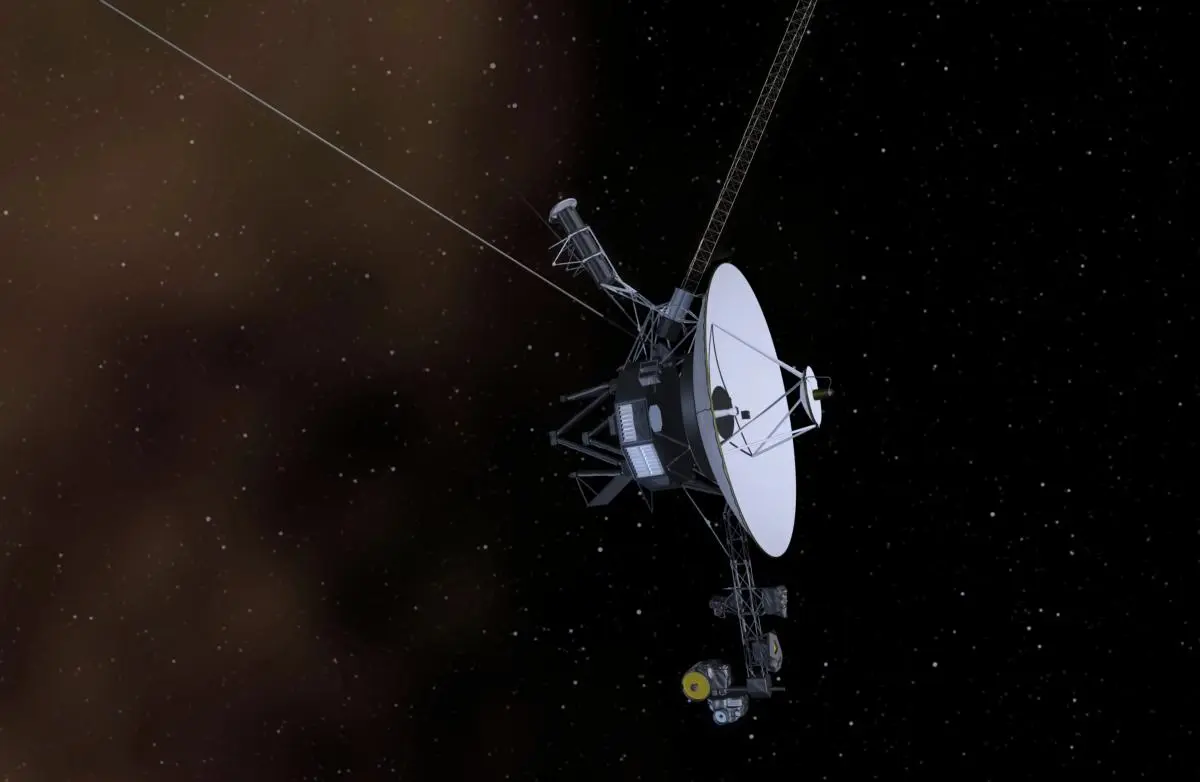
NASA's Voyager 1 space probe, launched in 1977, will be one light-day away from Earth on November 18. From now on, even the simplest round-trip signal exchange with the spacecraft will take 48 hours, according to Adevărul.
A light-day is the distance light travels in 24 hours: approximately 25.9 billion kilometers. Radio waves travel at the same speed, so it will take a full day for a signal from Earth to reach the probe, and the same amount of time for the return signal. Voyager 1 itself is traveling at a speed of about 61,155 km/h.
For the mission engineers, this distance turns every spacecraft control session into a test of patience.
“If you want to say ‘hello’ to Voyager, you send it a message, then go home and wait two days until you finally get a reply,” says Suzanne Dodd, Voyager project manager at NASA’s Jet Propulsion Laboratory (JPL).
Communication Outage and Operation “Big Bang”
The milestone comes shortly after an unexpected incident: On October 18 and 19, NASA temporarily lost contact with Voyager 1. Communication was restored on October 20, and it turned out that one set of attitude control thrusters had shut down, and the probe had automatically switched to the backup system. The exact cause of the incident is still being investigated.
“This is the first time we’ve seen a probe behave this way, but we’ve reached the stage of the mission where we have to be prepared for the unexpected,” emphasizes Karim Badruddin, Voyager mission manager at JPL.
In early September, the team replaced three devices on board Voyager 1—which maintain the proper temperature inside the probe—with more energy-efficient counterparts. The operation, codenamed “Big Bang,” was planned for several months and carried out about six weeks after a similar procedure on Voyager 2. It is expected to extend the operational life of the scientific instruments that are still active.
Both probes are powered by generators that convert the heat from plutonium decay into electricity. Each year, they lose about four watts of power, so NASA is gradually shutting down equipment that is not essential.
The Farthest Man-Made Object
As of February 17, 1998, Voyager 1 remains the most distant man-made object. On August 25, 2012, it became the first spacecraft to cross the heliopause—the outer boundary of the Sun’s magnetic field and solar wind—and enter interstellar space, according to Britannica.
Initially, the Voyager mission was planned to last only four years—enough time for flybys of Jupiter and Saturn. Project science lead Linda Spilker admits that she herself didn’t believe the probes would last this long, since she’d been hearing for decades that they had only a few years left. “And yet they just kept working. Any problems that arose were solved by a very resourceful team of engineers,” she told IFLScience.