
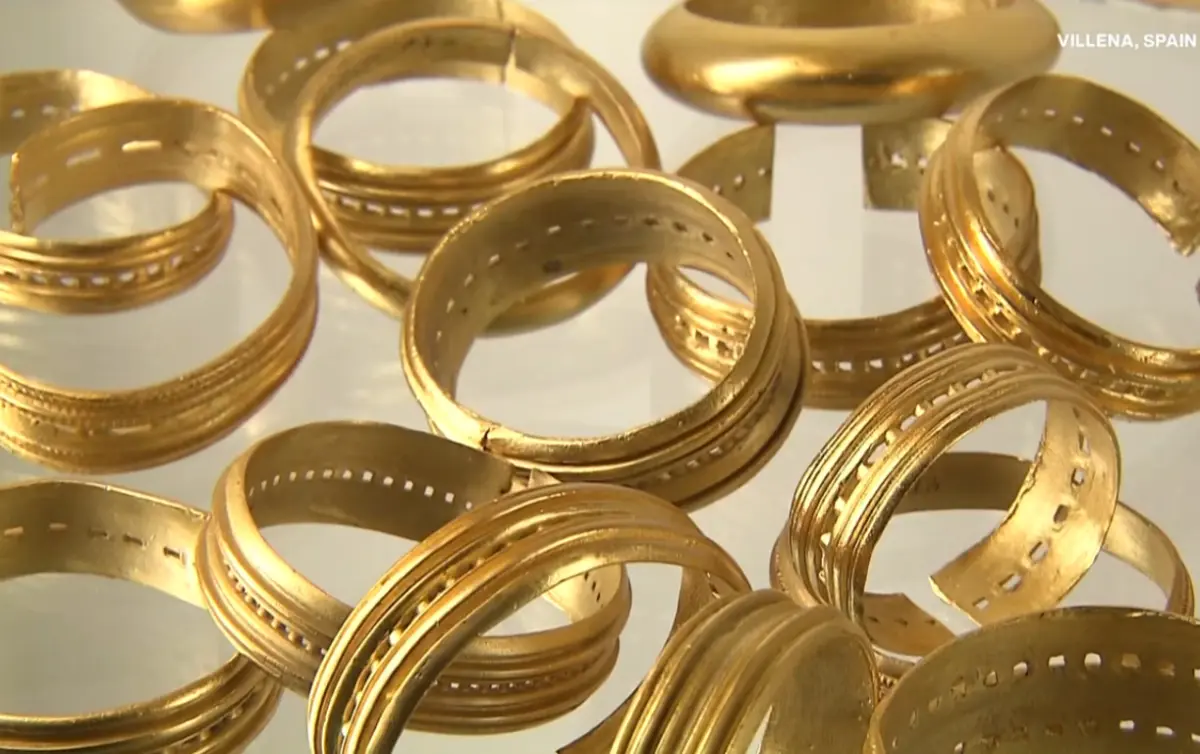
Two objects from the Villena hoard—one of Europe’s most significant prehistoric gold hoards, discovered in Spain in 1963—are made of meteoritic iron. These are a massive bracelet and a hollow hemisphere that was once wrapped in thin gold foil and likely crowned the hilt of a sword or a ceremonial scepter, according to Futura.
The study was organized by former museum conservator Salvador Rovira-Lawrence in collaboration with Ignacio Montero Ruiz and Martina Renzi. The scientists took microscopic samples from both artifacts for mass spectrometry and identified an alloy of iron and nickel. Meteorites contain significantly more nickel than terrestrial ore, which indicates the metal’s extraterrestrial origin.
The authors consider the results to be preliminary: over millennia, severe corrosion has altered the chemical composition of the surface. They plan to verify their findings using non-invasive methods, specifically portable X-ray scanning. If the data is confirmed, these objects will become the oldest known meteorite-iron artifacts on the Iberian Peninsula.
From the very moment the hoard was discovered, both iron objects have sparked debate regarding their dating. New analyses point to meteorite iron, suggesting that these objects may have been made during the late Bronze Age, even before the production of iron from terrestrial ore began, according to an article in the journal *Trabajos de Prehistoria*.
A Metal as Valuable as Gold
The hoard was discovered by archaeologist José María Soler on December 1, 1963, in a ceramic vessel hidden in the Rambla del Panadero area. The collection contains nearly 10 kg of high-purity gold and over 600 g of silver: bowls, bracelets, bottles, as well as an iron bracelet and a finial made of iron and gold, according to the Archaeological Museum of Villena.
The iron objects date back to 1400–1200 BCE. At that time, people in Western Europe had not yet learned to smelt iron from ore, so metal that fell from the sky was valued on par with gold and silver. Similar artifacts are known from the Eastern Mediterranean, notably Tutankhamun’s dagger. Researchers speculate that these items reached Spain via trade routes.
The thieves left the iron behind
On August 27, robbers made off with most of the treasures from the Villena Museum. The heist reportedly lasted just four minutes, even though the collection was housed in a highly secure facility that opened in 2024. The thieves left both iron objects behind, according to National Geographic.
Archaeologists and officials fear that the stolen gold artifacts will be melted down. The value of the metal is estimated at approximately $2 million.
“If the motivation is limited to the value of the gold, the possibility of irreversible destruction becomes evident. I am terribly sad and terribly angry,” emphasizes Montero Ruiz.
“Gold has a market price. The Villena Treasure does not,” asserts Gabriel García Atencer, an archaeologist at the University of Alicante.