
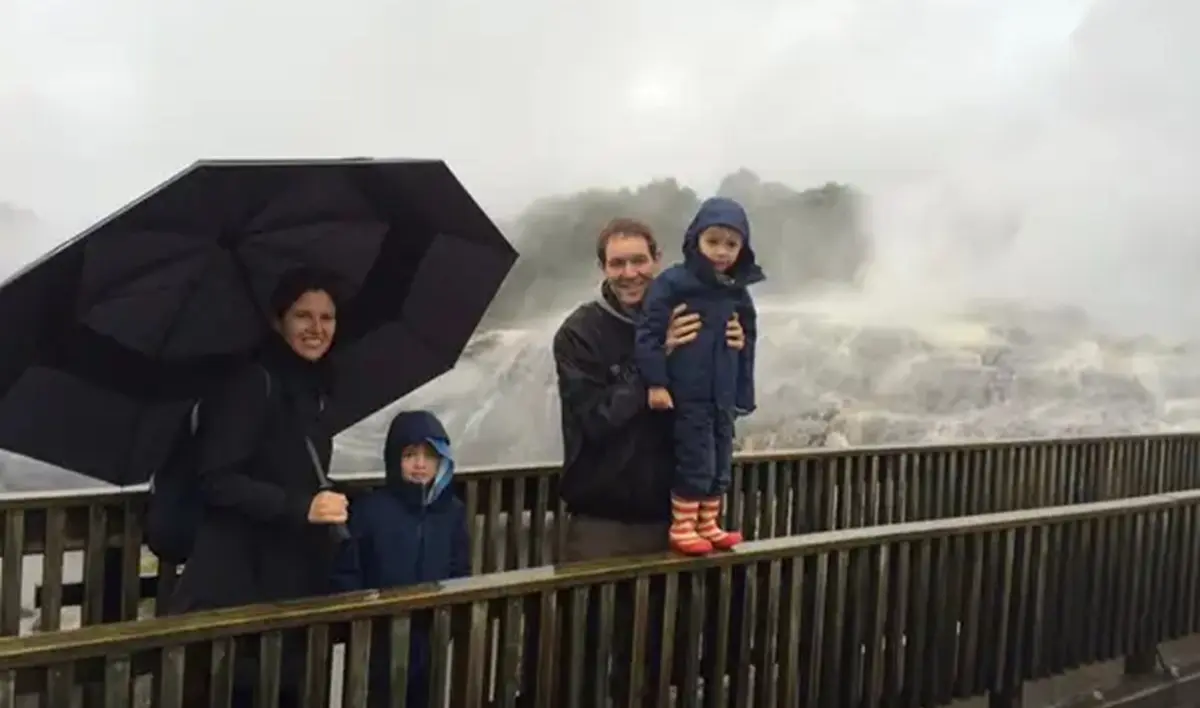
Traveling with infants and toddlers is worthwhile, even if the children won’t remember it: this helps them grow up to be confident travelers who aren’t afraid of change. That’s the conclusion reached by travel journalist Christina Valhuli, who didn’t stop traveling after the birth of her two sons, according to Business Insider.
Friends constantly asked her why she would take the children on trips they wouldn’t remember, and whether it wouldn’t be better to wait until they were old enough to appreciate it all. Instead of family-friendly resorts, the couple chose destinations that interested them personally: museums, unfamiliar cuisines, and long flights. Over the course of a decade, the family visited Edinburgh, Antigua, Amsterdam, the French Alps, Ireland, and New Zealand.
Their eldest son took his first transatlantic flight at four months old and cried almost the entire way. Valhuli makes no secret of the fact that lugging around car seats, strollers, and diapers is exhausting, and that the kids’ tantrums happened at the most inconvenient moments. Still, in her opinion, unpleasant surprises happen at any age.
The boys had little interest in Scottish castles, but their travels taught them other lessons: sometimes in the form of simple questions, such as why milk tastes different in France or why eggs aren’t kept in the refrigerator in Scotland. The children also learned to make friends at playgrounds abroad, even without a common language with the other children.
“I believe all this experience has built up over time. Traveling showed them different ways of life that simply seemed normal at the time. Today, they’re natural travelers who have even flown on their own,” notes Valkhuli.
Her sons are now 14 and 18 years old. The journalist is convinced that if the family had waited for the “perfect” age, they would have missed out on years of shared discoveries, including her older son’s first steps on a Caribbean beach. Paradoxically, traveling with teenagers isn’t any easier. You can wheel a four-year-old through a museum in a stroller, but teenagers might simply refuse to go, as happened at the Picasso Museum in Barcelona.
What Actually Sticks in the Memory
Scientists also question the notion that young children will inevitably forget everything. Carol Peterson, a researcher on children’s memory at Memorial University of Newfoundland, emphasizes that forgetting only slows down after age seven, but children retain vivid memories from a much earlier age, according to The Globe and Mail.
“Two-year-olds often remember fragments, three-year-olds have many memories, and four- and five-year-olds definitely do,” says Peterson.
According to her, travel provides unusual, vivid experiences outside of daily routines, and it is these that last the longest. “Children don’t usually remember everyday events, such as playing in the park, because how can they tell one day from another?” the researcher notes.
Julie Friedman Smith, a parenting expert from Calgary, considers continuous interaction with parents to be the greatest benefit of family trips for young children.
“Children spell the word ‘love’ with the letters ‘ch,’ ‘a,’ and ‘s.’ So spending time together as a family is the most important thing for the development of children aged zero to seven,” Friedman Smith is convinced.