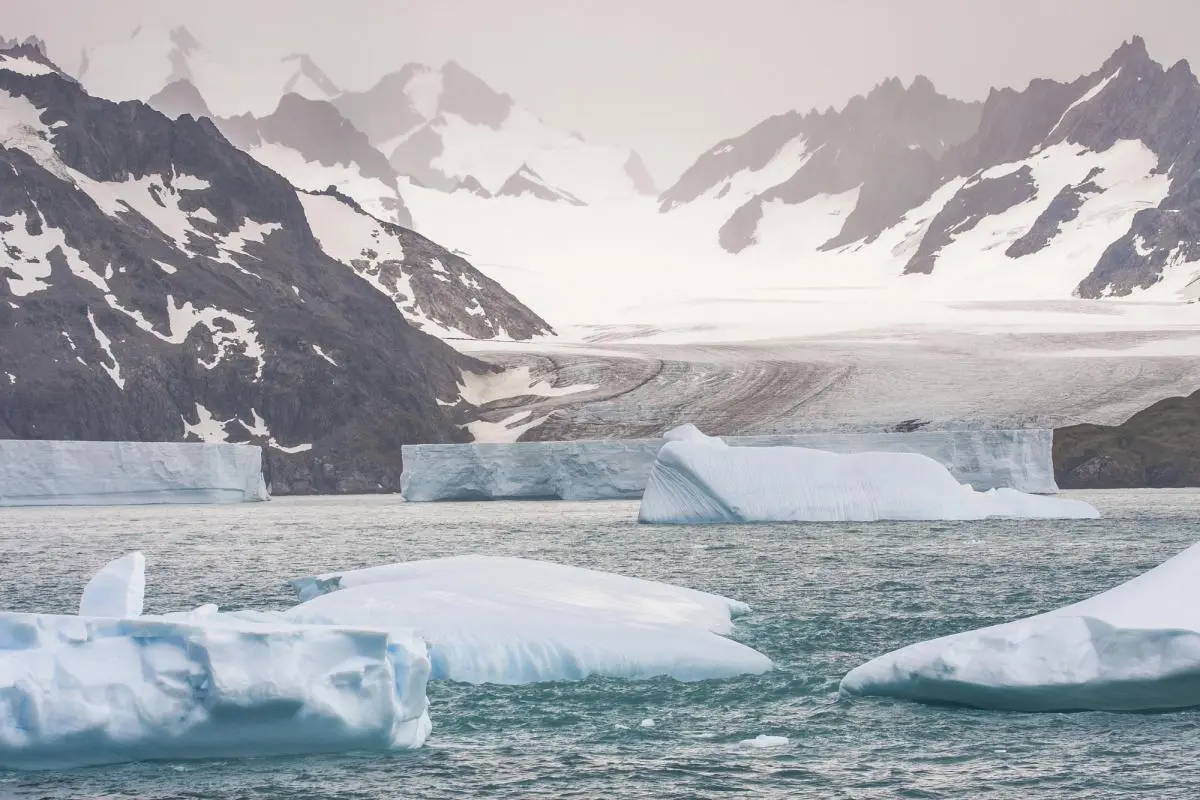
Hidden beneath Antarctica’s ice sheet lie the remnants of an ancient mountain range that may have been as high as the Himalayas. These mountains formed hundreds of millions of years ago during the emergence of the supercontinent Gondwana and may have altered the chemistry of the oceans and atmosphere, creating conditions for the rapid diversification of animal life, according to Spotmedia.
Scientists Yang Campbell and Bei Chen have determined that intense mountain-building in Antarctica lasted from 650 to 450 million years ago. According to their estimates, on the eve of the Cambrian Explosion, about 46% of all zircon crystals on Earth were formed in Antarctica. Among the crystals formed under high pressure in the bedrock of very high mountains, this proportion reached 55%.
What the mineral grains revealed
The study was conducted by an international team of scientists from the Australian National University (ANU) and the German Research Center for Geosciences (GFZ). Since more than 99.5% of Antarctica is covered by thick ice, the researchers analyzed 1,712 zircon grains from sediments recovered during oceanic drilling along the continental margin. The age and chemical composition of these grains showed that the mountains formed as a result of Antarctica’s collision with India and Africa, according to ANU.
The key question was whether these geological processes coincided in time with the early evolution of animals. According to study co-author Professor Emeritus Ian Campbell, such a coincidence does exist.
“These are undoubtedly the most extensive mountain-building processes ever to have affected Antarctica. Their significance lies in the fact that they correlate with the appearance of the first shelled animals 539 million years ago and the Cambrian Explosion, which, approximately 10–30 million years later, brought about a sharp increase in the abundance and diversity of animal life,” Campbell emphasizes.
According to the authors, the rapid erosion of the mountains supplied phosphates and other nutrients to the oceans, while large amounts of organic carbon were buried in river deltas. This reduced carbon dioxide levels and contributed to a sustained increase in oxygen in the atmosphere and water. Since the Antarctic mountains emerged during the late stage of Gondwana’s formation, they prolonged the period of abundant nutrient supply.
“It is hardly a coincidence that the period of Earth’s rapid evolution coincides with the most significant period of mountain-building on the planet: the formation and erosion of the supermountains of Gondwana,” Campbell believes. The study was published in the journal Earth and Planetary Science Letters.
However, not all scientists agree with the authors’ conclusions: some researchers are skeptical of the idea that nutrients from these mountains triggered the explosion of complex life, according to Live Science.