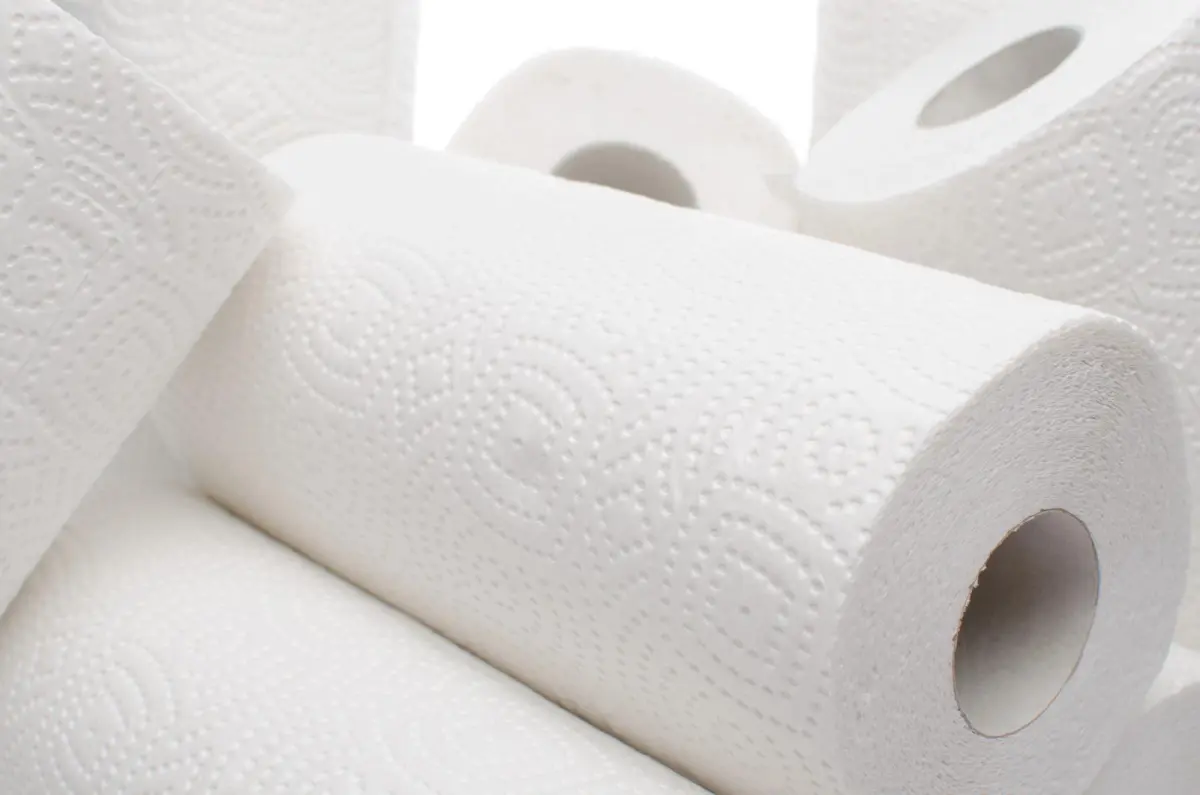
The embossed dots and flowers on paper towels serve a practical purpose: they help absorb liquid, make the paper softer, and bind the layers together. This effect is achieved through an embossing process, in which the paper is passed between special rollers to create tiny indentations and raised areas, according to Observator.
Embossing changes the volume and porosity of the sheet. Liquid is trapped in the cavities, and the towel itself feels thicker and more flexible. At the same time, excessive pressure applied to create a distinct pattern weakens the fibers, and wet paper tears more easily, so manufacturers strive to strike a balance between absorbency, softness, and strength.
Another, lesser-known function: the embossed dots hold two or more layers together, which would otherwise separate during use, especially when wet. Kitchen towels are designed to handle moisture, whereas toilet paper must break down quickly in water to prevent clogging the drain.
From One Layer to Two
The first paper towels appeared around 1910: they were first sold by the Scott brothers’ company in Philadelphia. Patterns didn’t appear on them right away, according to Jerry Ballas, holder of several patents in the field of nonwoven paper materials and a member of the board of directors at Sellars Absorbent Materials, as reported by Yahoo.
“Paper towels began to be embossed in the early 1920s as an innovation to improve quality. Embossing increased their ability to absorb liquid and made the product thicker and softer,” Ballas notes.
According to him, towels at that time were single-ply, and the embossed pattern was very dense and not particularly aesthetically pleasing. In the early 1950s, two-ply towels appeared, for which the embossing also served as a way to bond the layers together. Today, manufacturers select a pattern after laboratory testing and use it to distinguish their brand.
Is there a “best” pattern?
There is no clear-cut answer. Portuguese researchers compared lines and dots with straight and rounded edges. The geometry of the elements did not affect the rate at which liquid droplets were absorbed. At the same time, rounded elements provided the greatest softness in a two-layer sample, while fine dot-like micro-patterns increased the paper’s volume more significantly, according to a study published in the journal *Polymers* on PMC.
Ballas himself is convinced that a towel’s quality is determined by its wet strength, absorbency, and lint-free softness. However, these properties can only be verified in practice.