
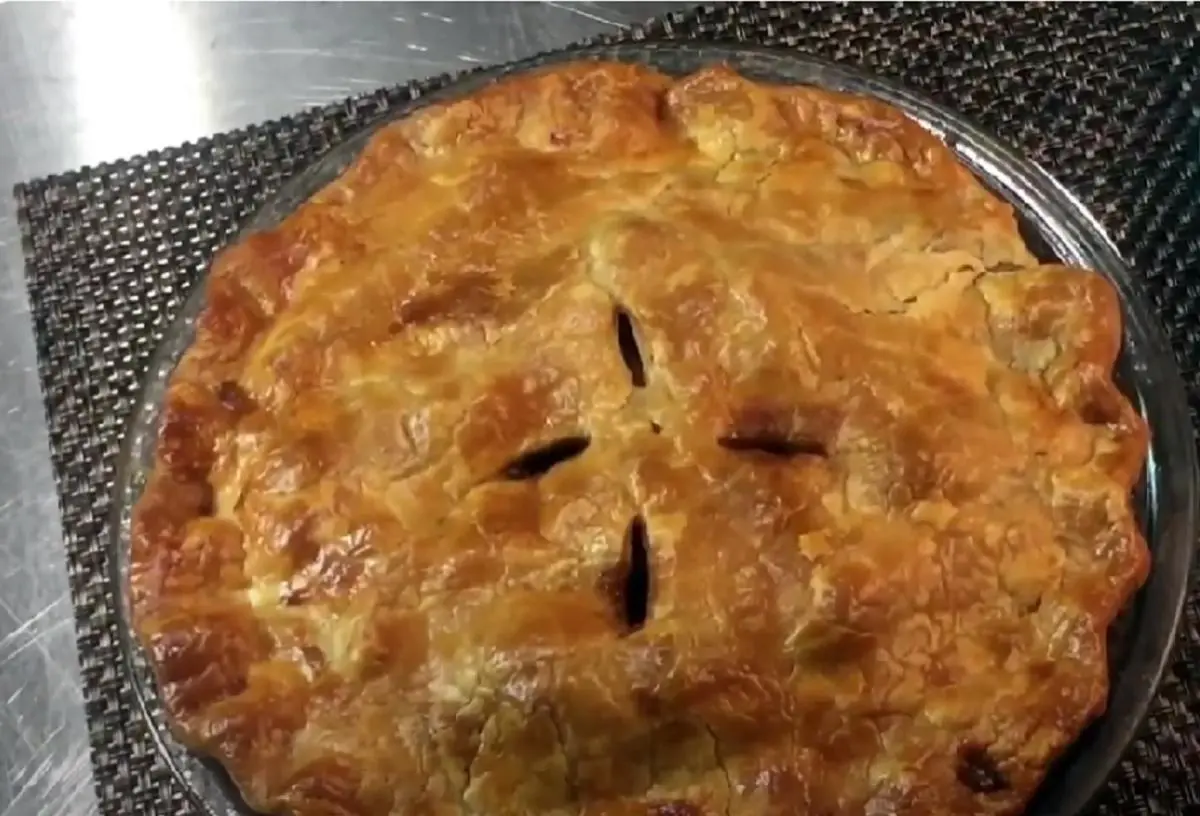
Most pies should be baked on the bottom rack of the oven: this way, the crust has time to bake through, and the top doesn’t brown too early. This advice comes from Maggie Davis, pastry chef at Little Bird restaurant in Fairhope, Alabama, according to Southern Living.
Davis emphasizes that this principle applies regardless of the type of oven, so your choice doesn’t depend on whether it has a fan.
“I’ve noticed that in both convection and conventional ovens, the heat from the bottom helps the bottom crust bake through completely and prevents the top from browning too much,” says Davis.
A particularly low rack position is ideal for custard pies, such as pumpkin pie, chess pie, or buttermilk pie: they require slow baking at a moderate temperature. For two-layer pies, you can move the pan higher toward the end of baking to get a browner crust. Halfway through baking, rotate the pan 180 degrees, as ovens often have hotter and cooler spots.
Another habit of the pastry chef is to always place a metal baking sheet under the pie. However, for thick ceramic pans, she advises skipping this step.
“This not only helps prevent leaks but also makes it easier to move the cake in and out of the oven. A baking sheet is much easier to handle than a cake pan,” notes Davis.
Why the Material of the Pan Matters
Bakers at King Arthur Baking explain that aluminum or aluminum-steel pans conduct heat the fastest: in their tests, an apple pie baked in such a pan had a golden-brown bottom on any rack. In contrast, in glass and ceramic pans on the middle rack, the crust remained pale and moist. Therefore, they recommend placing such a pan as close to the bottom of the oven as possible. You shouldn’t place it directly on a hot baking stone: a sudden temperature change could cause it to crack. For custard pies, whose filling cannot withstand prolonged heat, King Arthur Baking recommends pre-baking the crust as the best solution.
High temperatures change the rules
An experiment by Serious Eats showed that at moderate temperatures (around 160–175°C), the rack position has almost no effect on the result. However, at 500°F (approximately 260°C), the difference became significant. The empty crust on the top rack had burnt edges and an evenly golden bottom, but the inside remained raw and fell apart within a few minutes. On the lower rack, the cake was mostly baked through, but the bottom browned unevenly, with dark spots. The author of the test recommends lowering the temperature and increasing the baking time in such cases, and if the bottom starts to burn before the dish is ready, moving the pan higher, according to Serious Eats.