
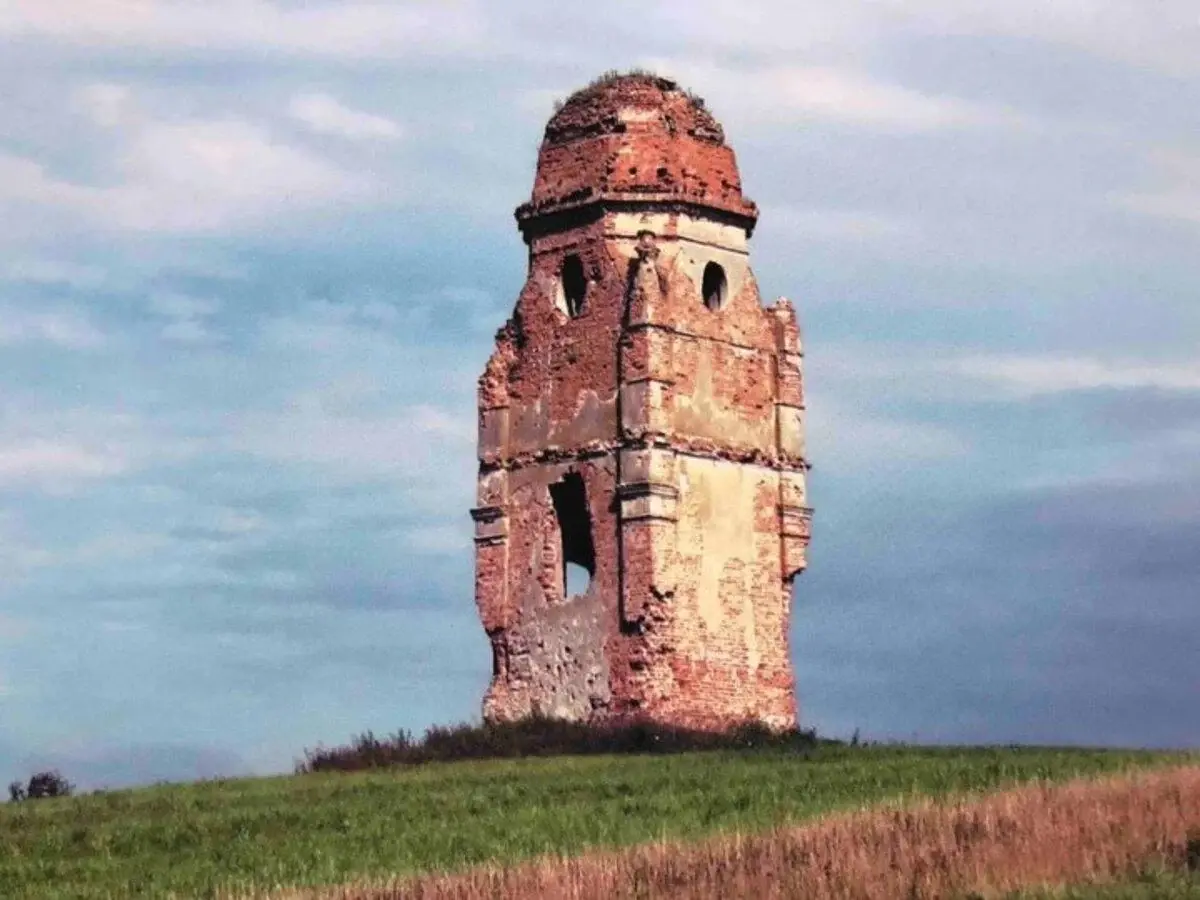
A restoration plan has been developed for the Arian tower-chapel in the village of Tykhomel, Yampil Community, in the Khmelnytskyi region, which survived an attempted bombing during the Soviet era. There are plans to build a tourism and recreation complex next to this national landmark. This was reported by researcher Vitalii Oluiko, a native of the community, according to “Suspilne Khmelnytskyi.”
The structure dates back to the late 16th to the first half of the 17th century. It was built when the Arian (Socinian) movement was spreading in Volhynia, which was then part of the Polish-Lithuanian Commonwealth. The community in Tykhomel was founded by a local landowner from the Seniut family. The tower may have served as a place of worship and, according to legend, as a family mausoleum. There were frescoes inside, and there is an underground section beneath the structure. According to Oluik, this is one of three towers of Arian culture that have survived in Europe, and the best-preserved of them.
How the Tower Survived
In 1985, when Oluiko was working as the chief engineer of a collective farm in Yampil, sappers arrived in Tykhomel to demolish the monument.
“They planted explosives in it. They wanted to blow up the area around it as well, but they didn’t have enough TNT,” the researcher recalls.
The explosion damaged part of the foundation; windows shattered in the neighboring village, and cracks appeared in the houses. The sappers left, promising to return, but they never showed up. Without protection from the elements, the structure’s condition continued to deteriorate.
From the Roof to the Transparent Floor
A phased restoration project was developed in collaboration with architect Serhii Kozak. Initial work was carried out in 2020 using funds from the regional budget: the structure was covered with a protective roof and fenced off.
“We covered it just before the war because the damage was already so severe that the roof could have collapsed or fallen apart. And so we completed the first phase of restoration work, which was focused on preserving the structure,” Oluyko emphasizes.
Next steps include restoring the structure, installing windows and a transparent floor through which visitors will be able to see the underground section, as well as landscaping the surrounding area. Oluiko developed the concept for a tourist complex near the chapel and the castle ruins in collaboration with artist and designer Leonid Kovalenko. They plan to hold local history festivals and fairs there. However, everything depends on funding: the search for European partners to provide grant support has been suspended due to the full-scale war.
Specifically, the concept calls for the full-scale reconstruction of a wooden, fortified Old Russian settlement, an amphitheater for festivals, and an observation deck overlooking the Horyna floodplain. The city of Shepetivka’s website also notes that plans call for building a hotel and tourist complex with 250–300 beds at a safe distance from the historic center.
Near the tower lies the settlement of the chronicle-mentioned city of Tykhomel from the 9th–13th centuries, which has the status of an archaeological monument of national significance. Previously, the prosecutor’s office proved in court that during an inventory, a plot of land covering more than 5 hectares was illegally classified as agricultural land and transferred to the community in 2019. The Khmelnytskyi Regional Commercial Court has returned it to state ownership, according to ZAXID.NET.