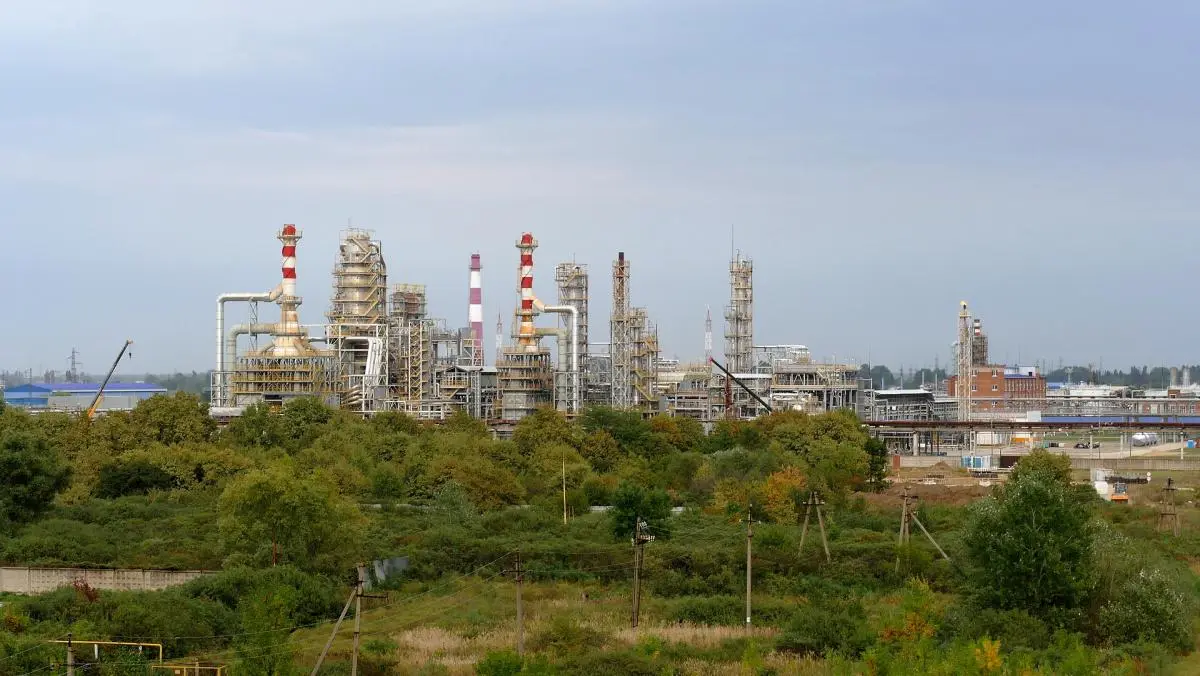
Strikes by the Ukrainian Defense Forces on Russian oil refineries are forcing Moscow to spend money on purchasing fuel abroad to avoid shortages in the domestic market. These attacks are also complicating logistics for the occupying army, military analyst Denis Popovich said on a FREEДОМ TV broadcast, according to FREEДОМ.
Popovich recalled the attacks on oil refineries in Ryazan, Kirishi, and Volgograd, as well as on the Ilsky Refinery in the Krasnodar Region. In his assessment, these strikes are part of a single campaign that is already having a tangible economic impact.
“This is a systematic strike against the Russian oil industry, which has already led to Russia actively importing fuel to avoid a fuel shortage. And that’s a blow to the budget,” Popovich noted.
The expert emphasizes that the Russian leadership is forced to divert resources that could be used for the war against Ukraine to ensure the country’s fuel supply. Refinery operations are also directly linked to fuel supplies for the military, so their disruption negatively impacts military logistics.
Gasoline from India and Turkey
The International Energy Agency confirms that Russia has begun importing gasoline. Belarus and Kazakhstan are supplying it by rail, but neither of these countries has sufficient capacity to cover Russia’s shortfall. Therefore, in July and August, Russian oil companies purchased gasoline by sea: tankers arrived from Morocco, South Korea, India, and Turkey. At the same time, Moscow banned gasoline exports and, for the first time in history, also banned exports of jet fuel and diesel. According to Rosstat, gasoline prices in Russia have risen by more than 19% since the beginning of the year, and diesel prices by approximately 18%, reports the IEA.
The Third Fuel Crisis
Meanwhile, Sergey Vakulenko, an analyst at the Carnegie Russia Eurasia Center, estimated that Ukrainian drones have already struck refineries that produce about 55% of Russia’s gasoline and diesel. Among them are the Omsk Refinery, Russia’s largest, which was attacked on November 11, and the Volgograd Refinery, which was struck the following day. Russia is facing its third fuel crisis this year. On November 9, Rosneft again limited gasoline sales to 30 liters per vehicle at urban gas stations and 50 liters on highways in Karelia, Buryatia, the Novosibirsk Region, and the Krasnoyarsk Territory, according to IntelliNews.
It is difficult to count on help from Moscow’s neighbors: Since the summer, Kazakhstan has supplied only 8,000 metric tons of gasoline to Russia and has extended its own ban on fuel exports until May 2027.
Vakulenko warns that market mechanisms are no longer capable of balancing demand and available supply.
“If gasoline production does indeed fall by the amounts described, the government will have to introduce measures to bring demand in line with available supplies. This can no longer be achieved through market mechanisms. The government will be forced to sharply restrict private gasoline consumption, almost to zero,” the analyst wrote.