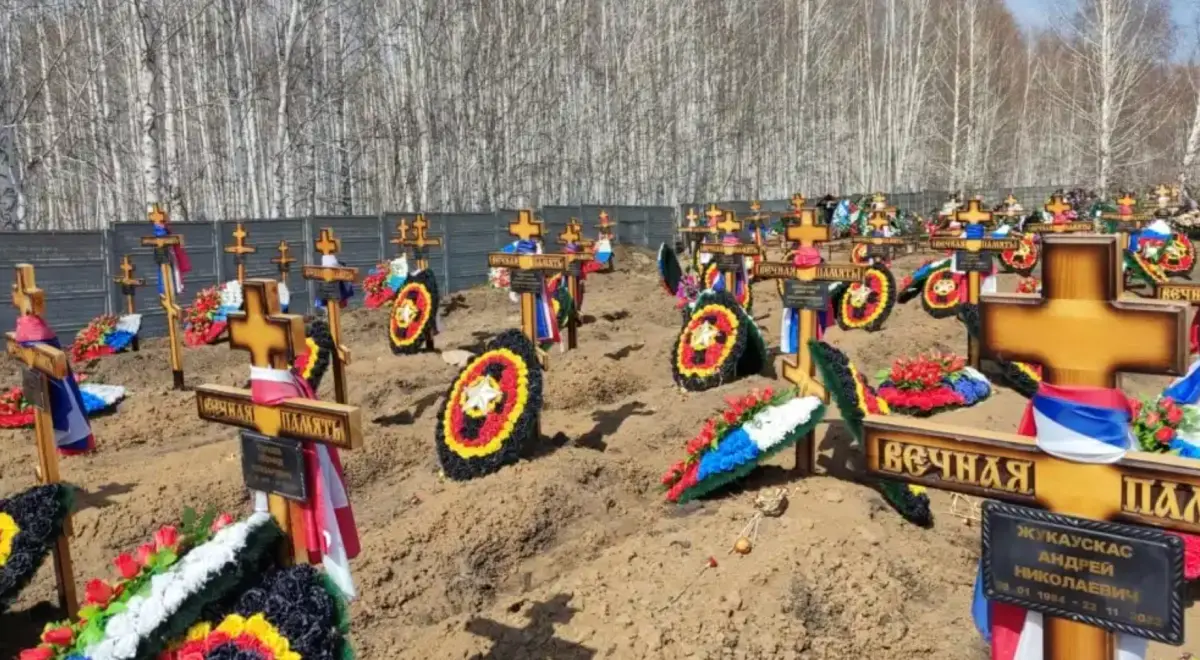
Russian authorities have equated photographing the graves of soldiers killed in Ukraine with treason. In recent months, dozens of people have been detained in Russia for photographing the gravestones of the occupying forces, and cemeteries have begun to be patrolled by officers of the Federal Security Service (FSB), according to Today.ua.
In September, a court in Yaroslavl sentenced a middle-aged man to 14 years in prison solely for taking photos of military graves. Such cases are heard behind closed doors, and those detained are accused of collaborating with Ukrainian intelligence agencies. Authorities warn that this offense can even carry a life sentence.
Since Moscow has classified the official statistics, photos from cemeteries have become one of the main ways for independent journalists and activists to count the casualties. Jan Berends, a historian at the Leibniz Center for Contemporary History in Germany, attributes the Kremlin’s harsh reaction to the fact that fresh graves cannot be hidden from the public, Politico reports.
“The growing number of graves is likely a sight that deeply troubles the authorities, as it reminds them of the failure of Putin’s war. So many people have died,” Berends emphasizes.
Between 283,000 and 700,000 dead
A joint project by “Mediazona” and the BBC’s Russian Service, based on obituaries in the media and on social media, has already identified the names of nearly 283,000 fallen Russian soldiers. However, the journalists lack the resources to conduct a complete tally. According to estimates by the British Foreign Office and Dutch intelligence, the Russian military’s losses have exceeded half a million people. In July, Volodymyr Zelenskyy stated that 700,000 Russians had been killed. Even the most conservative estimates are many times higher than the Soviet Union’s losses during the ten-year war in Afghanistan.
The list of names was last updated on November 6. Among the confirmed dead are 7,983 officers from the army and security forces, 15 generals, and at least 350 conscripts—even though Vladimir Putin promised at the start of the invasion that conscripts would not be sent to fight, notes “Mediazona.”
The Kremlin is shutting down one source after another
Sergei Shoigu last cited the official casualty figure (5,937 people) in September 2022. In April 2024, the Kremlin reiterated that such data constitutes a “state secret.” Subsequently, Rosstat restricted access to statistics on excess mortality, which had been publicly available since the 1990s. At the end of 2025, court cases regarding the recognition of military personnel as missing in action or deceased were also classified: in 2025 alone, there were nearly 90,000 such cases—ten times more than in previous years.
Dmitry Treshchanin, editor of “Mediazona,” believes that official statistics were the strongest argument against propaganda.
“We could list everyone by name, but someone in the government would always say, ‘That’s fake news.’ But when there’s official data confirming our figures, there’s nothing they can do about it,” notes Treshchanin.
The publication has now stopped photographing cemeteries: according to the editor, volunteers have already been attacked at cemeteries.
Russian military analyst Yan Matveev attributes this secrecy primarily to the recruitment of new soldiers.
“It’s a way to deceive potential recruits. If people could easily find out what percentage of contract soldiers survive on the front lines—or how long a new recruit is most likely to last—it would be extremely difficult to recruit even 30,000 soldiers a month,” Matveev believes.
He also suggests that by concealing its losses, Moscow is seeking to convince an international audience—particularly Donald Trump—that Putin’s army is on the verge of winning the war.