
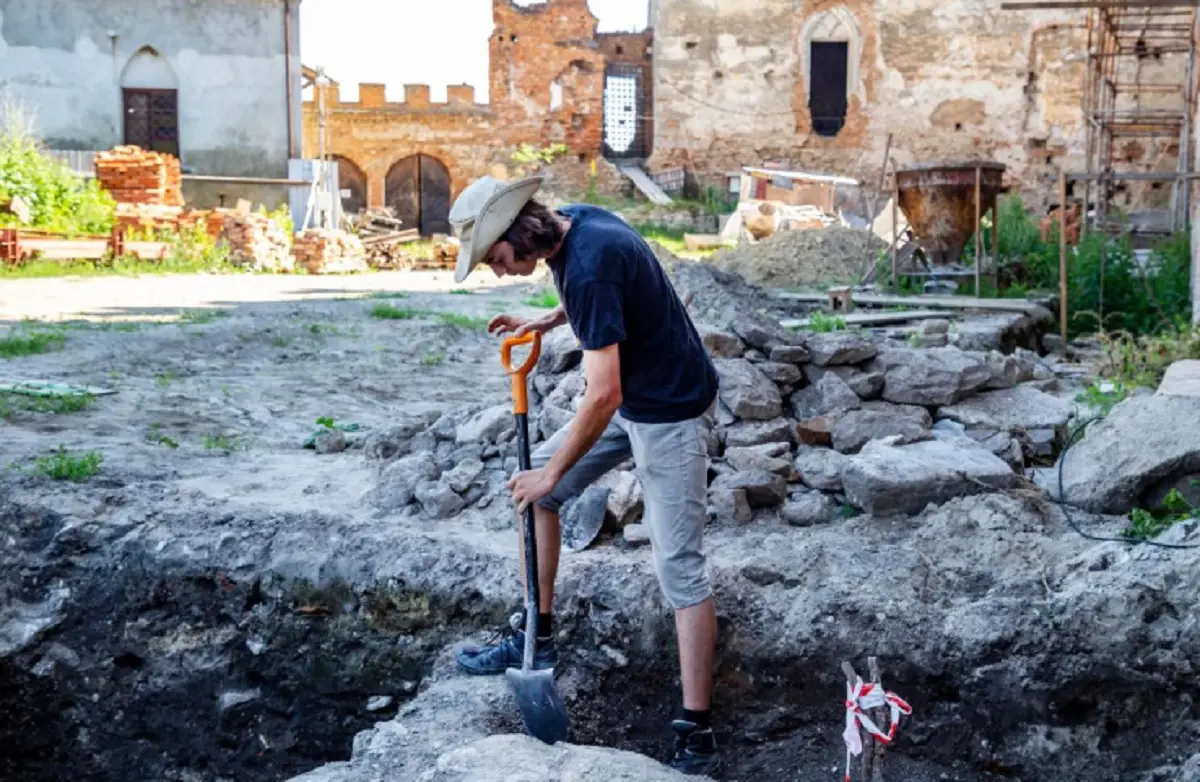
Archaeologists investigating the site of the 1596 battle near Mezekerestesh, Hungary, have uncovered a hoard that is 2,500 years older than the battle itself. The bronze vessels and jewelry date to the Late Bronze Age, the 13th–11th centuries B.C., and laboratory analysis revealed that the hoard contained more items than were found in the field, according to Arkeonews.
Initially, researchers from the Hungarian National Museum and the National Archaeological Institute discovered a large bronze vessel and two spiral bronze forearm bracelets. During micro-excavations in the laboratory, a third spiral ornament was found inside the vessel. Conservators do not rule out the possibility that even smaller metal objects may emerge from the ornaments as the soil is cleaned.
Volunteer Zoltán Vago noticed the metal detector’s signal. Scientists have determined that the finds are not random, scattered objects: they were intentionally left in the ground together. The museum has been investigating the battlefield near Mezekerestes for about ten years, and the search area covers more than 100 square kilometers.
The objects were not separated at the excavation site but were removed together with the soil as a single block to preserve their original arrangement. In the laboratory, archaeologist János Gábor Tarbai and geographer András Gemeri removed the soil layer by layer, while project leader Gábor Bakos created 3D documentation of each stage. According to the museum, this is the first hoard of this caliber in the Borsod region to be investigated using the micro-excavation method.
What Was Stored in the Bronze Vessel
Now, scientists will search for microscopic residues on the inner surface of the vessels and on the ornaments. Soil samples will be analyzed for plant remains and pollen, and chemical analyses may reveal traces of plant or animal substances.
Similar analyses have already yielded results. In 2025, Tarbai and his colleagues reported traces of millet and honey in a Late Bronze Age bronze cup found on Shomlo Hill. It is not yet known whether the vessel from Mezekeresteș contained anything similar, according to Ancientist.
The reason the hoard was buried also remains a mystery. Similar bronze hoards in Europe have been interpreted both as hidden valuables and as ritual offerings. Archaeologists emphasize that such finds with an intact original context are extremely rare, which is why it may help determine the treasure’s purpose, notes HeritageDaily.
The Battle of Mezekerestesh took place on October 22–26, 1596, during the Thirteen-Year (Long) War. In that battle, the Ottoman Empire’s army fought against a Christian coalition led by the Habsburg Monarchy and the Principality of Transylvania.