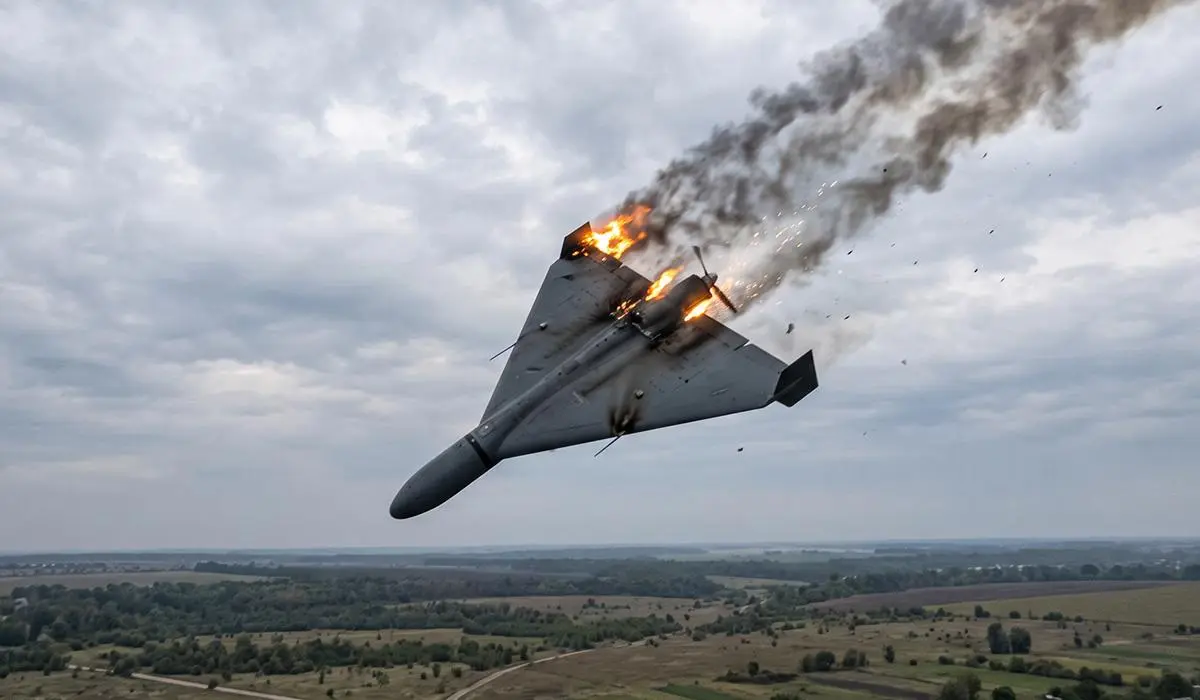
Over the course of three months, Russia increased the number of attacks using jet-powered strike drones tenfold: from approximately 350 in June to about 3,500 in September 2026. Only about 57% of such targets are successfully shot down. Ukraine still does not have mass-production capabilities for jet engines for interceptor drones. Maxim Sheremet, CEO of Drone Space Labs, spoke about this on the “Den.LIVE” broadcast, according to “Novyny.LIVE.”
The growth rate is rapid. In August, according to official data from the General Staff of the Armed Forces of Ukraine (AFU), Russia launched approximately 2,850 jet-powered “Shaheds,” and in September, according to Air Force estimates, the number had already reached about 3,500.
Sheremet notes that, according to Ukrainian President Volodymyr Zelenskyy, the overall interception rate for Russian drones this month is about 70%, and for jet-powered models—approximately 57%. At the same time, the expert cautions against a simplistic interpretation of these figures.
“Again, this is a measure of counter-UAV effectiveness, and it does not reflect the overall effectiveness of interceptor drones,” Sheremet emphasized.
The main challenge with jet-powered targets is that there is significantly less time to react. According to Sheremet’s assessment, Ukrainian engineers were not immediately prepared for such a sharp increase, particularly due to difficulties in scaling up production.
What Interceptors Are Missing
Sheremet sees the key shortcoming in the lack of mass production of jet engines for interceptor drones. He clarifies that the problem lies not in a lack of research and design work, but specifically in scale.
“We have drones; they fly fast. But it’s one thing to fly, and quite another to use them effectively,” the expert notes.
High speed alone is not enough for effective interception. Sheremet emphasizes that radio communication, payload, and the performance of the propeller-engine unit—which depends, in particular, on the weight of the fuel and the warhead—are also crucial. The Ukrainian engineering community is working on these challenges, but it is difficult to combine all the necessary characteristics into a single product and mass-produce it.
At the same time, Ukraine is strengthening other countermeasures. According to Zelenskyy, aviation accounts for 55–60% of the downed “Shahed” drones, so the country is increasing the supply of 20-mm ammunition for F-16 fighter jets. Production of turrets designed to counter “Shaheds” will also be ramped up: their production has already moved beyond the stage of one-off prototypes.
Why Russia Has Bet on Speed
The switch to jet engines was a response to Ukraine’s increasingly effective air defense: the faster “Geran” is capable of outpacing interceptors and reducing response time. The first such drone, the Iranian Shahed-238, appeared in Ukraine as early as January 2024, and about a year later, Ukrainian intelligence reported that Russia had launched its own production line for the jet-powered version. This variant, the “Geran-3,” is equipped with a Chinese Telefly JT80 turbojet engine, which propels it to 300 miles per hour (about 480 km/h), write CSIS analysts Kateryna Bondar and Nicole Herrera.
Russia is also equipping the drones with self-defense systems. In 2025, the R-60 air-to-air missile, as well as the “Verba” man-portable air defense system (MANPADS), began to be mounted on the Geran’s fuselage to counter helicopters and interceptors. Just four months after the first R-60 appeared, drones carrying decoy missiles emerged, making it more difficult for the Ukrainian military to assess the threat.
Control capabilities have also changed. In the summer of 2025, the Russians began equipping drones with XK-F358 mesh modems from the Chinese company Xingkai Tech: each drone became a relay for neighboring drones, and the operator gained the ability to control them in real time. By early 2026, all series of “Gerana” drones had been connected to this network. According to analysts’ estimates, the drone has evolved from a programmable munition into a remotely piloted strike aircraft capable of patrolling, searching for targets, and changing its route on the operator’s command.
A similar race is underway in electronic warfare. According to a representative of the Air Force, Ukrainian electronic warfare systems neutralize nearly half of the “Gerani” drones in some nighttime attacks. Russia is responding with antennas featuring an ever-increasing number of elements: from four in the Iranian Nasir module to 16 in the “Kometa-M16” by the end of 2025. According to CSIS, this cycle of improvements is advancing faster than any Western procurement program can keep up with.