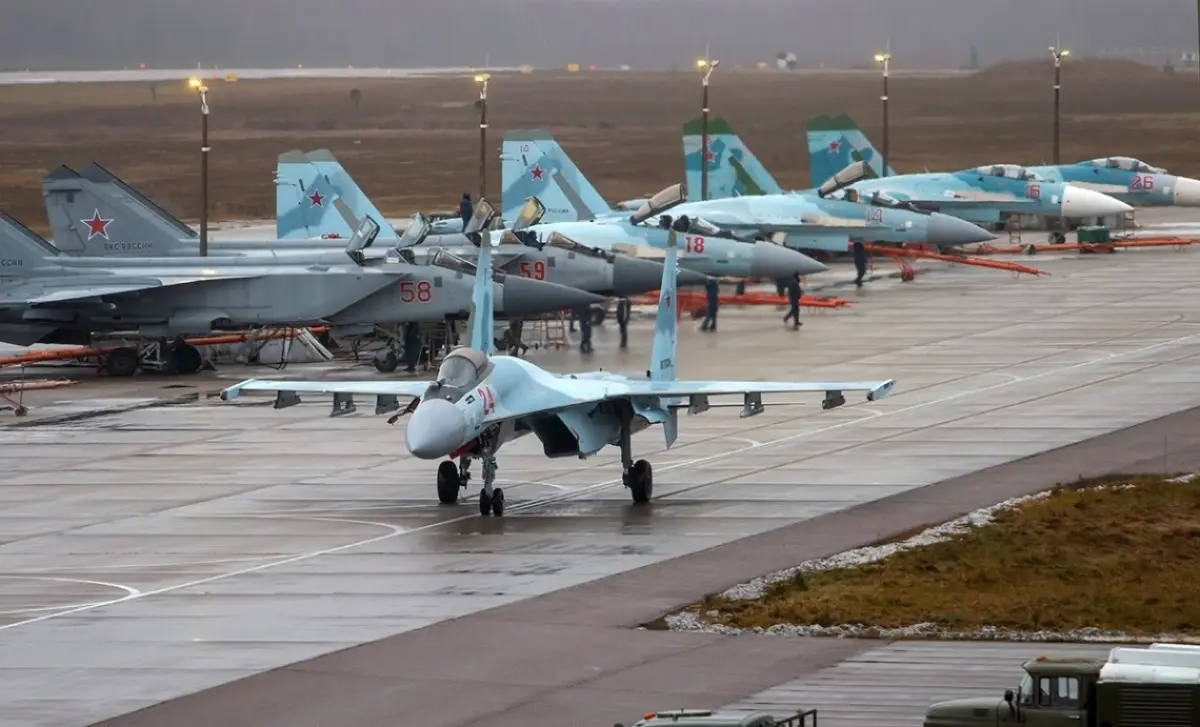
The Naval Forces of the Armed Forces of Ukraine (AFU) struck the Russian “Marinovka” airfield in the Volgograd region and destroyed two Su-34 fighter-bombers. Russia had been using them to launch guided airstrikes against Ukrainian cities and Defense Forces positions. The strike was carried out using “Neptune” missiles, Navy spokesperson Dmytro Pletenchuk said during a live broadcast on the “Apostrophe” TV channel, according to “Apostrophe.”
According to Pletenchuk, the operation demonstrated the growing capabilities of the coastal missile system. The missiles must overcome Russian electronic warfare (EW) and air defense (AD) systems, and the greater the range, the higher the accuracy requirements, especially when targeting relatively small targets.
“This can certainly be called a triumph for Ukrainian weapons, because the results are clear. And, of course, without the people who operate them, it wouldn’t work either,” Pletenchuk noted.
He recalled that the Navy remains the sole operator of the “Neptune” system within the Armed Forces. The system is gradually expanding its operational range and also serves as a deterrent: the mere threat of its use limits the actions of Russian troops.
How Many Su-34s Are Left in Russia
According to the Navy, the aircraft were destroyed at the base of the 11th Mixed Aviation Regiment near the village of Oktyabrsky. The Navy has not released any visual evidence of the destruction. On the same day, October 29, President Volodymyr Zelenskyy confirmed the destruction of two Su-34s and added that the Defense Forces had also struck an “Iskander” launcher, according to The Kyiv Independent.
As of October 22, Russia had about 140 Su-34s of various modifications, including the upgraded Su-34M, according to the Main Intelligence Directorate (GUR). Since the start of the full-scale invasion, Russia has lost 43 such aircraft, which were destroyed, and another seven were damaged. According to intelligence estimates, Russia is capable of producing 14–18 Su-34s per year, meaning the destroyed aircraft represent approximately 2.5–3 years of production. The strike on “Marinovka” occurred two weeks after the “Neptune” missile attack on the “Borisoglebsk” airfield in the Voronezh region on October 15, where four Su-34Ms were destroyed and two more were damaged.
Pletenchuk estimates the annual production rate more conservatively—at six to 12 aircraft. He emphasizes that the loss of two aircraft weakens Russian aviation in areas where it drops guided aerial bombs (KAB).
“This product isn’t exactly a one-off; it is, after all, mass-produced, but the rate at which such orders are fulfilled ranges up to about ten units per year. At least, that’s what most experts believe. So, in principle, yes, losses of such assets aren’t easy to replace, since the component base still depends on foreign parts,” the press secretary asserts.
This isn’t the first time “Marinovka” has been attacked
This airfield was already targeted in June. At that time, the Security Service of Ukraine (SBU), together with the Special Operations Forces (SOF), attacked it with long-range drones, destroying two Su-34s and damaging two more. Satellite images captured characteristic explosion marks at the parking site of one of the bombers, likely from the detonation of air-to-ground munitions, according to Defense Express.