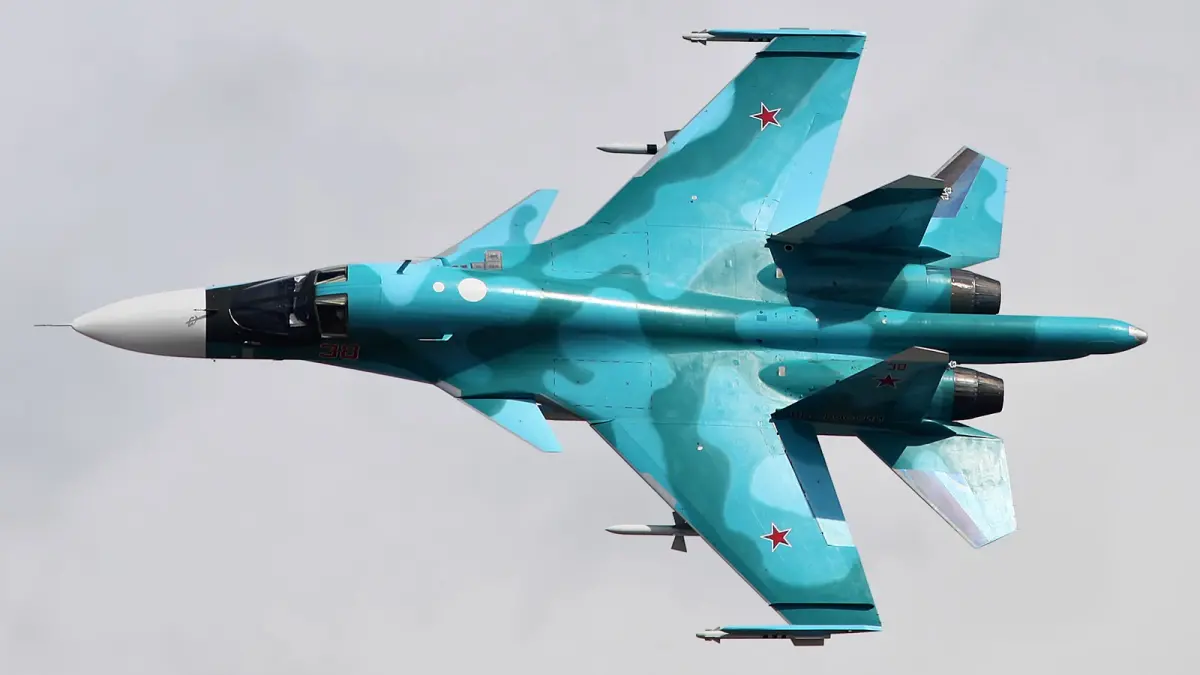
As of the end of 2025, Russia had approximately 125 Su-34 and Su-34M front-line bombers, 140–145 Su-30M2, Su-30SM, and Su-30SM2 fighters, 135–140 Su-35S fighters, and about 20 Su-57 fighters. The Main Intelligence Directorate of the Ukrainian Ministry of Defense provided these estimates in response to a request from the UNIAN news agency. Despite its losses, the Russian combat aviation force retains significant potential and is capable of partially replenishing its fleet through serial production, according to Defense Romania.
The fleet’s combat readiness does not correspond to its registered strength. Some aircraft are undergoing repairs or modernization, others have limited service life, and there are no publicly available statistics for the current year.
“It is important to note that the figures provided reflect only estimates, not a guaranteed number of aircraft that Russia can simultaneously deploy for combat missions. The exact number of aircraft depends on deliveries and losses in 2026, but this data is not currently being disclosed. Regarding losses of Russian military aircraft in 2026, only a few isolated cases of aircraft destruction or critical damage are known,” the GUR noted.
The Su-34 and Su-35S remain the priorities of the Russian aviation industry. According to intelligence reports, Russia received eight Su-34s in 2022, 11 in 2023, and 12–14 in 2024. This does not mean that this pace has been maintained. Currently, Moscow appears to be capable of delivering 10–15 of these bombers per year.
As for fighter jets, intelligence provides only rough estimates.
“For the Su-35S, the historical average delivery rate for 2021–2025 was approximately 11–12 aircraft per year. At present, this figure should be viewed as a guideline rather than an established production volume for 2026. Production of the Su-30SM2 and Su-57 continues,” the GUR notes.
It is not yet possible to reliably determine the production rates for the Su-30SM2 and Su-57. Regarding the Su-30, intelligence recommends distinguishing between new aircraft and modernized Su-30SMs. Russia is not mass-producing new Su-24s, Tu-95s, or Tu-22M3s; these fleets are maintained solely through repairs. The Kremlin may be rebuilding its tactical aviation capabilities, but every irreplaceable loss of an old bomber significantly reduces its potential for the long term.
Intelligence reports also identified the production sites. The Su-34 is assembled at the Chkalov Novosibirsk Aircraft Plant, while the Su-30SM/SM2 is assembled at the Irkutsk Aircraft Plant. The Su-35S and Su-57 are produced by the Gagarin Plant (KnAAZ) in Komsomolsk-on-Amur, which serves as the main assembly center for both types.
Among the main airfields for the Su-34, the Main Intelligence Directorate (GRU) lists Baltimore in the Voronezh Region, Morozovsk in the Rostov Region, Shagol in the Chelyabinsk Region, and Khurbu in the Khabarovsk Territory. The Su-30SM/SM2 are associated with Domna in Transbaikal, Millerovo, and Chernyakhovsk. The Su-35S are based in Dzhemgi, Central Ugolnaya, Besovka, and Khotilovo. Su-57s are concentrated in Akhtubinsk and at the Dzemgi factory airfield. Intelligence sources clarify that reports from April 2026 regarding these aircraft in Shagol do not confirm that they are permanently based there. Su-24s, particularly the reconnaissance variants, are linked to Gvardeyskoye and Saki in occupied Crimea, as well as to Monchegorsk.
New deliveries have offset losses
The GUR’s data aligns with the findings of the British think tank RUSI. According to its estimates, approximately 130 Russian aircraft have been shot down or severely damaged since February 2022. Among tactical aircraft, the Su-25SM(3) and Su-34(M) suffered the heaviest losses—approximately 40 aircraft of each type—as well as about ten Su-24M/MRs. At the same time, new deliveries of the Su-34 have exceeded the losses of this type over the years of the war. As of the publication date in 2025, the Russian Air Force had received nine such aircraft and was expecting two more. Losses of the Su-35S and Su-30SM(2) combined amount to only about 20 aircraft. Therefore, the number of modern Russian fighters and attack aircraft has even increased slightly since then, according to RUSI.
Analysts estimate that the flight crew suffered significantly fewer losses than the aircraft themselves. A significant portion of the aircraft was destroyed on the ground by drone strikes and ATACMS attacks on airfields, while crews who ejected mostly landed in Russian-controlled territory. Four years of combat sorties against advanced air defense systems have given Russian pilots experience that even veterans of the Syrian campaign lacked prior to 2022. Coordination between fighter jets and ground-based air defense systems has also improved.
The mission profiles of the aircraft have also changed. The Su-35S—and, increasingly, the Su-30SM2—are being re-equipped with the R-37M long-range missile instead of the R-77-1. Since early 2024, the Su-34 has been repurposed for massive strikes using FAB-500, FAB-1500, and FAB-3000 guided bombs equipped with UMPK and UMPB modules. These are dropped from a distance of at least 60 km, and under certain conditions—up to 130 km; hundreds of such munitions are dropped on Ukrainian positions every week.
“In any war against NATO forces, the Russian Aerospace Forces in early 2022 would have faced difficulties in deploying effective firepower on the battlefield on a large scale due to an insufficient selection of weapons, a lack of precision-guided munitions, and poor preparation for direct air support. That is no longer the case,” warns the study’s author.
RUSI believes that in the event of a direct conflict, Su-34s could rain aerial bombs down on NATO positions without leaving the dense cover of their own air defense systems. This would force the Alliance, from the very first days, to wage an intense battle for air superiority in parallel with a large-scale campaign to suppress anti-aircraft systems. Despite its losses, Russia’s ground-based air defense system comprises several hundred batteries, and all major systems continue to be produced in new variants.
One Platform—Various Roles
Most of the aircraft accounted for by Ukrainian intelligence are derived from a single design. The Su-30, Su-33, Su-34, and Su-35 are based on the Su-27 “Flanker,” which was developed starting in the late 1970s as a response to the American F-15 and F-16. The Su-30 was originally called the Su-27PU and was conceived as a command aircraft with a weapons operator who would guide other “Sushkas” in the absence of AWACS. Later, it also took on strike capabilities, according to Defence Aviation.
The Su-34 was developed to replace the Su-24 with variable-sweep wings, and in certain roles, the Tu-22M as well. The publication considers comparisons with the American F-15E to be inaccurate, since the Su-34 has largely lost the maneuverability of a classic fighter. The Su-35 was originally called the Su-37 and was developed based on the modernized Su-27M. It is classified as one of the “final” variants of the family, similar to the F-16V in the American lineup.