
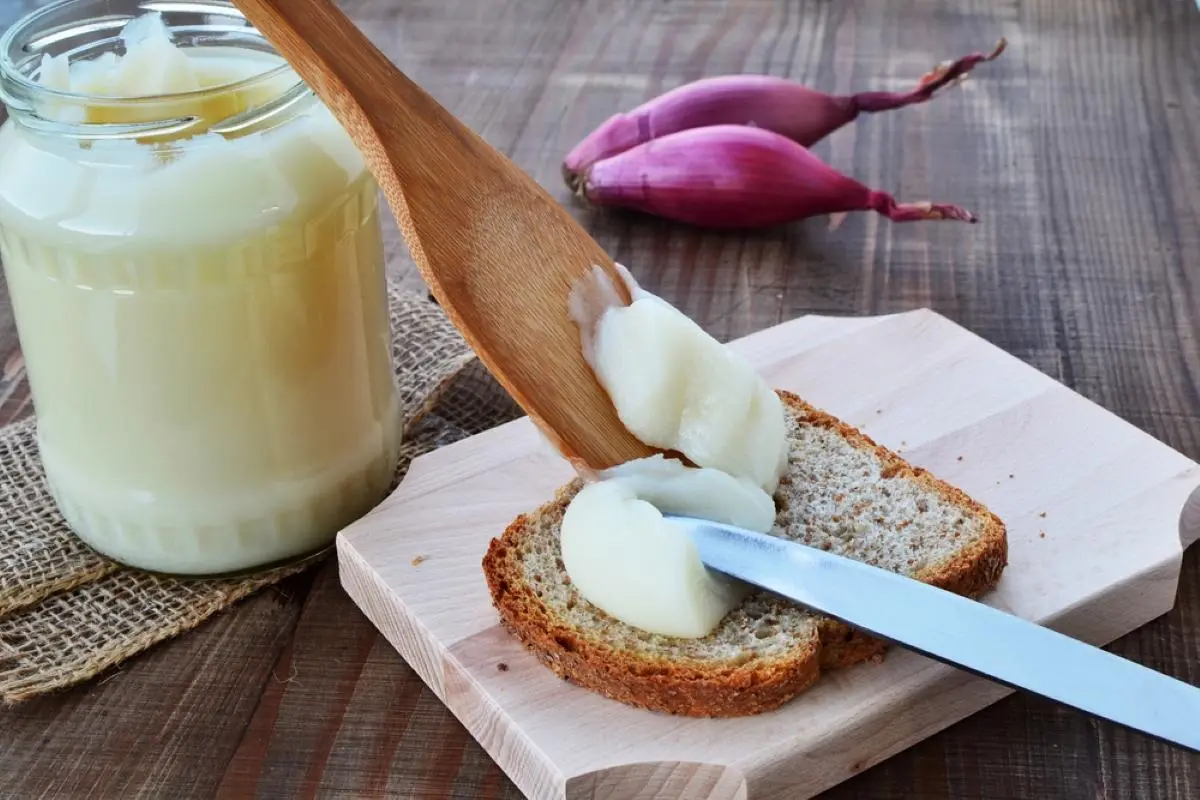
A thin layer of lard on rye bread may be a better choice than a thick layer of butter. This opinion was expressed by an unnamed cardiologist in an article in the Czech publication Spartanské Noviny. At the same time, official cardiology guidelines do not consider lard to be healthier than butter, according to NLCafé.
The doctor believes that it’s not just the type of fat that matters, but also the amount, the type of bread, and what you eat for the rest of the day. Lard has a more pronounced flavor, so, in his opinion, a smaller portion is enough for many people. The mild flavor of butter, on the other hand, encourages people to spread it more thickly on bread. The cardiologist also warns that a generous portion of salami, sausage, or other cured meats completely alters the nutritional composition of such a sandwich.
The doctor’s arguments are partially supported by data from the British Heart Foundation. Saturated fatty acids account for about 40% of the fatty acids in lard, while monounsaturated fatty acids—particularly oleic acid—account for 43%. In butter, the proportion of saturated fats is close to 52%, while monounsaturated fats account for about 21%.
What the cardiologist’s advice fails to consider
The Czech publication does not cite any clinical studies proving the superiority of lard over butter. Therefore, the doctor’s opinion should be viewed as a personal dietary choice rather than a medical recommendation. Lard remains a source of saturated fats, an excess of which raises LDL cholesterol levels, one of the key risk factors for cardiovascular disease.
In its guidelines updated in 2026, the American Heart Association recommends replacing some saturated fats with unsaturated fats: olive and canola oils, nuts, and seeds. The organization emphasizes that overall diet—not individual foods—is important for heart health. The British Heart Foundation also lists both butter and lard as significant sources of saturated fat.
Lard, moreover, is higher in calories: 100 g of nearly pure fat contains about 900 kcal, while butter with a fat content of 80–82% has approximately 720–750 kcal.
A Comparison That Changes Little
Discussions about the “rehabilitation” of lard have been going on for a long time, and experts remain cautious about them. Tong Wang, a lipid chemist at Iowa State University, acknowledges that lard is healthier than partially hydrogenated vegetable fats, but it is not better than olive oil. By comparison, vegetable oils typically contain less than 10% saturated fat, according to NPR.
“It’s all relative. And the key question is quantity!” Wang noted.
The researcher points out that lard, like all animal fats, contains cholesterol. In addition, store-bought lard is often hydrogenated to extend its shelf life, so it may also contain trans fats.