
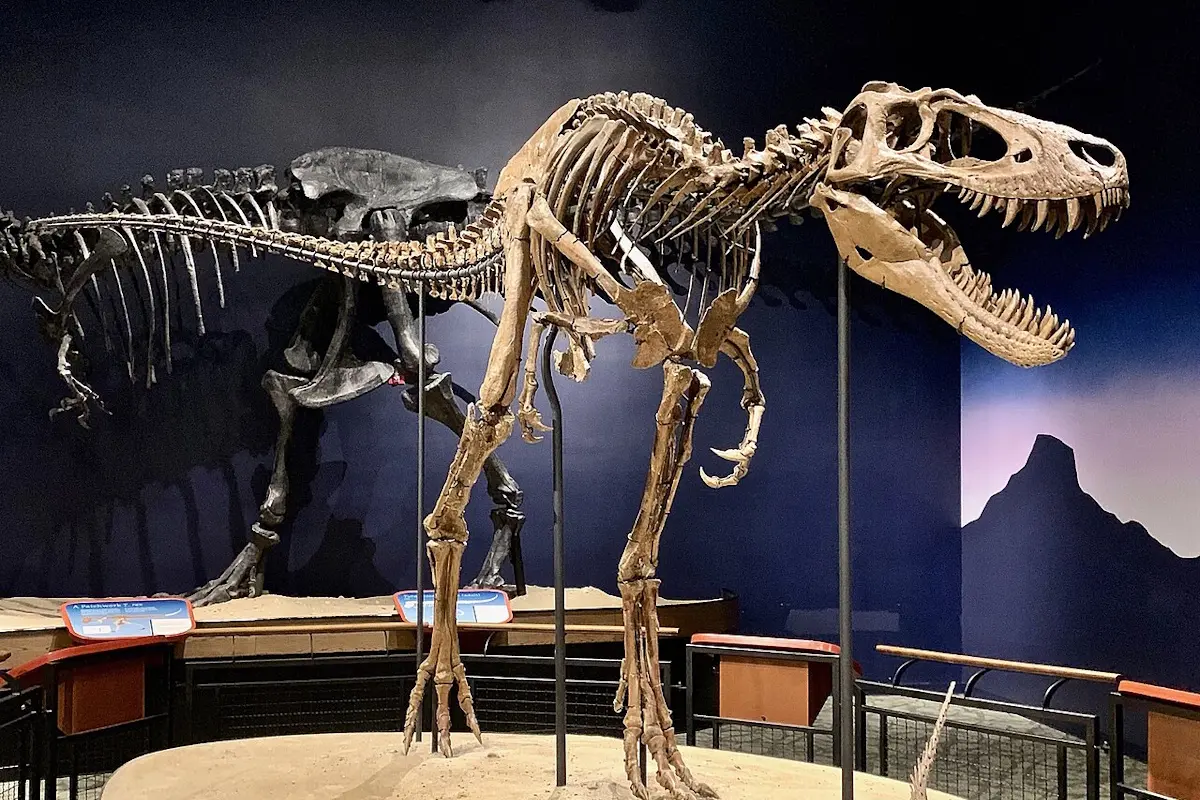
A Nanotyrannus skeleton nicknamed “Jody,” found on a private ranch in Montana, was sold at a Sotheby’s auction in New York for $47.3 million. This is the second-highest price ever paid for a dinosaur at auction, according to Futura Sciences.
The fossil was discovered in 2019 on her own property by ranch owner Jody Pearson, after whom the specimen was named. The bones were found in the Hell Creek Formation, which preserves the remains of animals dating back 67 million years. According to Sotheby’s, the skeleton is 70% complete: it is nearly 6 meters long and over 2.7 meters tall. To date, only three other similarly complete Nanotyrannus skeletons have been found in the region.
Bidding exceeded the upper limit of the preliminary estimate within just a few minutes. The auction house did not disclose the buyer’s name or specify whether it was a private individual or an institution.
Not a Juvenile, but a Predator in Its Own Right
Nanotyrannus was significantly smaller than an adult Tyrannosaurus rex, with longer forelimbs, larger claws, and narrower teeth. For decades, paleontologists debated whether it was a separate genus or simply juvenile T. rex. In the fall of 2025, a study was published in the journal Nature in which the authors analyzed more than 200 tyrannosaur fossils, including a complete skeleton from the famous “Dueling Dinosaurs” specimen. They concluded that Nanotyrannus was a separate species that lived at the same time as T. rex, and that the specimen studied was about 20 years old and fully grown, according to National Geographic.
“There is no possible way to scientifically prove that this is a T. rex,” emphasizes study co-author James Napoli, a paleontologist at Stony Brook University.
Independently, a team from Princeton University and the Cleveland Museum of Natural History reached the same conclusion. The scientists examined a skull found in 1942, which is what sparked the controversy in the first place. Based on the growth rings in the hyoid bones, they determined that the animal was an adult, although its body mass was only about one-tenth that of a Tyrannosaurus rex, according to Princeton University.
“We used to think that at the end of the Cretaceous period, there was only one large predator in western North America, but now we know that before the mass extinction, there was greater diversity and greater ecological complexity,” said lead author Christopher Griffin.
Museums Struggle to Compete
The high price has once again reignited the debate over private ownership of rare fossils. Public museums rarely stand a chance against private buyers, and scientists’ access to such specimens depends on the owner’s discretion. The buyer of “Jody” has not yet announced any restrictions, and researchers hope that the skeleton will end up in a museum or be made available for study.
In the U.S., bones excavated on private land belong to the landowner, whereas in Canada and Mongolia, for example, dinosaur fossils are state property. Some paleontologists believe that such finds should be part of the public domain, rather than a source of profit. By comparison, the “Dueling Dinosaurs” from 2020 were sold to a nonprofit organization affiliated with the North Carolina Museum of Natural Sciences for $6 million, according to Bloomberg.