
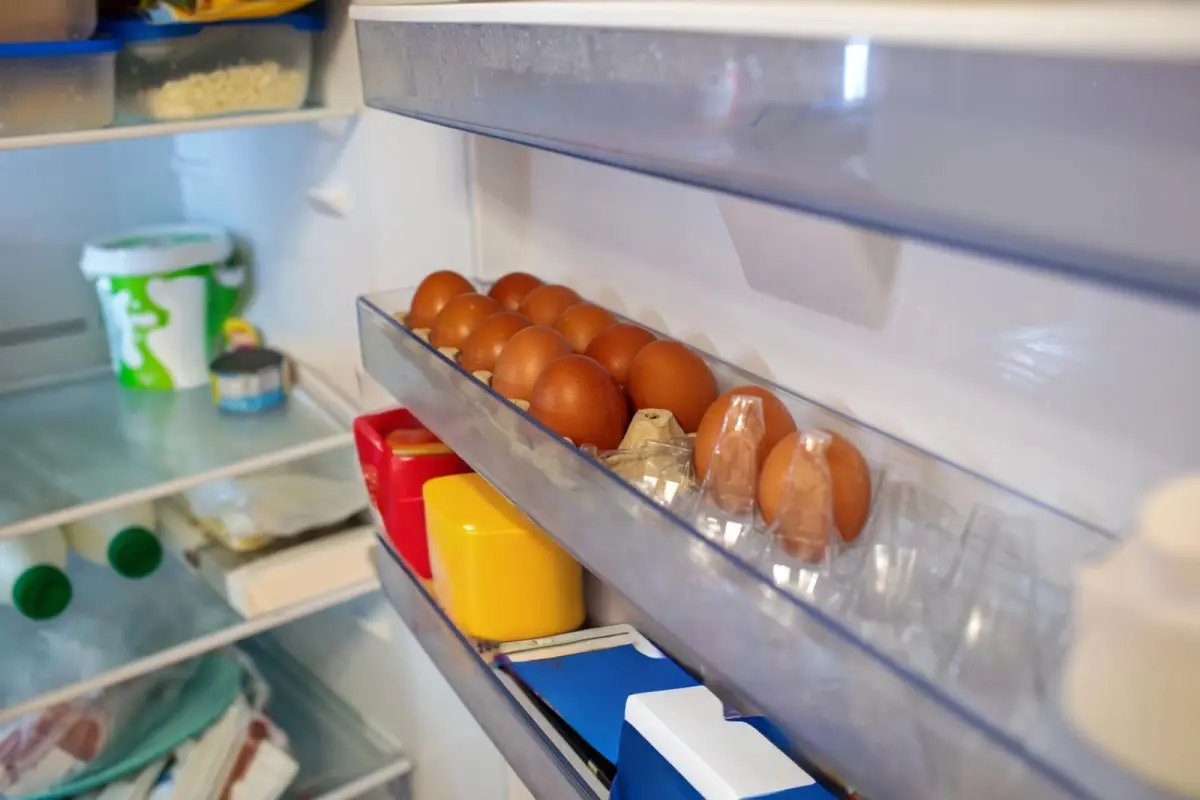
The German consumer protection organization Verbraucherzentrale advises against storing eggs in the egg tray in the refrigerator door and recommends moving them to the middle shelf, according to Business Insider Deutschland.
The problem with the usual egg compartment is its location right next to the refrigerator door. Warm air enters the refrigerator through the door, causing the temperature to fluctuate throughout the day.
“The egg compartment in the refrigerator door isn’t really suitable for this. Because the door is constantly being opened and closed, the eggs are exposed to temperature fluctuations,” writes the Verbraucherzentrale on its website.
As temperatures rise, condensation can form on the shell. This can damage the egg’s natural protective layer—the cuticle—and make it easier for germs to get inside. Therefore, the rule is: once eggs have been chilled, they should be kept cold from then on.
The middle shelf and no washing
The temperature on the middle shelf remains more consistent. The organization recommends no higher than 7 °C: at 2–6 °C, fresh eggs will keep for four to six weeks. The original cardboard packaging provides additional protection against impacts. Eggs should not be washed before storage, as this destroys the protective layer. In German stores, they’re sold unwashed.
The main reason for this caution is the risk of salmonellosis. The German Federal Center for Nutrition (BZfE) emphasizes that contamination cannot be seen or tasted. If an egg has been stored improperly, “Salmonella can multiply rapidly and cause gastrointestinal illnesses in humans, including diarrhea and fever.” Infants, young children, the sick, the elderly, and pregnant women are particularly vulnerable.
American experts have reached the same conclusions
Food scientist Brian Kwok Lee describes the refrigerator door as its warmest area of the refrigerator with the least stable temperature. South Dakota State University professor Kasiviswanathan Mutukumarappan believes eggs need a “cool, quiet, stable environment” and advises placing them on the middle or bottom shelf, according to Prevention.
The importance of cold storage was also confirmed by a study conducted by the U.S. Agricultural Research Service, in which 5,400 eggs were monitored for 15 weeks. The refrigerated eggs maintained Grade A quality regardless of whether they had been washed. Unwashed eggs kept at room temperature dropped from the highest grade, AA, to Grade B in just one week. “Essentially, the key point is that egg quality remains high in the refrigerator, but deteriorates rapidly without it,” notes study author Deena Jones, according to ARS USDA.