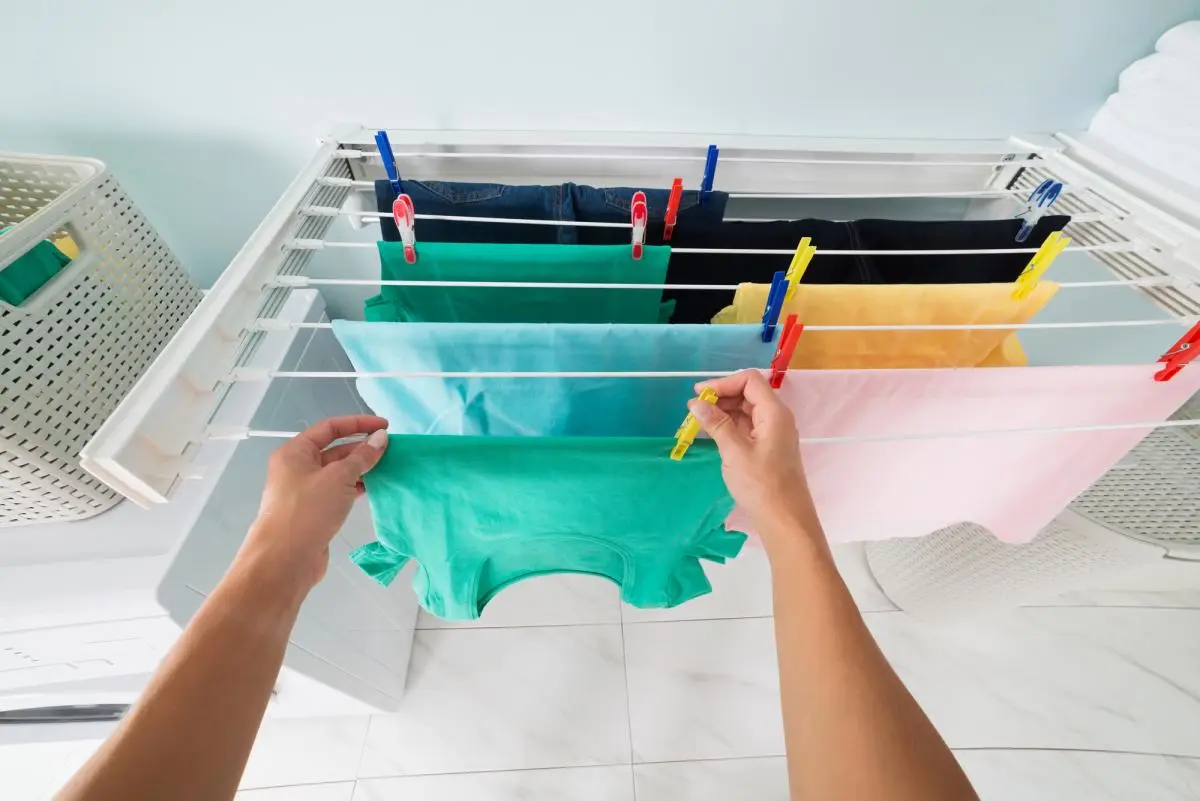
To help laundry dry faster indoors and fit more items on the drying rack, use hangers and clothespins, alternate between heavy and light items, and avoid hanging clothes on every crossbar. These and other tips are suggested by the British magazine *Good Housekeeping*.
They recommend drying shirts, tank tops, and T-shirts on thick plastic hangers, hooking them over the edge of the drying rack. These hangers spread out the clothes and don’t absorb moisture, while keeping the crossbars free. Clothespins with rubber pads allow you to hang jeans on a single rod instead of three or four. It’s best to clip jeans by the bottom of the legs so that the waistband and pockets get plenty of air.
Heavy items shouldn’t be grouped together: this hinders air circulation and can warp the dryer. Small and light items are best hung closer to the center, while long items should be hung closer to the edges. An overloaded drying rack only slows down the drying process and increases the risk of bacterial growth and musty odors. Another tip is to cover the drying rack with a sheet, but only if there’s a heat source nearby and there’s a gap at the bottom. Be sure to ventilate the room or turn on a dehumidifier.
Radiators Are Not for Drying
Mistakes made during the drying process can increase humidity in the home and drive up energy bills, warns textile expert and Or & Zon founder Guillaume Drew. The main one, he says, is hanging wet clothes on radiators, according to the Liverpool Echo.
“This is one of the most common ways to make the problem worse. It causes a sharp spike in local humidity, restricts heat transfer, and distorts certain types of fabrics,” Drew emphasizes.
The expert notes that a single load of laundry can release several liters of moisture into the air. It condenses on cold walls and window frames, leading to the growth of mold and mildew. Drew recommends using an extra spin cycle, placing a portable dehumidifier near the dryer, using a fan to circulate air around the laundry, or slightly opening a window while keeping the doors to other rooms closed.
It’s best to ventilate beforehand
Researchers at the University of Huddersfield compared humidity levels while drying laundry in a closed room, with ventilation turned on during the drying process and with ventilation planned in advance. In the latter case, the window was opened, and the dehumidifier was turned on before, during, and after drying. This approach reduced peak humidity, shortened the duration of elevated humidity levels, and prevented moisture buildup after several drying cycles, according to a paper presented at the IEEE COMPSAC 2026 conference in Madrid, reports the University of Huddersfield.