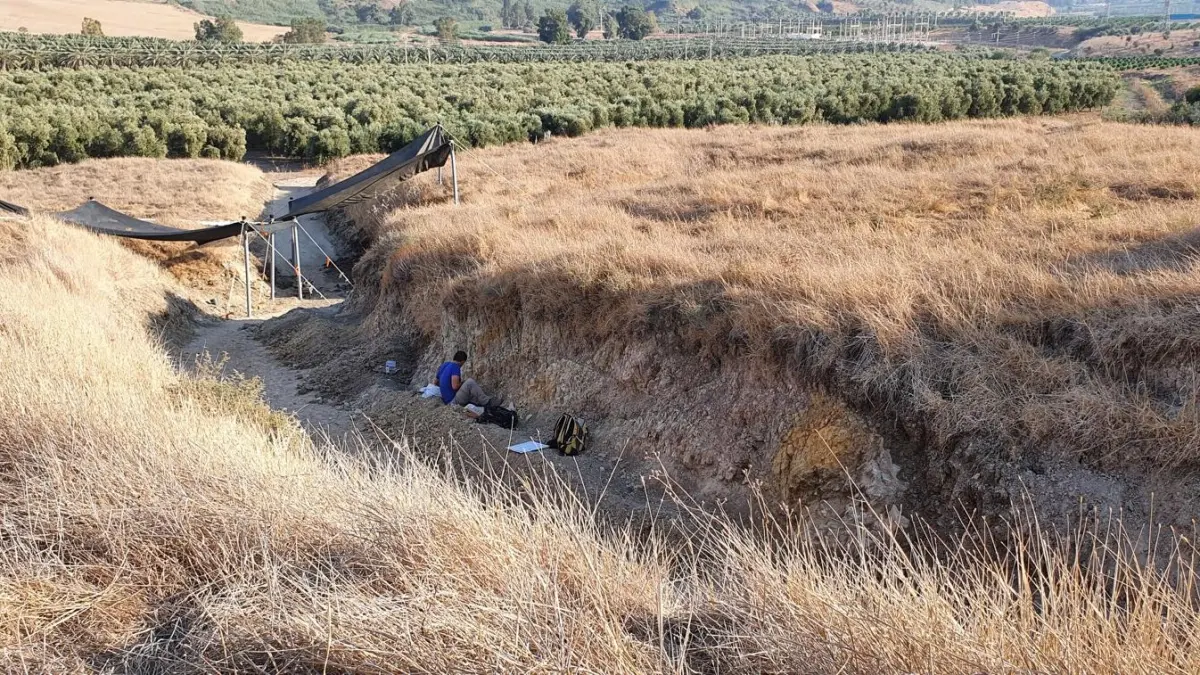
Ancient humans settled at the Ubeidiya site in the Jordan River Valley at least 1.9 million years ago, rather than 1.2–1.6 million years ago, as previously thought. This pushes the date of the first members of the Homo genus leaving Africa back by hundreds of thousands of years. This conclusion was reached by an international team of scientists led by Professor Ari Matmon of the Hebrew University of Jerusalem, Professor Omri Barzilai of the University of Haifa, and Professor Miriam Belmaker of the University of Tulsa, according to NV Techno.
The new dating places Ubeidya on par with Dmanisi in Georgia and makes it one of the oldest known centers of human activity outside of Africa. This temporal overlap indicates that ancient populations spread across different parts of Eurasia almost simultaneously. At Ubeidiya, a rich Acheulean layer containing complex hand axes worked on both sides has been discovered, whereas simpler Olduvai tools predominate at Dmanisi.
The study was published this month in the peer-reviewed journal *Quaternary Science Reviews*. Until now, scientists had believed that the Dmanisi population, which had different anatomical features, represented an earlier wave of migrants than the Ubeidiya inhabitants. It has now become clear that, as early as the earliest known stage of migration, at least two distinct groups of hominids left Africa, according to The Times of Israel.
“Until now, researchers believed that the Acheulean stone tool tradition found in Ubeidiya was younger than the Olduvai tools discovered in Dmanisi, Georgia. However, new dating shows that this is not the case. Instead, both tool traditions likely left Africa and reached Eurasia at roughly the same time, about 1.9 million years ago,” Omri Barzilai emphasizes.
Three independent methods
Ubeidiya was first excavated in the 1960s, and since then its age has been determined only relatively: animal remains from this site were compared with similar finds in other parts of the world. According to Ari Matmon, the current study marks the first attempt at independently dating the site. The scientists’ key tool was “natural clocks,” which begin ticking as soon as the rock is buried under a layer of sediment.
“Cosmogenic isotopes are constantly formed in very low concentrations on the Earth’s surface due to its interaction with cosmic rays originating from throughout the universe. When these isotopes are buried [under sediments], they decay, while new isotopes cannot form because cosmic rays cannot reach them,” notes Matmon.
The median age of the isotopes buried at Ubediya was approximately two million years. Two other methods determined not the exact date of settlement, but the lower age limit of the site. An analysis of the paleomagnetic properties of the lake sediments showed that they are at least 1.1 million years old and likely date to the period of magnetic field reversal between 1.7 and 1.9 million years ago.
Uranium-lead dating of the fossilized shells of freshwater Melanopsis snails yielded a minimum age of 1.3 million years. Matmon clarifies that the aragonite in the shells gradually transforms into calcite after burial, and isotopic dating begins only after this process is complete—a process that can take hundreds of thousands of years. By combining all the results into a probability curve, the scientists determined 1.9 million years to be the most likely age of Ubeidiya.
Some of the initial isotopic measurements even indicated an age of 3 million years. This discrepancy is explained by the geology of the Dead Sea rift zone: the sedimentary rocks underwent a long cycle of erosion and redeposition, so the ancient material was buried long before the shore of the ancient Lake Ubeidiya formed.
Revising the Evolutionary Chronology
The findings may influence the relative dating of other sites. For paleoecologists, Ubeidiya has always been special: animals from Africa, Asia, and Europe lived side by side here, and their age, as determined by paleobiochronological methods, had long been estimated at 1.2–1.4 million years.
“This new date not only changes the chronology for Ubeidiya and its stone tool assemblage, but also suddenly tells us that these species were already living two million years ago. [The results] have extended their evolutionary timeline, which will lead to a reassessment of many species, their distribution, and the paleoecology of the region,” Miriam Belmaker believes.
According to Barzilai, in recent years there has been a growing body of evidence for the presence of early humans outside Africa around two million years ago, particularly in China and Romania.
“New information is gradually emerging from various regions of Eurasia, using different dating methods, and it consistently points to an earlier spread of the Acheulean culture than we thought. We may have to rethink some of our assumptions and remain open to new dating methods, provided they are reliable and supported by multiple independent lines of evidence,” Barzilai notes.
Barzilai and Belmaker are continuing their excavations at Ubediya, which has since been designated a national park. The scientist insists that the site should remain accessible to visitors.
“As the oldest prehistoric site discovered outside of Africa, it must remain accessible so that visitors can see the ancient landscapes of Israel and learn about the early humans and animals that once lived here,” Barzilai emphasizes.