
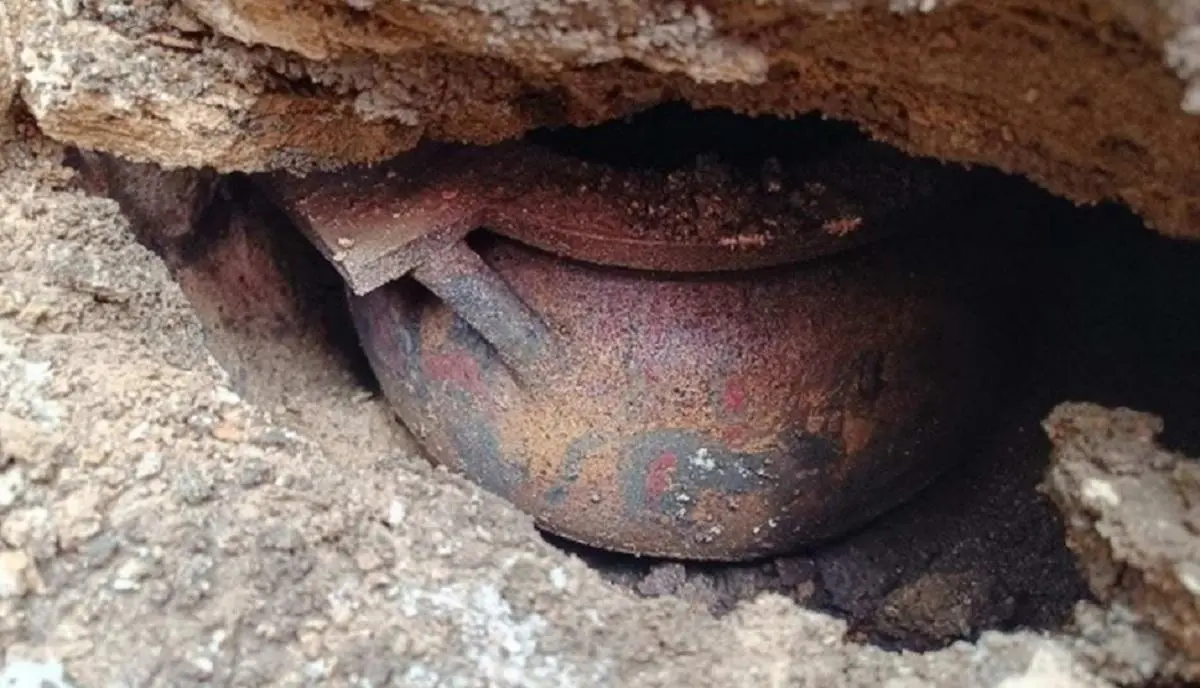
Archaeologists have discovered the oldest known fired clay vessels in the Middle East at the Çemk-Höyük site in southeastern Turkey. The finds date to approximately 9350 B.C. Researchers from Mardin Artuklu University, the Russian Academy of Sciences, and Koç University in Istanbul have concluded that the widespread use of pottery was preceded by millennia of technological experimentation among hunter-gatherer communities, according to Múlt-kor.
The settlement in the Tigris Valley was discovered by chance during road construction. People lived there from 10,800 to 8,700 BCE. In the second construction layer, archaeologists examined 46 clay fragments, whose age was determined using charcoal samples.
The fragments do not resemble any known type of pottery and are divided into three groups: clay coatings on organic objects, attachments used to increase the capacity of stone vessels, and fragments of thick-walled pottery molded from unshaped layers of clay. Analyses showed that the clay was mixed with plant chaff and animal manure and then intentionally fired over an open flame at a temperature of 600–700 °C.
The black core and reddish surface of the fragments indicate a brief and incomplete firing. Local residents had already learned to coat stone walls with clay and applied these skills to make their first vessels. However, pottery-making did not become widespread at that time, likely due to the lack of an urgent need for it in food preparation and the storage of provisions. Pottery did not come into widespread use in the region until around 7000 BCE.
An article published in the journal *Antiquity* specifies that the 46 fragments belonged to nine different vessels. The settlement was damaged during road construction as part of the Ilisu Dam project. The authors consider the finds to be evidence of a formative stage, when the community was exploring the properties of clay and integrating new technology into established social and economic practices, according to Cambridge Core.
Not the world’s oldest, but significant
The discovery does not rewrite the global history of technology: the oldest known pottery from the Xianzhendong Cave in China is about 20,000 years old. However, the Turkish fragments confirm that pottery in the Fertile Crescent emerged from a mosaic of independent regional experiments rather than from a single invention.
There is no consensus among scholars on exactly how pottery first appeared in Southwest Asia. Amos Frumkin, a geologist at the Hebrew University of Jerusalem, suggests that ancient fires that fired the clay may have been the catalyst. Kamal Badreshani, an archaeologist at Durham University, disagrees with this hypothesis.
“Rather than being the product of opportunistic experimentation, they arose from established craft traditions that long predated the invention of pottery and encompassed complex, standardized techniques passed down through apprenticeship and social learning,” Badreshani emphasizes in a comment to Discover.