
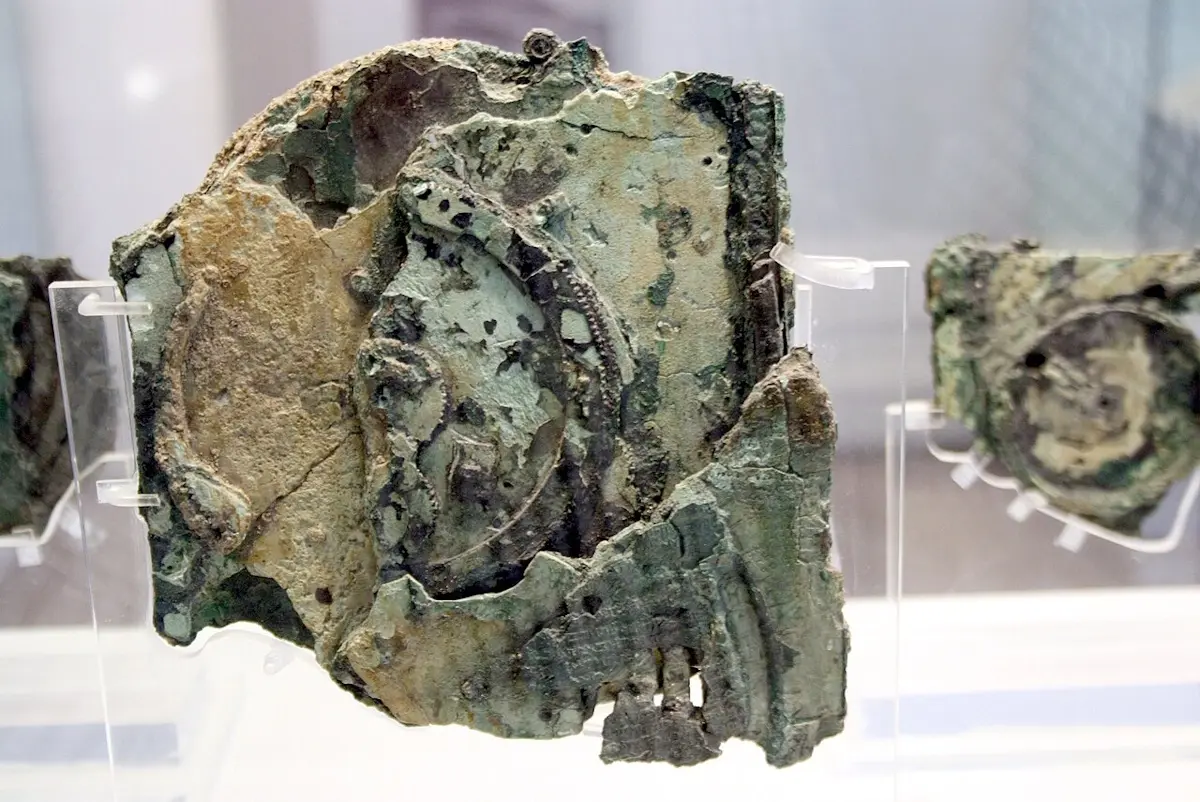
The Antikythera Mechanism—a bronze device consisting of about three dozen gear wheels—was recovered from the bottom of the Mediterranean Sea over a hundred years ago. By turning a handle, it allowed users to determine the positions of the Sun and Moon, the phases of the Moon, and to predict eclipses. The device is dated to approximately 150–100 BCE. It demonstrates that the Greeks possessed precise gear mechanisms, a technology to which the West would not return for over a thousand years, according to Science et Vie.
The shipwreck was accidentally discovered in the spring of 1900 by sponge divers from the island of Simi, who had been driven to Antikythera by a storm. The ship lay at a depth of about 50 meters. The recovery of the statues and amphorae took nearly ten months and cost the life of one of the divers; two others were left paralyzed.
At first, no one noticed the mechanism itself. It was not until May 17, 1902, that archaeologist Valerios Stais, at the National Museum of Athens, spotted a gear wheel in a calcified block. The find seemed so unusual for antiquity that some people long believed it to be a modern object that had accidentally ended up at the site of the wreck.
According to research, it was a Roman ship that, between 70 and 60 B.C., was carrying Greek treasures from the eastern Mediterranean to the west, some of which were already several centuries old at the time of the disaster. Who created the mechanism, why it was made, and how it ended up on board remain unknown, according to Smithsonian Magazine.
Eclipses, the Calendar, and the Olympic Games
To predict eclipses, the device used the Saros cycle—known to Babylonian astronomers—which repeats approximately every 18 years. The largest wheel, with a diameter of 13 centimeters, had 223 teeth—exactly the number of lunar months in a Saros cycle. A separate dial displayed the calendar of the Greek city-states and the four-year cycle of the Olympic Games.
X-rays helped shed light on its structure. In the 1970s, physicist Derek de Solla Price was the first to discern the interlocking gears, and in 2005, a team led by Mike Edmunds at Cardiff University examined 82 fragments using X-ray tomography and uncovered hidden inscriptions and teeth. Scientists are still trying to reconstruct the missing part, which likely tracked the five planets known in antiquity—from Mercury to Saturn.
The Universe in a Shoebox
Alexander Jones, director of New York University’s Institute for the Study of the Ancient World, notes that the device—about the size of a shoebox—had a sort of planetarium on its front face featuring the Sun, the Moon, and five planets. According to him, this is the most sophisticated of the surviving ancient Greek machines: similar technologies did not appear until the public astronomical clocks of late medieval Europe, NYU reports.
The researcher points out that, in addition to celestial cycles, the device displayed the local calendar and the dates of the Games, thus combining science with public and religious life.
“Because it’s not a research instrument at all—that’s how I see it. It’s an educational device that shows how the world—both the human world and the celestial world—is organized and governed by time. So, with something like this, you could essentially teach an entire course in cosmology,” Jones is convinced.
According to the scientist, the mechanism wasn’t particularly precise, since the same calculations could be done with a pencil and paper. However, it allowed one to “speed up” time and, in a matter of minutes, show students the rotations of Jupiter or Saturn—processes that take 12 and 30 years, respectively, in nature.