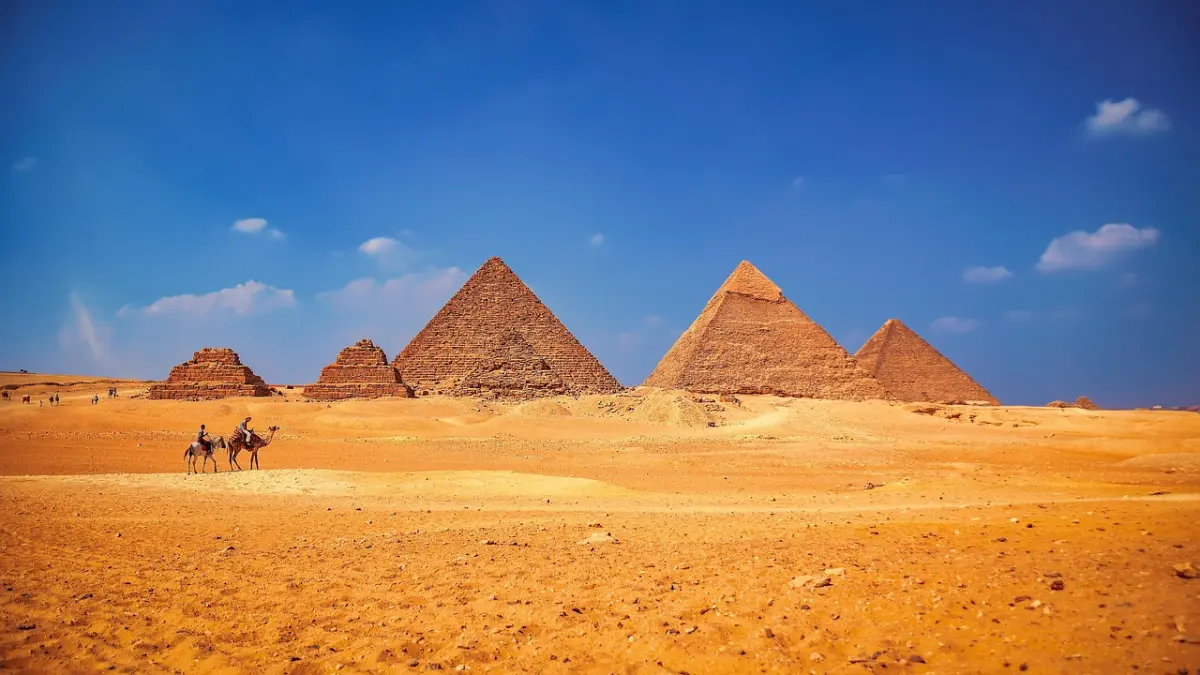
The Great Pyramid of Giza may have taken longer to build than had been believed for decades, and significantly fewer stones were used in its construction. New data suggests that Pharaoh Khufu reigned for at least 27, and possibly as many as 30, years—rather than about 20—so the builders of his tomb had more time, according to Rzeczpospolita.
The previous theory assumed that the structure was built during approximately 20 years of Khufu’s reign using more than 2.5 million blocks. Under that scenario, workers would have had to lay one block on average every two minutes. Scientists drew conclusions about the pharaoh’s longer reign based, in particular, on the records of the overseer Merer found in Wadi el-Jarf, and these conclusions are corroborated by other findings.
The amount of building material is also being reevaluated. Egyptologist Zahi Hawass believes that about one million blocks were used, since part of the lower structure consists of natural rock. Researchers also speculate that there are sections inside the pyramid filled with sand or gravel, and even cavities. Furthermore, by that time, the Egyptians already had over a century of experience building pyramids.
What Merer’s journal revealed
Hundreds of papyrus fragments were discovered in 2013 at Wadi el-Jarf, Egypt’s oldest harbor on the Red Sea coast. Some of the documents are dated to “the year following the 13th cattle count” of Khufu, that is, approximately the 26th or 27th year of his reign. These are the oldest known papyrus documents. Merer’s team transported limestone blocks for the pyramid’s casing from the quarries at Tura to Giza, a distance of 15–20 km, and was able to deliver about 200 blocks per month, according to History Today.
Egyptian archaeologists consider these papyri to be decisive evidence of Khufu’s authorship. The documents detail the number of workers, artisans, and boats used to transport the blocks to the Giza Plateau.
“The most important archaeological evidence that Khufu was indeed the pharaoh who built the Great Pyramid is the discovery made in 2012 by French archaeologist Pierre Tallé in a rock cave in the Wadiel-Jarf, two kilometers south of Zafarana, on the Red Sea,” emphasized Mohamed Abdel Maksoud, head of the Department of Ancient Egyptian Antiquities, as quoted by Ahram Online.
Traditional estimates still appear in reference publications: approximately 2.3 million stone blocks with a total weight of 5.75 million metric tons, 20 years of construction, and roughly 20,000 workers. The pyramid’s original height was about 147 meters, according to Britannica.