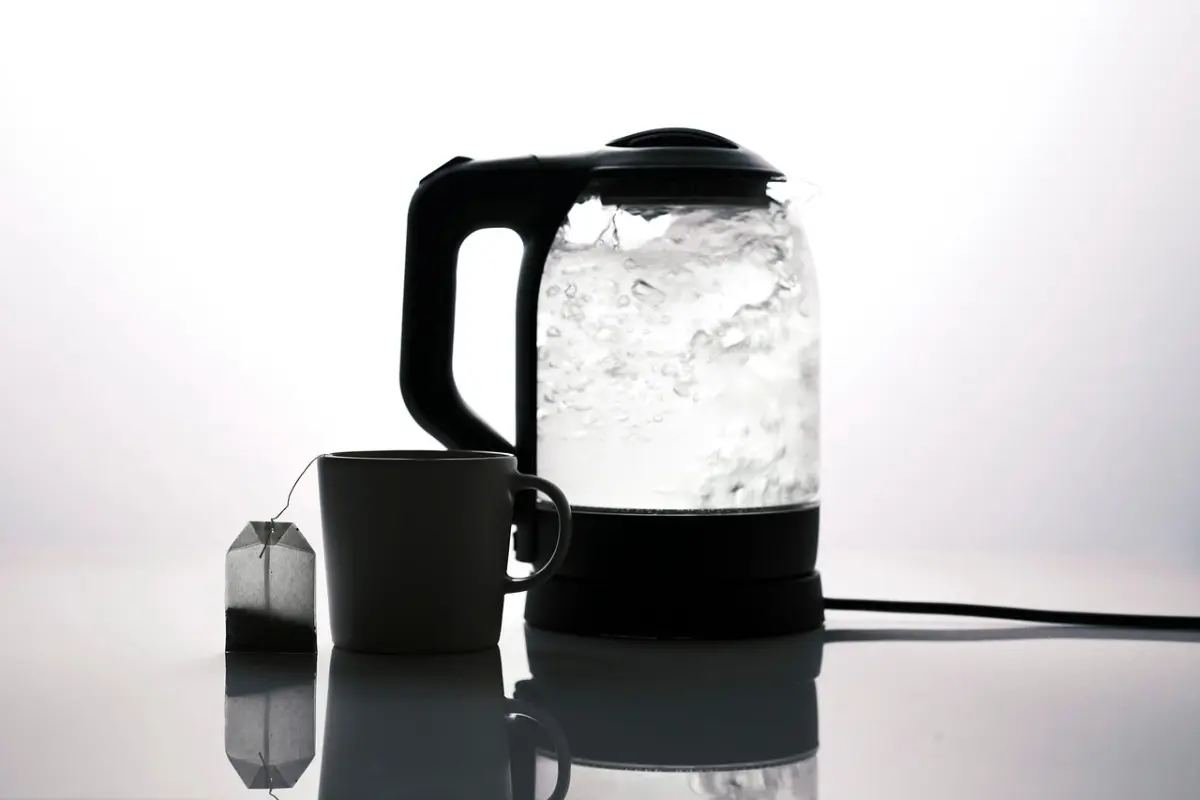
An electric kettle in the U.S. takes almost twice as long to boil as it does in Europe: a liter of water on the American power grid takes nearly four minutes to reach a boil, while at 230 volts, it takes less than two. It is this difference—and not just a matter of taste or tradition—that has prevented electric kettles from catching on in American kitchens, according to The Coolist.
Most American homes are powered by a 120-volt electrical system, whereas in much of the world the voltage is 220–240 volts. A standard American outlet is rated for 15 amps at 125 volts, or approximately 1,800 watts. During prolonged use, an appliance should not consume more than 80% of this limit to prevent the wires from overheating. Therefore, the power of American kettles is limited to just under 1,500 watts, while European ones can reach about 3,000 watts.
The One and a Half Minutes That Changed Everything
An American woman who moved to the United Kingdom was surprised to find that it was nearly impossible to find the type of stovetop kettle she was used to there. British physicist and teacher Reed calculated that even with ideal efficiency, a 2,800-watt kettle brings a liter of water to a boil in 127 seconds, while a 1,500-watt American kettle takes 237 seconds.
“It’s such a problem that many households in the U.S. still use old-fashioned stovetop kettles,” concludes Reed, as quoted by Business Insider.
Habits have also played a role. A British man living in the U.S. cited another reason besides voltage: “There’s no culture for it.” Americans drink less tea and aren’t particularly concerned about how quickly water boils.
In the UK, the situation is the opposite: 97% of households have an electric kettle, over 90% of people use it daily, and 40% use it five times a day or more, according to a study published on ScienceDirect.
Slower, but more economical
Despite its slower speed, the electric kettle remains one of the most efficient ways to heat water. According to estimates by a researcher at the U.S. National Renewable Energy Laboratory, its efficiency is about 80%. By comparison, electric and gas stoves have an efficiency of about 70%, while microwaves reach 50%. Only an induction cooktop, with its 85% efficiency, can outperform the kettle, though it requires special cookware.
The easiest way to speed up boiling is to pour only the necessary amount of water. At the same time, a 1,500-watt kettle uses most of the power from a 15-amp circuit, so turning on a toaster or microwave at the same time could trip the circuit breaker. There’s also no point in buying a kettle rated for 230 volts: in a U.S. outlet, it will only draw about 820 watts and heat water even more slowly.