
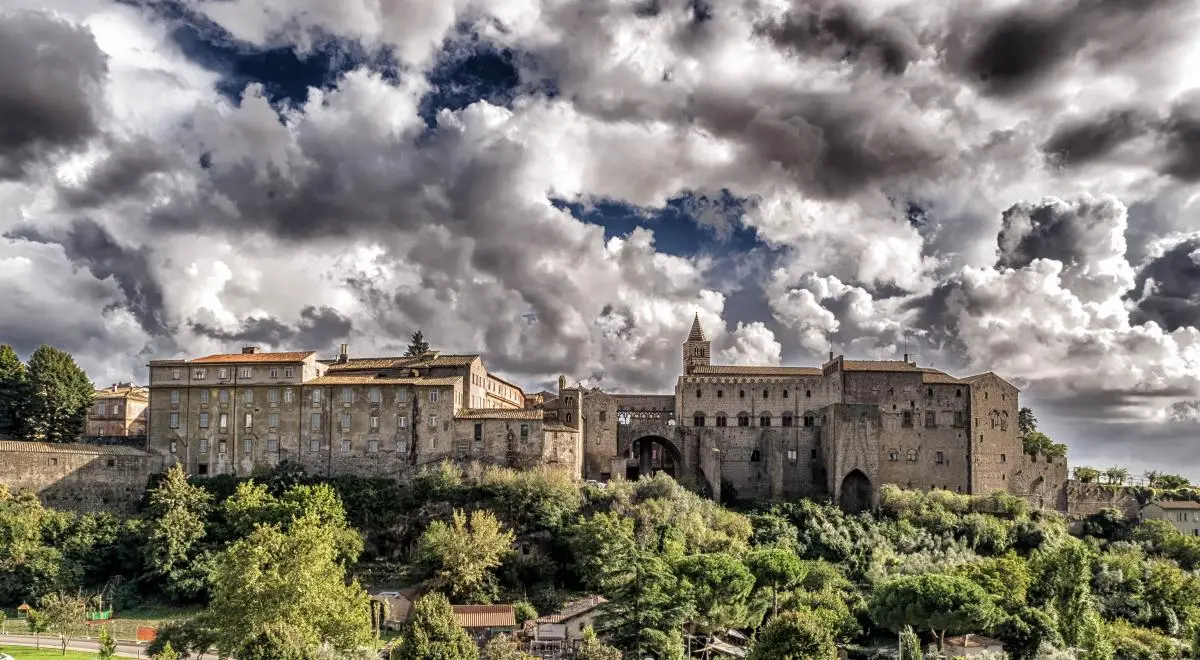
Viterbo, located in the Lazio region north of Rome, could be a more affordable and peaceful alternative to Italy’s crowded tourist destinations. A plate of homemade pasta at local osterias costs about $12, whereas in Rome, you can pay up to $30 for a simple pasta dish. The best time to visit is November, according to Travel Off Path.
Italy is currently breaking tourism records. According to Eurostat, in the first half of 2026, the country surpassed Spain and France in the number of overnight stays, recording over 65 million.
In November, the summer heat subsides, making it much more comfortable to walk along the steep cobblestone streets. The cool autumn weather makes the Terme dei Papi thermal springs, with their warm volcanic mineral water, even more appealing. Plus, at this time of year, the city is free of crowds of day-trippers from Rome.
The City Where the Cardinals Were Imprisoned
Viterbo’s main attraction is the Papal Palace. It is open daily except Fridays. Admission for adults is 10 euros; children under 12 enter for free.
Viterbo served as the papal residence from 1257 to 1281. The palace’s hall was the site of the first and longest conclave in Christian history: it lasted 33 months. The townspeople locked the cardinals inside and left them only bread and water until they elected Gregory X, according to Rome Reports.
In the 13th century, the Eternal City was torn apart by the rivalry between two powerful factions, and the popes needed a new residence. Elena Cangiano, director of the Cathedral Hill monumental complex, explains the reasoning behind this choice.
“So the Pope realized it would be better to move the papal see. And he chose Viterbo because it is close to Rome, it is on the Guelph side, and, most importantly, it already has a circular wall two and a half miles long. In short, it’s a nearby, safe city on the Via Francigena—a very important pilgrimage route,” said Kanjano.
The Middle Ages for 8 euros
The San Pellegrino district is one of the largest and best-preserved 13th-century neighborhoods in Europe. There are no Renaissance or Baroque additions here, only narrow streets paved with volcanic stone, external staircases called “profferli,” and “bridge houses” connecting opposite sides of the street, notes Italia.it.
The easiest way to get to Viterbo is by train from Roma Termini station to Viterbo P. Fiorentina station. The trip takes 1 hour and 43 minutes, and a ticket costs 8–23 euros. The historic center is compact, so it’s easy to explore on foot, and a 90-minute city bus ticket costs 0.70 euros.
It’s also worth keeping in mind the local pace of life. Shops in the city are closed from 1:00 p.m. to 4:00 p.m., and on Sundays, most are closed entirely, according to Italy Segreta.