
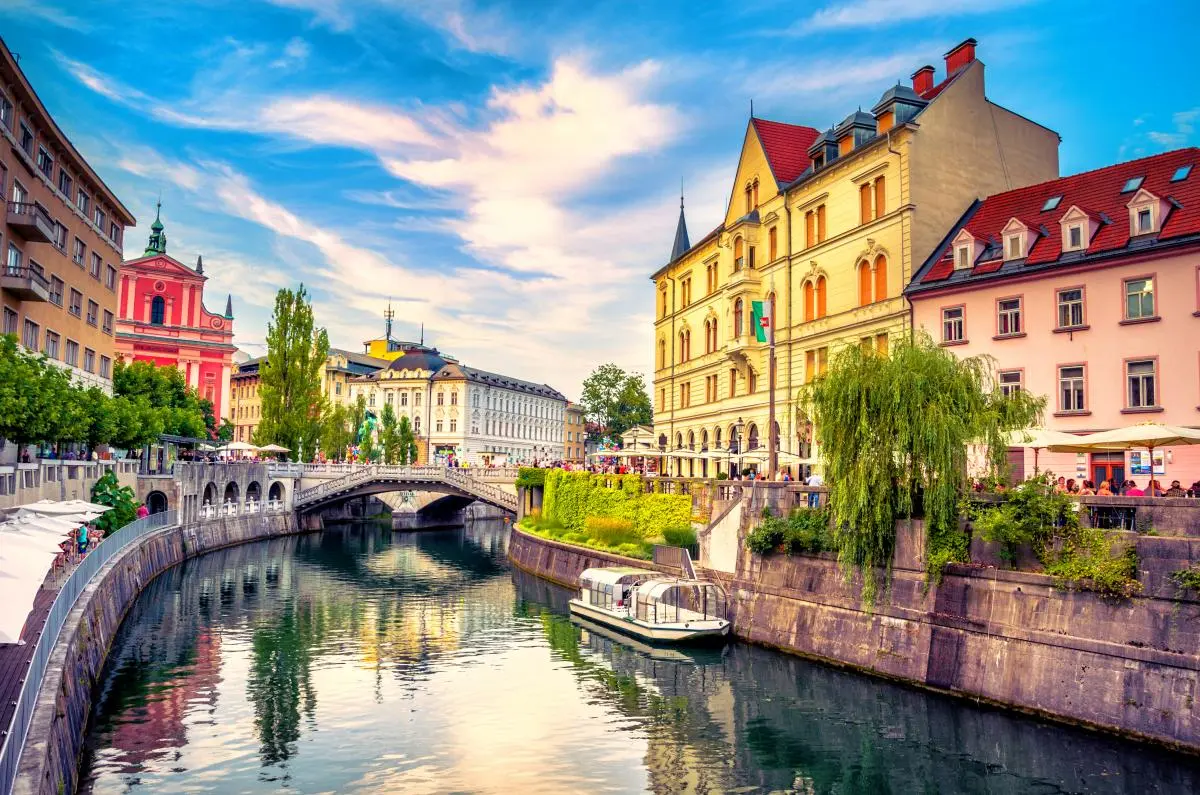
The author, who has visited more than 200 cities in Europe, named five compact destinations that can be fully explored on foot in a single day: Luxembourg, Bruges, Menton, Zagreb, and Ljubljana. Their tourist centers are concentrated in a small area and do not require complicated logistics or transportation costs, according to Travel Off Path.
The publication’s lead writer, Vinicius Costa, who has visited more than 40 European countries, rules out overrated locations, crowded city centers, and megacities with extensive subway systems—places that would take more than a week to explore. His selection consists of the exact opposite.
“If you love European cities that are easy to navigate and haven’t yet been overrun by tourists, I’ve put together a list of five completely walkable hidden gems that won’t require an expensive day pass just for public transportation,” notes Costa.
Free trams and canals
First on the list is Luxembourg, where public transportation is free throughout the country. The Old Town, a UNESCO World Heritage Site, is divided into the Upper Town—home to the Grand Duke’s Palace and the Cathedral of Our Lady—and the Lower Town, known as the Grund. You can walk around the historic center in about four hours. The author also recommends taking a bus to the castle in Vanden: the trip takes about an hour one way.
In Bruges, Belgium, the author believes 5–6 hours are sufficient. A 30-minute canal tour from the Rosengudkaai waterfront allows you to see most of the city. It’s worth walking to Markt Square and climbing the medieval bell tower, where 366 steps await visitors, so it’s best to arrive early before the lines form.
Lemons, a funicular, and beer for $4
The French town of Menton, on the border with Italy, is just a 3–4-hour trip away. The upper part of the town is closed to cars, and you can walk to the Italian border in about 15 minutes. According to the author, the best time to visit is February, when the Lemon Festival takes place there.
In Zagreb, all the main attractions are located in the Old Town, which consists of the Upper Town, the Lower Town, and Kaptol. A 135-year-old funicular runs between them, making the ascent in 64 seconds. Nearby are Lotrščak Tower, the Museum of Broken Relationships, and St. Mark’s Church.
Rounding out the list is Ljubljana, which is a two-hour train ride from Zagreb. The Slovenian capital has no subway, and the Old Town is easy to explore on foot. The author recommends adding a trip to Lake Bled, which is a 75-minute bus ride away.
“It’s the kind of city that doesn’t impress you with any one standout feature, but gradually wins you over by the end of the day,” Kostha concludes.