
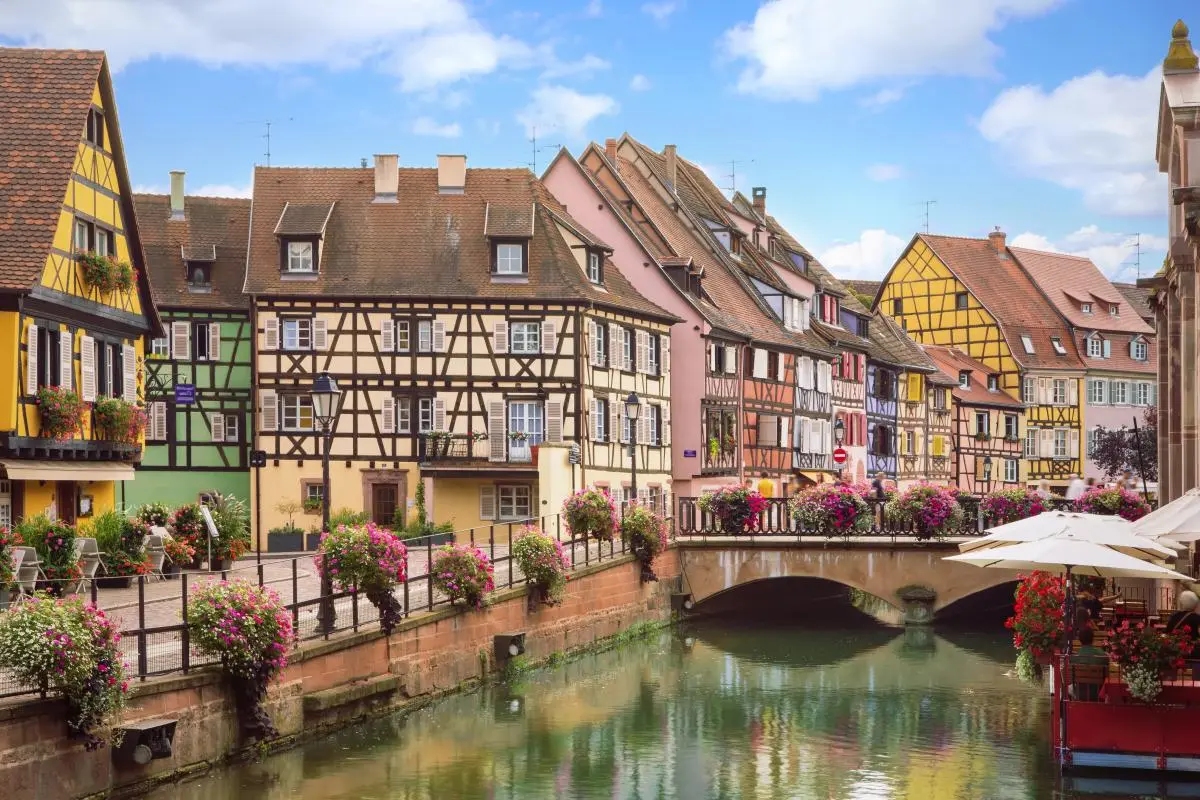
This year, the Christmas markets in Colmar, Alsace, will run from approximately November 26 through December 29. The best hotels in this city, located near the German border, fill up several months before the holidays, so it’s a good idea to book your accommodations for December now. American travel journalists call Colmar the best holiday destination in Europe and recommend choosing it over crowded Paris or London, according to Travel Off Path.
The publication’s editor-in-chief, Tyler Fox, usually heads to warmer climates with his wife when the cold weather sets in. He makes an exception only for the European holiday season, since, in his opinion, large capitals can’t match the atmosphere of small provincial towns.
“If you want a town that looks like it was plucked straight out of a snow globe, you need to head to the Alsace region of France,” Fox advises.
The main feature of Colmar is that the holiday markets aren’t concentrated in a single square but are spread across several historic neighborhoods, each with its own theme. The market at Place des Dominicains is set around a 14th-century church, whose stained-glass windows illuminate the square in the evening. A five-minute walk away, at Place de l’Ancienne Douane near the Schwendi Fountain and the old Koïfhus customs house, local artisans sell blown glass, woodwork, and ceramics.
The Petite Venise (“Little Venice”) district, with its canals and half-timbered houses decorated with evergreen garlands, is geared primarily toward families. Here you can buy brédel—traditional Alsatian Christmas cookies. The market on Jeanne d’Arc Square is styled after an Alsatian village and focuses on gastronomy: instead of mulled wine, it offers craft beer, dried meats, cheeses, and foie gras from local producers.
In addition to the markets, tourists are advised to take a stroll through the city center at dusk, when thousands of LED lights illuminate the facades of historic buildings. You can warm up at a winstube, a traditional Alsatian wine tavern: Fox recommends Winstub Brenner. Among typical souvenirs, he mentions local ceramics with floral patterns or storks, a bottle of Gewürztraminer or Pinot Gris, and a kugelhopf—a classic yeast cake.
Where to Stay and What to Look Out for at Christmas
Among the city’s most famous hotels, the publication highlights La Maison des Têtes—a 17th-century building with 106 sculpted heads on its facade and the Restaurant Girardin. Hôtel Le Colombier, housed in a 16th-century building, is located right in “Little Venice,” just a few minutes’ walk from the main Christmas markets. For those looking for a quieter spot, the magazine recommends Le Chambard in the neighboring village of Kaysersberg, home to the Michelin-starred restaurant La Table d’Olivier Nasti.
Those planning to stay in Alsace over the holidays should keep in mind that most shops and restaurants close early on December 24 and are closed entirely on December 25. Reservations for a festive dinner on these days should be made several weeks in advance.
Strasbourg and the Alsatian Roots of Christmas Traditions
The Colmar markets carry on a long-standing regional tradition. Nearby, in Strasbourg, France’s oldest Christmas market is held: it features about 300 chalets throughout the city and welcomes an average of two million visitors each year. As far back as the 13th century, there was a toy market there leading up to St. Nicholas Day on December 6, when gifts were exchanged in this part of the country, according to The Connexion.
The modern format of the holiday emerged as a result of the Reformation. In the early 16th century, Strasbourg adopted a new faith, and in 1570, the city government’s religious stance also changed the nature of the December market, explains Sophie Balan of the Strasbourg Tourist Office.
“Protestant leaders wanted nothing to do with saints and decided to replace the old fair with another one, named after the Christ Child—Christkindelsmärik in the Alsatian dialect. This was undoubtedly the first Christmas market in France,” notes Balan.
The market changed locations several times: it was first held on Cathedral Square, then on Place Kléber, and later on Place Broglie. Many of the customs associated with it originated in Alsace. The first written mention of Christmas trees appears in the city register of Sélestat from 1521, and foresters were paid four shillings at the time to protect the forest and collect fines from those who cut down fir trees.
Another familiar element of winter decor also has its origins in Alsace.
“Glass ornaments to hang on Christmas trees were first made in Meisenthal, Alsace. People usually hung red apples on the branches, but one year there were none, so the glassblowers replaced them with balls they made themselves,” says Balan.
In the 1970s and 1980s, the market’s popularity declined as people increasingly bought gifts at supermarkets. In 1992, the city council decided to invest time, money, and effort into reviving the tradition and declared Strasbourg the “Capital of Christmas.”
“It worked. The idea was to highlight both the city’s commercial and human strengths. The emphasis is on making it a warm, friendly event that brightens the dark days and is steeped in Christmas traditions,” Balan emphasizes.
In recent years, the Strasbourg Christmas market has faced several serious challenges. In 2018, five people were killed there in a terrorist attack, and in 2020, the market was canceled due to the COVID-19 pandemic.